
LED sensors drastically cut energy use by ensuring lights operate only when needed. These sensors, such as occupancy, motion, and photosensors, work with LED fixtures to save energy without reducing lifespan. Key benefits include:
- Occupancy sensors: Automatically turn lights on/off based on room activity, saving up to 76%.
- Daylight harvesting: Adjusts artificial lighting based on natural light, reducing energy use by 35%.
- Combined strategies: Pairing occupancy and daylight sensors can achieve total savings of 79% in open-plan offices.
LED sensors offer precise control, reduce waste, and lower utility costs. Wireless systems simplify installation, making them ideal for retrofitting older buildings. Proper setup and ongoing maintenance ensure maximum savings and compliance with energy codes.
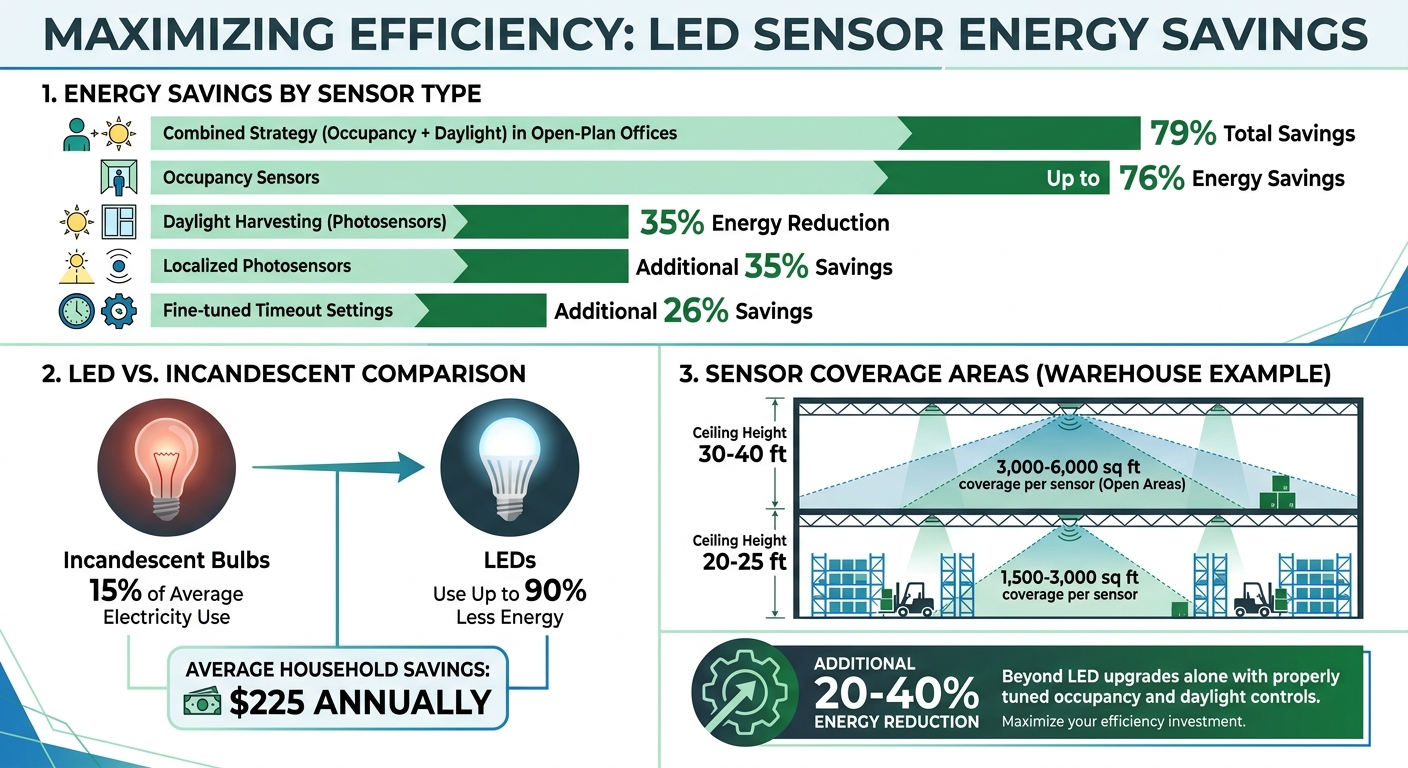
LED Sensor Energy Savings Comparison by Type and Application
Cut Energy Waste with Motion Sensor Switches & LED Lighting
sbb-itb-034f8e1
Types of LED Sensors and How They Work
This section dives into how different types of LED sensors function, helping you make informed decisions to enhance energy efficiency in your facility. Choosing the right sensor – whether it’s an occupancy sensor, motion sensor, or photosensor – can significantly improve lighting management and energy savings. Here’s a closer look at how each type works.
Occupancy Sensors
Occupancy sensors are designed to detect when people are present in a space and automatically adjust the lighting. These sensors are commonly used in places like offices, restrooms, and conference rooms. The lights stay on while the space is occupied and turn off after a short period of inactivity.
By operating with very short timeout periods, these sensors can achieve energy savings of up to 76% when paired with LED lighting [3]. However, improper installation can negate these benefits, so proper setup is essential to maximize their effectiveness.
Let’s move on to motion sensors, which are ideal for transitional spaces.
Motion Sensors
Motion sensors are tailored for detecting movement, making them perfect for exterior and transitional areas such as parking lots, garages, and entryways. They activate or brighten lights only when movement is detected, ensuring energy is used efficiently in spaces people or vehicles pass through rather than linger.
For example, in parking structures, motion sensors maintain a low level of safety lighting and increase brightness only when they detect movement. Advanced Digital PIR (Passive Infrared) sensors take this a step further by filtering out heat sources like equipment or HVAC systems, focusing solely on human movement to avoid false triggers [4].
Photosensors
Photosensors work by measuring the amount of natural light available and adjusting LED lighting accordingly. This process, known as daylight harvesting, is especially effective in areas with windows or skylights, where natural light levels vary throughout the day due to weather or the time of day.
To ensure optimal performance, photosensors are often installed at each fixture near windows. This localized setup allows each light to respond precisely to the surrounding natural light, ensuring efficient energy use and maintaining consistent illumination levels.
How to Implement LED Sensors in Your Facility
Setting up LED sensors effectively can lead to significant energy savings. By following a structured plan, you can ensure the right sensors are installed in the best locations, improving efficiency from the start.
Step 1: Evaluate Your Current Lighting System
Begin by pinpointing areas in your facility where energy is being wasted. For example, outdoor lights that stay on during the day or interior lights left on unnecessarily are prime candidates for improvement. Conduct a daylight audit in the morning to uncover lighting that isn’t essential.
Check for outdated incandescent bulbs, as they consume about 15% of the average electricity used in lighting. LEDs, which use up to 90% less energy, should replace any remaining incandescent bulbs before adding sensor controls [2].
Also, assess fixture placements to identify lights that operate unnecessarily during daylight hours. Older fixtures may not support modern LED controls like dimmers, timers, or motion sensors, so it’s important to review their compatibility. For outdoor or unheated spaces, ensure fixtures can handle cold or wet conditions – LEDs excel in such environments. Consider ENERGY STAR-qualified fixtures, which often come with built-in motion sensors and daylight shut-off features [2].
Use the insights from this evaluation to determine the most suitable sensors for each area.
Step 2: Choose the Right Sensors for Each Area
Selecting the correct sensors for specific spaces is essential for efficient operation. For example, in warehouses with ceiling heights of 20–25 feet, a single sensor can cover 1,500–3,000 square feet, while at 30–40 feet, coverage increases to 3,000–6,000 square feet in open areas [5]. If there are obstructions like high shelving or machinery, aisle-mounted or staggered sensors may be necessary to maintain proper coverage and avoid false vacancy detections [5].
In areas with ample natural light, such as those near skylights or large windows, photosensors can automatically dim or switch off lights when daylight is sufficient [5]. A control hierarchy can be helpful: occupancy sensors decide whether lights are on or off, while daylight sensors adjust brightness when the space is in use [5]. For spaces requiring adjustable light levels, make sure your LED bulbs are labeled as dimmable before using sensor-based dimming controls [2].
Environmental factors also play a role in sensor selection. Look for sensors with appropriate IP ratings, such as IP65, for protection against dust and water, especially in areas with challenging conditions [5]. Additionally, confirm compatibility with your LED driver’s dimming protocol – usually 0–10V – and verify whether the driver needs a current-sinking or current-sourcing device for proper functionality [5].
Once you’ve chosen the right sensors, you’re ready to move on to installation.
Step 3: Install and Connect the Sensors
Proper installation is key to achieving maximum energy savings. Most industrial LED sensors operate on a 0–10V dimming system, where 10V represents full brightness and 0–1V indicates lights are off [5]. Be sure to separate line-voltage and 0–10V control conductors to meet NEC Class 1 or Class 2 standards [5].
In warehouses, mount sensors mid-aisle to maintain a clear line of sight [5]. Set vacancy timeouts wisely: 30–60 seconds for aisles and areas with frequent movement, and 5–15 minutes for larger spaces or production zones [5]. Position photosensors to avoid fixture glare and program them to maintain a target illuminance – typically 20–50 lux from electric lighting – when natural light is present [5].
Commission sensors only after operational obstructions, like furniture or machinery, are in place. Testing in an empty building can lead to inaccurate results [5]. Additionally, ensure that emergency egress lighting operates independently of occupancy sensors to comply with safety regulations [5].
For expert guidance on integrating LED sensor technologies, you might consider consulting with E3 Design-Build Contractor. Their specialized knowledge in energy-efficient upgrades can help align your sensor installations with both energy-saving goals and regulatory standards.
Configuring and Tracking LED Sensor Performance
Setting Up and Testing Sensors
Once installed, your sensors need to be properly configured to deliver the best energy savings. Start by programming occupancy settings, such as on-levels and timeouts, and then adjust daylight dimming for times when natural light is abundant [5]. Doing this in a step-by-step manner prevents any interference between the systems.
It’s essential to establish a clear control hierarchy. Occupancy sensors should determine whether lights turn ON or OFF (or operate at high and low levels), while daylight sensors adjust fixture brightness based on available natural light. For instance, daylight sensors can be set to maintain an electric lighting level of 20–50 lux when natural light is present, ensuring consistent overall brightness [5].
"Sensors tuned in an empty shell building almost always need rework once racks, machinery, and product loads arrive." – Steve Shepherd, hi-hyperlite.com [5]
Before handing over the system, make sure to disable test modes. Leaving test modes active can waste energy and frustrate occupants.
When testing photocells, use tools like an opaque lens cap or a light-tight box to block light. Allow at least 60 seconds for the sensor to respond, as most include built-in delays (20–60 seconds) to avoid unnecessary cycling caused by temporary light sources, such as lightning or car headlights [6].
Once all sensors are properly configured and tested, the next step is to monitor their performance to ensure they continue delivering energy savings.
Tracking Energy Savings
Tracking performance is key to validating your investment and spotting areas for improvement. Centralized control modules with trend logging are a great way to monitor energy use over time. Integrating this data with a Building Management System is especially useful for larger facilities [5].
Keep detailed records of sensor settings and export digital configurations. These records can simplify rebate applications and maintenance down the line [5]. Properly tuned occupancy and daylight controls can typically cut lighting energy use by an additional 20–40% on top of the savings from LED upgrades alone [5].
For facilities without centralized monitoring, plan quarterly walk-throughs to confirm that sensors are triggering correctly based on actual traffic patterns. Additionally, clean sensor lenses every three months using a non-abrasive cloth. Dust, spider webs, or salt spray can reduce sensor effectiveness. Even a small drift – like 30 minutes – can increase the annual energy use of a 100W LED fixture by about 25% [6].
Benefits of LED Sensors for Public Facilities
Energy Savings and Lower Costs
LED sensors are a game-changer for cutting energy expenses in public facilities. By combining occupancy and daylight sensors, facilities can achieve up to 79% energy savings in open-plan offices [1]. This goes well beyond the efficiency of standard LED lighting alone.
Fine-tuning occupancy sensor timeouts and using localized photosensors can add another layer of savings – 26% and 35%, respectively [1]. For facilities like schools, hospitals, and municipal buildings, where lighting typically accounts for around 15% of electricity use [2], these savings can translate into significantly lower utility bills. To put it into perspective, while the average household saves about $225 annually by switching to LED lighting, the financial impact is far greater for large-scale facilities [2].
These savings not only help balance budgets but also pave the way for positive environmental outcomes.
Environmental Impact
LED sensor systems do more than save money – they also make a meaningful difference for the environment. By ensuring lights are only active when needed, these systems cut energy consumption and reduce carbon emissions. This aligns with strict energy conservation codes like ASHRAE and IECC, which are becoming more rigorous across the U.S.
Another often-overlooked benefit is the reduction of light pollution. Many states have enacted "dark sky" legislation to combat excessive sky glow and light trespass [7]. Features like motion detection and daylight sensing help facilities meet these requirements while safeguarding wildlife habitats, especially in coastal areas with sea turtle protection laws. As Litetronics explains, "Schools and hospitals alike are charged with protecting the health and safety of the people they serve. They are also tasked with being good stewards of the funds that make their work possible. Outdoor LED lighting helps them do both" [7].
To maximize these benefits, professional installation is key. Contractors like E3 Design-Build Contractor specialize in energy-efficient solutions for public facilities in Texas. Their expertise ensures proper sensor placement, system compatibility, and precise control settings, delivering optimal energy savings without compromising safety or visibility standards.
Conclusion: Improving Efficiency with LED Sensors
LED sensors offer a powerful way to cut energy use in public facilities. By combining occupancy detection with daylight harvesting, facilities can achieve energy savings of up to 79% [1]. These sensors are built to handle frequent switching, which allows for short timeout settings – as low as 1 minute – resulting in an additional 26% savings [1].
The financial benefits are just as compelling. In places like schools, hospitals, and municipal buildings, where lighting makes up about 15% of electricity use [2], these savings directly lower utility bills. This frees up funds for other priorities while helping facilities meet stringent energy codes and reduce their environmental footprint. However, achieving these results depends on proper sensor placement and settings.
Sensors positioned at individual fixtures outperform zone-based systems by 35% because they adjust to specific areas rather than relying on an average reading [1]. Additionally, wireless sensors simplify retrofitting in older buildings, reducing installation challenges and minimizing disruptions.
For public facilities in Texas, working with professionals like E3 Design-Build Contractor can ensure the best results. Their expertise in LED lighting, building automation, and energy-efficient systems allows them to customize solutions for each facility. This includes fine-tuning sensor placement, ensuring system compatibility, and optimizing controls to maximize savings – all while maintaining safety and functionality.
When advanced sensor technology is paired with expert implementation, facilities can achieve long-term energy efficiency and a reduced environmental impact.
FAQs
Which LED sensor type is best for my space?
The best type of LED sensor for your space depends on factors like size, layout, and detection requirements:
- Microwave sensors: Perfect for large spaces or areas where motion needs to be detected through walls or ceilings, such as warehouses.
- PIR sensors: Great for smaller, indoor spaces like offices where precise motion detection is needed.
- Outdoor motion sensors: Designed for exterior use, these are weather-resistant and often come with smart features for added convenience.
Will sensors work with my existing LED fixtures?
Yes, wireless sensors can be used with existing LED fixtures, provided they are compatible. Many sensor systems are specifically designed to integrate smoothly with LED lighting setups, making it easier to improve energy efficiency and minimize energy waste.
How do I avoid false triggers and missed detections?
To improve the accuracy of LED sensors and avoid false triggers or missed detections, consider using high-resolution sensor controls. These provide more dependable occupancy detection. Opting for shorter timeout periods – such as 1 minute – can also refine detection performance.
For better daylight harvesting, install localized light sensors directly at each fixture. This helps optimize lighting control while addressing issues related to placement or sensitivity. When these strategies are combined, they can significantly boost detection precision and cut down on energy waste.