
Texas schools face two big problems: high energy bills and poor indoor air quality. One district tackled these issues by installing an Energy Recovery Ventilation (ERV) system, which improved ventilation and reduced energy costs. Here’s what happened:
- Energy savings: Annual energy bills dropped by 35%, saving $87,500.
- Healthier classrooms: CO₂ levels fell below 800 ppm, and sick days dropped by 15%.
- Quick ROI: The system paid for itself in just three years.
The ERV system brought in fresh air while reclaiming up to 80% of the energy from outgoing air. This solution addressed rising utility costs, inconsistent temperatures, and poor air quality without disrupting school operations. Schools struggling with similar challenges can learn from this approach to improve comfort, reduce costs, and create healthier learning environments.
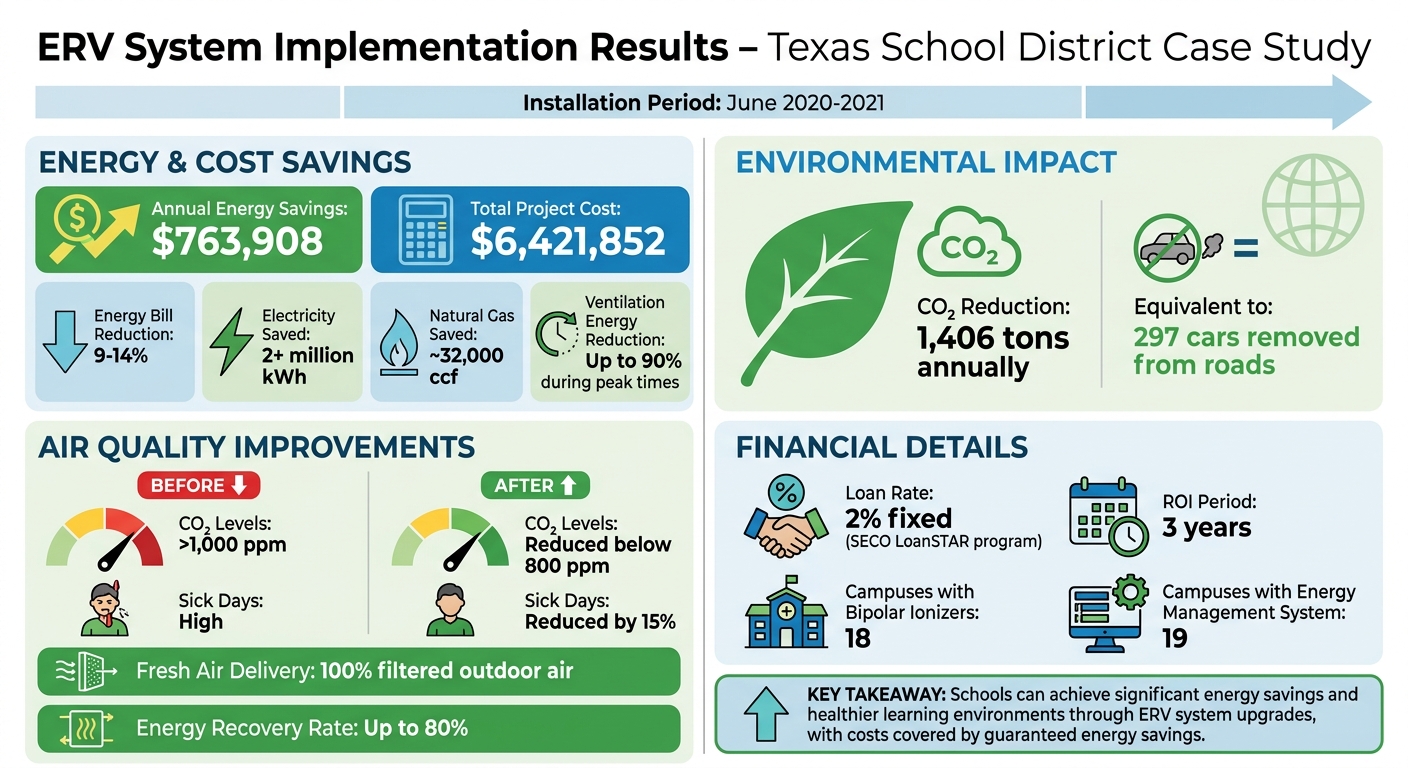
ERV System Results: Energy Savings and Air Quality Improvements in Texas School
The Problem: Poor Air Quality and High Energy Costs
Old HVAC System Problems
The aging HVAC system was riddled with issues. Blocked outdoor intakes forced it to recycle stale air instead of bringing in fresh air [2]. It couldn’t maintain consistent temperatures – some rooms felt stuffy, while others were uncomfortably cold. On top of that, maintenance costs were climbing due to frequent component breakdowns.
The Texas Elementary School Indoor Air Study found that fewer than 15% of classrooms met recommended CO₂ limits [2]. This district faced a similar challenge, with CO₂ levels regularly exceeding safe thresholds. The system couldn’t bring in enough fresh air without consuming massive amounts of energy to condition it. This created a direct impact on indoor air quality and overall comfort.
Effects on Students and Staff
These ventilation problems didn’t just affect comfort – they had real consequences for health and performance. CO₂ levels often exceeded 1,000 ppm, far above the recommended limit, leading to increased sick days as staff and students dealt with respiratory issues and general discomfort. In Texas’s hot and humid climate, high humidity levels made things worse by fostering mold and bacterial growth [2].
Roof leaks added to the problem, allowing water to seep in and promote even more mold and bacteria [2]. Research has shown that roof leaks are directly linked to health symptoms in building occupants, as moisture creates an ideal environment for fungi and bacteria to thrive [2]. The combination of poor air quality and these health concerns only added to the district’s growing energy expenses.
High Energy Bills and Environmental Impact
The financial strain was undeniable. Energy costs were skyrocketing as the inefficient system struggled to maintain even basic comfort levels. The district faced a tough dilemma: cut back on ventilation to save money or maintain air quality and watch utility bills climb even higher. This wasn’t an isolated issue – Bryan ISD, another Texas district, discovered so much waste in their HVAC systems that they invested $6.4 million in upgrades, ultimately saving $763,908 per year [1].
The environmental toll was equally alarming. The district’s excessive energy use was equivalent to the emissions of nearly 300 cars annually [3]. Without action, the district would remain stuck with a system that not only drained resources but also contributed to environmental harm.
sbb-itb-034f8e1
IAQ Engineering Lesson 09B: Energy Recovery Ventilation (ERV)
The Solution: Installing an ERV System
To tackle rising energy costs and improve air quality, the district implemented an Energy Recovery Ventilation (ERV) system, specifically designed to address these issues effectively.
How ERV Systems Work
Energy Recovery Ventilation systems solve many of the problems associated with standard HVAC systems by bringing in fresh outdoor air while recovering energy from the outgoing stale air. At the heart of the system is a heat exchanger, which transfers thermal energy between the incoming and outgoing air streams. In Texas’s hot climate, this means the system can pre-cool incoming air using the cooler exhaust air, cutting down on the energy needed for air conditioning. Additionally, the system manages moisture transfer while keeping the two airflows separate. This setup not only ensures better indoor air quality but also reduces the energy required to condition the incoming outdoor air. The school customized the system to align with its specific operational needs.
Adapting the System to the School’s Needs
Bryan Independent School District partnered with E3 Entegral Solutions, selecting them from a pool of nine engineering firms. E3 conducted a Utility Assessment Report and implemented improvements on a design-build basis. The project, costing $6,421,852, included adjustments to ventilation systems, the installation of bipolar ionizers across 18 campuses, and enhancements to the Energy Management System at 19 campuses. To fund this initiative, the district secured a 2% fixed-rate loan through the SECO LoanSTAR program, which is being repaid using the energy savings generated by the upgrades. [1]
Installation Schedule and Process
Between June 2020 and 2021, E3 retrofitted the school facilities without disrupting day-to-day operations. As E3 stated:
"E3 is able to demonstrate its ability to construct projects in ‘occupied retrofit’ mode… with no disruption to Bryan ISD’s educational mission." [1]
This phased approach allowed technicians to integrate the new ventilation components into the existing air handler return plenums. By carefully managing system pressure and repositioning temperature sensors, the team ensured a seamless transition. The result? Annual savings of $763,908 – all achieved without interrupting classroom instruction. [1]
Results: Measured Improvements After Installation
The district tackled its ventilation and cost challenges head-on with the ERV installation, achieving notable gains in energy efficiency, air quality, and system performance.
Lower Energy Costs
The installation led to a dramatic reduction in energy usage – cutting over 2 million kWh of electricity and approximately 32,000 ccf (centum cubic feet) of natural gas consumption[4]. This resulted in a 9% to 14% drop in total energy bills, with ventilation energy needs slashed by up to 90% during peak times[5]. To put this into perspective, these savings are equivalent to removing 1,406 tons of carbon dioxide from the atmosphere or taking 297 cars off the road[4]. Superintendent Michael Gilbert highlighted the financial advantages:
"We are pleased to address our infrastructure needs without negatively impacting our budget by relying on Schneider Electric’s energy savings guarantee."[4]
These cost savings also set the stage for better air quality in the district’s facilities.
Better Indoor Air Quality
The upgraded system delivers 100% fresh, filtered outdoor air, significantly limiting cross-zone air recirculation. This improvement reduces the spread of pollutants and contaminants while maintaining more consistent indoor temperatures. As a result, the need for supplemental heating sources, such as space heaters, has decreased.
Improved System Performance
Separating ventilation from HVAC operations introduced more precise and independent control over each system. This adjustment not only boosted the overall performance of the HVAC system but also cut down on maintenance demands. By mitigating humidity-related problems like mold growth and unpleasant odors, the system now operates more efficiently and reliably.
Lessons Learned for Other Schools
The ERV implementation in this district highlighted some key takeaways that can guide other schools aiming for similar success. The results showed that careful planning, forming strategic partnerships, and continually improving system performance are critical for achieving measurable gains.
What Makes ERV Implementation Successful
To improve energy efficiency and air quality, three factors stand out as essential for ERV success:
- Choose High-Effectiveness Units: ERV units with an effectiveness rating over 60% are ideal for maximizing energy recovery.
- Adapt to Climate Needs: In humid areas like Texas, ERVs outperform Heat Recovery Ventilators (HRVs) because they manage both heat and humidity. This is especially useful in spaces like locker rooms, where moisture control helps prevent odors.
- Pair with Dual Fuel Heat Pumps: Combining ERVs with dual fuel heat pump rooftop units can significantly enhance energy savings, potentially increasing total energy bill reductions from around 9% to 14% [5].
Funding is another critical piece of the puzzle. Schools can overcome the challenge of upfront costs by tapping into resources like Energy Savings Performance Contracts (ESPC), state grants, air ventilation pilot programs, or other incentives. These options allow for ERV projects to move forward without straining current budgets.
Applying This Solution to Other Buildings
The lessons from this case study show that ERVs can reduce utility bills by as much as 10% for schools operating with lower ventilation rates. For example, primary schools using traditional rooftop units could see energy bill reductions of approximately 9% when ERVs are added during scheduled equipment replacements [5]. This makes ERV integration a practical choice for a variety of educational facilities.
Timing is everything when it comes to installation. Aligning ERV integration with planned HVAC upgrades can streamline the process and reduce costs. Depending on the facility’s infrastructure and budget, ERVs can either be built into existing rooftop units or installed as standalone exhaust systems. Adding a Building Automation System (BAS) can further enhance efficiency by offering centralized control and real-time system monitoring.
For schools in Texas, partnering with experts like E3 Design-Build Contractor ensures a seamless transition. With their expertise in energy-efficient solutions for educational facilities, they can help integrate ERV systems into existing setups while tailoring solutions to each school’s specific needs.
Conclusion
This case study highlights how targeted ERV upgrades can transform air quality and energy efficiency in schools. Bryan Independent School District faced significant challenges with aging HVAC systems and poor ventilation across its campuses. Superintendent Michael Gilbert emphasized the importance of addressing these issues:
"We strive to create a comfortable and safe environment where our students can learn and grow, and that becomes increasingly challenging as our facilities age" [3].
With limited funds, the district needed a cost-effective solution. The answer came through a $6.4 million energy efficiency project funded by the SECO LoanSTAR program. Partnering with E3 Design-Build Contractor, the district implemented a series of upgrades, including ERV systems, bipolar ionizers across 18 campuses, and enhanced Energy Management Systems at 19 campuses. This approach allowed Bryan ISD to modernize its facilities without upfront costs, as the project was financed through a 2% fixed-rate loan repaid using future energy savings [1].
The results speak for themselves: guaranteed annual savings of $763,908, reduced energy consumption, and minimized environmental impact [1]. Superintendent Michael Gilbert noted the financial benefits:
"We are pleased to address our infrastructure needs without negatively impacting our budget by relying on Schneider Electric’s energy savings guarantee." [4]
FAQs
How do I know if my school needs an ERV?
If your school is struggling to improve indoor air quality (IAQ) while managing energy costs, it might be time to consider an energy recovery ventilator (ERV). Schools with large areas, significant ventilation requirements, or increasing HVAC expenses are often good candidates for this solution. To determine if an ERV is the right fit, consult with an HVAC professional who can evaluate your school’s unique needs.
Will an ERV work with my existing HVAC equipment?
An Energy Recovery Ventilator (ERV) can usually work alongside your current HVAC system, provided the ductwork is suitable and correctly set up. Important considerations include the size and type of ducts, as well as the temperature and moisture conditions within the system. These factors play a crucial role in ensuring the ERV operates efficiently.
What funding options can help pay for an ERV project?
One way to fund an ERV project is through low-interest, fixed-rate loans, such as the SECO LoanSTAR program. This program is specifically designed to finance energy efficiency projects in the public sector. It offers an interest rate of approximately 2%, with repayment schedules tailored to match the project’s payback period.