
Most energy feasibility grants pay for study work, not equipment. In plain terms, that usually means grants can cover labor and analysis for site surveys, utility bill review, load modeling, roof checks, interconnection review, cost modeling, and payback estimates.
If I were scanning this topic fast, here’s what I’d want to know first:
- Grants often fund planning before construction
- USDA REAP feasibility study grants can go up to $50,000
- Items like solar panels, batteries, HVAC units, LEDs, and install labor are usually not covered
- Reimbursement usually depends on task-based invoices, time logs, reports, and calculation files
That’s the core point: the money usually goes to figuring out whether a project should move forward, not to buying the system itself.
Quick comparison
| Cost category | Usually covered by feasibility grants? | What it helps answer |
|---|---|---|
| Site surveys | Yes | What is on-site now? |
| Utility bill review | Yes | How much energy does the building use? |
| Load analysis | Yes | What system size fits the demand? |
| Roof and structural review | Yes | Can the building support the project? |
| Interconnection review | Yes | Can the utility accept the power? |
| Cost modeling | Yes | What will it cost and save? |
| Payback estimates | Yes | When does it break even? |
| Equipment purchases | No | Procurement, not study work |
| Installation labor | No | Construction, not planning |
Below, I’ll sum up the seven cost types grants most often pay for, plus the records usually needed to get reimbursed.
2025 USDA Rural Energy for America Program Grants
sbb-itb-034f8e1
What Energy Grants Typically Fund in a Feasibility Study
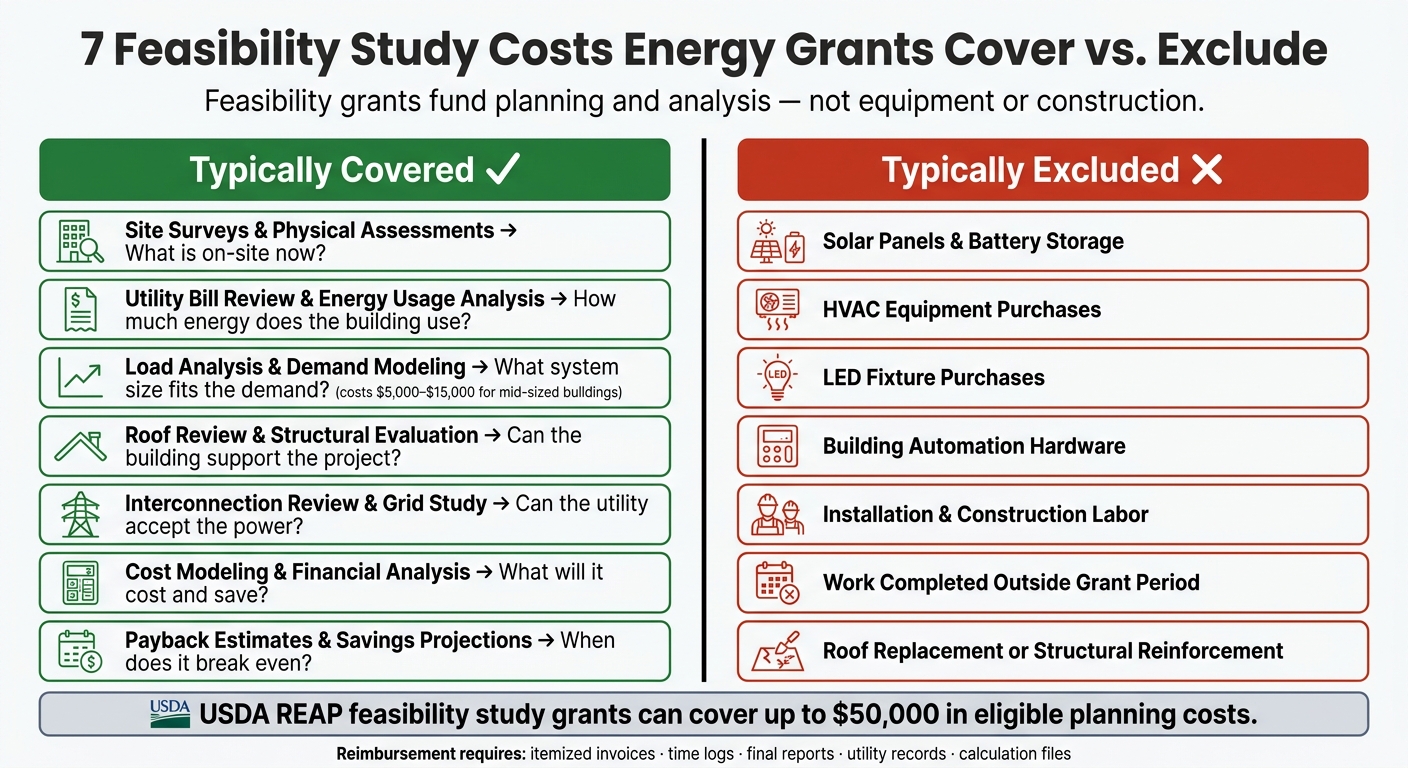
7 Feasibility Study Costs Energy Grants Cover vs. Exclude
Feasibility grants usually pay for documented study work completed during the grant period, not equipment or installation. Put simply, the money goes toward analysis, not procurement or construction. The seven categories below are the study costs most often reimbursed.
Common Eligible Planning Costs
Eligible costs usually include consultant labor, engineering review, utility data analysis, and energy modeling. Many programs also ask for a business case analysis that sums up current facility conditions and projected outcomes [1]. Those are the planning tasks most grant programs reimburse.
Costs Usually Excluded from Feasibility Grants
Capital purchases are usually not eligible. Equipment purchases, installation labor, and construction are typically excluded, even if the study ends up recommending them. That means items like solar panels, battery storage systems, HVAC equipment, LED fixtures, and building automation hardware usually fall outside the scope of a feasibility grant. Work completed outside the grant period is also usually ineligible [1].
| Cost Type | Typically Eligible | Typically Excluded |
|---|---|---|
| Consultant labor for technical assessments | ✓ | |
| Engineering review of existing infrastructure | ✓ | |
| Utility data and energy usage analysis | ✓ | |
| Energy modeling and savings projections | ✓ | |
| Business case analysis and cost estimates | ✓ | |
| Solar panels or battery storage | ✓ | |
| HVAC or LED equipment purchases | ✓ | |
| Installation and construction labor | ✓ | |
| Building automation hardware | ✓ |
1. Site Surveys and Physical Condition Assessments
The first eligible cost is the site survey because every estimate that follows depends on solid field data. In most cases, this is the starting point for an energy feasibility study. Before any modeling or cost projections begin, someone needs to visit the site, take measurements, review existing equipment, and record current conditions.
Without verified field data, the rest of the study leans on guesswork. That’s why grant programs usually cover labor tied to site visits, inspections, measurements, and documentation. This step gives the study a clear baseline and makes later cost estimates easier to trace back to actual conditions. Document the survey findings as the basis for the written estimate [4].
That survey data becomes the baseline for the rest of the feasibility study.
2. Utility Bill Review and Energy Usage Analysis
After the site survey, utility bills and usage data show how the building performs in day-to-day use. This step usually means pulling utility bills, reviewing interval usage data, and looking at consumption patterns over time. Those records form the baseline for the savings model.
Utility bill review also feeds straight into the business case analysis – the document that estimates projected savings and points to the upgrade options likely to have the biggest impact. Gathering bills, organizing interval data, and running consumption models helps support savings estimates and gives the study documented support for its cost projections. For school districts, municipalities, and healthcare systems, this step cuts out guesswork and replaces it with utility data, giving decision-makers numbers they can defend during budget review. Keep consumption records, demand history, and the method used to build the savings model. Those are the records that support reimbursement [4].
Once consumption patterns are documented, the next move is to test how those loads shift under the proposed project.
3. Load Analysis and Demand Modeling
Direct Tie to Project Feasibility
Once usage patterns are on the table, load modeling shows how the proposed system would hold up against actual demand. It takes raw usage data and turns it into system sizing, showing how demand would line up with the proposed setup.
That’s what tells you how large the project should be and whether the facility’s demand profile can support it. This is especially important for buildings with uneven usage or around-the-clock loads.
Typical Grant-Funded Planning Expense
Most federal and state energy grants treat load analysis as a pre-development expense. In plain terms, they often pay for the engineering time needed for hourly load modeling.
For a mid-sized municipal building, these studies often cost $5,000 to $15,000 [1]. Federal grant programs, utility incentives, and state-specific programs such as SECO in Texas are often set up to help cover these early planning costs [1].
Technical Documentation Required
Grant reimbursement usually calls for a clear paper trail. That often includes:
- interval data summaries
- load duration curves
- a modeling report that explains how the proposed project will offset the identified load [2][3]
An engineer review or stamp can make audit records stronger [2][3]. Those records also help with the next step: roof and structural review.
Value for Public-Sector Decision-Making
This information gives public leaders something solid to point to when they need to defend project size, budget, and savings assumptions.
4. Roof Review and Structural Evaluation
Once load modeling sets the system size, the next step is simple: the roof has to be able to carry the equipment.
A structural evaluation checks whether a roof can handle a rooftop solar or HVAC upgrade. That review looks at load-bearing capacity, roof age, membrane condition, and remaining service life. Those details have a direct impact on whether a rooftop energy project can move forward as planned or whether it needs a different design [5][6][7].
For public facilities, roofs with less than 10 to 15 years of remaining life usually aren’t a good long-term fit for rooftop solar. In that situation, the project often shifts to a ground-mount or carport system. In some cases, roof replacement needs to go into the capital plan first. That kind of review helps leaders sort through the main siting options: rooftop, carport, or ground-mount.
Typical Grant-Funded Planning Expense
Eligible work usually includes:
- Site inspections
- Review of structural drawings
- Load calculations
- A written findings report
Roof replacement and structural reinforcement are usually excluded.
Technical Documentation Required
That finding should be backed by a roof condition report, load calculations, and a stamped engineer letter.
A solid roof and structural evaluation usually includes a narrative roof condition report, annotated roof plans that show viable equipment zones and setbacks, structural load calculations, and a photo log of observed deficiencies. For public facilities, a stamped structural engineer’s letter confirming roof capacity under local building-code assumptions is often included in the feasibility report [5][6][7].
5. Interconnection Review and Grid Study Support
Once the roof checks out, the next issue is simple: can the utility take the power? That’s where the focus moves from the building itself to the grid.
An interconnection review looks at whether the utility’s distribution system has enough room to accept the electricity a facility’s solar array would produce. In crowded parts of the grid, a project can be technically impossible no matter how much money is set aside. And without a completed interconnection study and agreement, the utility will not grant permission to operate. That means the system cannot be turned on legally.
Direct Tie to Project Feasibility
An early utility review can flag grid limits before the final design is locked in. That matters because public dollars should not move toward construction until the project can connect in the first place.
Typical Grant-Funded Planning Expense
Eligible costs usually cover utility coordination, application preparation, and preliminary engineering, such as single-line diagrams. Utility application fees and impact-study fees are often reimbursable when they are listed in the grant scope.
Technical Documentation Required
Standard deliverables usually include:
- A single-line diagram
- A site plan showing the point of common coupling
- Inverter data sheets
These documents help the utility process the review. They also give the public owner the records needed to support and defend the project.
Value for Public-Sector Decision-Making
Interconnection review shows whether a project can move ahead before construction funds are spent. That can stop a painful situation where procurement starts, only for the team to run into surprise utility fees or a rejection at the connection stage.
Once interconnection is viable, the study moves to cost modeling and financial analysis.
6. Cost Modeling and Financial Analysis
Once a project passes technical review, the next step is simple: do the numbers work? Cost modeling is the part that shows whether a project fits the budget, what it’s likely to cost, what it may save, and whether it makes sense for a public entity to move ahead.
Direct Tie to Project Feasibility
A solid financial model helps teams compare project paths side by side. It measures the relative cost-effectiveness of different alternatives, flags high-cost components early, and gives decision-makers a way to weigh options before picking a direction [4].
For public entities, this often takes the form of a business case analysis. That review looks at current facility conditions, points to the most cost-effective upgrades, and models the savings those upgrades are expected to deliver [1].
Typical Grant-Funded Planning Expense
Eligible costs in this category usually cover the work required to build the financial model itself. That can include:
- Cost estimates
- Savings projections
- Stacked funding analysis, such as utility incentives, federal grant programs, and credits like New Market Tax Credits (NMTCs) [1]
This work gives public leaders the numbers they need to approve or reject the project.
Value for Public-Sector Decision-Making
A completed cost model gives decision-makers the financial picture needed to make a funding call [1]. It turns a rough idea into something concrete, with numbers tied to cost, savings, and budget fit.
From there, attention usually shifts to one practical issue: how long it takes for the project to pay for itself.
7. Payback Estimates and Savings Projections
Payback estimates bring the site survey, utility review, and cost model together into one simple question: when will the energy savings pay for the project? That matters a lot in public-sector work, where every dollar gets examined. It also matters early, because grant programs often cover the professional labor needed to build these projections.
Direct Tie to Project Feasibility
Once the cost estimates are done, payback helps show whether the expected savings are worth the upfront spend. For public entities dealing with aging infrastructure and tight budgets, a clear payback projection gives administrators something concrete to approve or reject [1].
It also helps compare options side by side. If two upgrade paths both look workable, payback shows which one earns back its cost sooner.
Typical Grant-Funded Planning Expense
This part of the planning process is often covered by grant programs. That usually includes the professional labor needed to run savings models for specific upgrade scenarios and find layered incentives that may shorten the payback period [1] [4].
In plain English, the grant may help pay for the analysis that answers:
- What does this upgrade save?
- How long until it breaks even?
- Are there rebates or other incentives that improve the numbers?
Technical Documentation Required
Payback calculations need a Basis of Estimate (BOE). This document records the assumptions behind the projection [4]. It creates a clear paper trail from the savings estimate back to the site data and utility analysis.
The EPA‘s guidance, Publication 540R00002, sets a benchmark for documenting cost estimates in public-sector feasibility studies [4]. Using that standard from the start can help lower compliance risk later.
Value for Public-Sector Decision-Making
A finished payback estimate turns technical work into a budget decision: what it costs, what it saves, and when it breaks even [1]. That kind of clarity helps with budget approval and supports long-term planning.
Grant Compliance Notes for These 7 Cost Categories
Once the study is done, the file needs to show that every claimed cost was eligible. Getting paid back depends just as much on paperwork as it does on the work itself.
Records That Support Reimbursement
Invoices should break out costs by task instead of showing one lump sum. If internal staff worked on the study, they should keep time logs for in-house labor so feasibility hours stay separate from regular job duties.
Keep the source records behind each claim, including:
- Itemized invoices
- Time logs
- Final reports
- Utility records
- Dated photos
- Calculation files
Documentation should also include assumption notes and calculation files used for cost models and payback projections. A centralized grant file, both digital and physical, can make it much easier to keep correspondence, signed engineering seals, and timestamped photos in order [4].
Keeping Study Costs Separate from Construction Spending
Feasibility study costs are planning expenses, so they need to be documented separately from capital expenditures like equipment and construction [4]. This separation helps avoid mixed billing and budget confusion.
A simple way to handle this is to assign a separate project ledger code to the feasibility study and keep a separate scope of work that ends before procurement or installation begins. In plain English: keep feasibility costs in their own ledger, and stop that scope before any buying or building starts.
Clear records also make life easier for contractors managing grant-funded studies from day one.
How Specialized Energy Contractors Can Support the Study
Once the paperwork is lined up, the study still needs a careful technical check. This is where specialized energy contractors come in. They help keep feasibility studies accurate, well-supported, and ready for grant review. E3 Design-Build Contractor can support Texas public entities with feasibility-phase engineering, energy analysis, and documentation. That help ties the site survey, utility review, and financial model into one study file that can stand up to scrutiny.
This becomes even more important when renewable energy planning overlaps with HVAC, LED lighting, or building automation upgrades. In those cases, the right contractor helps keep the study centered on eligibility, accuracy, and clean documentation.
Conclusion
These seven grant-funded cost categories answer two key questions before any capital is committed: Can the project work on the ground, and does the math hold up?
That early analysis helps cut down on surprises during construction and gives public owners a plain view of likely project results. E3’s point is simple: straight answers matter more than a sales pitch.
From site surveys to payback estimates, each category helps build the case before construction starts. For schools, cities, and public health systems, that kind of clarity matters before money goes out the door. When each cost is documented clearly, the study can support both grant reimbursement and a go/no-go decision before any capital is spent. Taken together, these categories turn early analysis into a defensible funding decision.
FAQs
How do I know if my project needs a full feasibility study?
A full feasibility study is usually the right move for large retrofit projects, like major HVAC upgrades or renewable energy installs. It gives you the level of detail lenders, investors, and performance contract providers often want before they sign off.
If the project scope still feels a bit fuzzy, start simpler. A basic walk-through audit can spot quick wins and lower-cost fixes first. Then, if the numbers and project path look promising, you can step up to a more detailed study.
What documents should I keep for grant reimbursement?
Keep records that back up both project costs and the technical work behind them. That usually means gathering:
- 12 to 36 months of utility bills
- equipment inventories, maintenance records, and system nameplate data
- site control documents and letters of intent
- cost estimates, engineering reports, financial models, invoices, and receipts
These records help confirm the work completed during the feasibility study, show that the project makes sense on paper, and support the projected savings.
Can one grant cover both the study and construction?
It depends on the program guidelines.
Some grants pay for the feasibility study first. In that case, you may need to finish the study before you apply for a separate construction or implementation grant.
Other programs may offer limited funding for small repairs or upgrades. But if you’re planning a larger construction project, you’ll usually need to submit a separate application.