
If I had to boil this down to one point, it’s this: most Texas cities should mix funding sources, not rely on just one. Grants and utility rebates can cut the upfront bill, leases can move smaller jobs faster, bonds can fund large long-life work, and performance contracts can tie repayment to measured savings.
If you’re weighing retrofit funding, I’d focus on four things right away:
- Project size
- Asset life and payback
- Budget and debt room
- Procurement and utility rules
This article compares 7 funding paths for municipal retrofits:
- Grants
- Municipal bonds
- Tax-exempt leases and lease-purchase agreements
- Utility rebates
- Tax-credit-linked financing
- Capital budgets and revolving funds
- Energy savings performance contracts
A few numbers show why the choice matters:
- Austin Energy rebates can reach $300,000 per site per fiscal year, capped at 50% of job cost
- San Marcos secured $16.6 million in grants in 2022–2023
- Texas PACE programs have supported more than $500,000,000 in financing since 2015
- One Texas ESPC example cited $12.7 million in project cost, $949,508 in annual savings, and a 13.4-year payback before finance costs
My short take:
Use rebates and grants to shrink the financed amount. Use bonds for large, long-life upgrades. Use leases when timing matters. Use capital funds for smaller pay-as-you-go work. Use performance contracts only when savings can be measured from day one.
Funding Your Green Projects: Federal & Incentive Updates
Quick Comparison
| Funding path | Best fit | Main pay source | Approval load | Speed |
|---|---|---|---|---|
| Grants | Projects that match program rules | None | High | Slow |
| Municipal bonds | Large retrofit packages | Taxes, fees, or system revenue | High to medium | Slow |
| Tax-exempt leases | Small to mid-size upgrades | Annual budget payments | Low | Fast |
| Utility rebates | Cost reduction for eligible measures | None | Low | Fast |
| Tax-credit-linked financing | Large projects with a private-party structure | Varies by deal | Medium | Medium |
| Capital budgets / revolving funds | Small repeat projects or cash-funded work | Internal cash or reinvested savings | Medium | Medium |
| Performance contracts | Multi-system projects with trackable savings | Verified savings | Medium | Medium |
Bottom line: the best funding path depends less on what sounds simple and more on whether the city can pay, procure, and verify the work without delays or gaps.
What Texas Cities Should Evaluate Before Choosing a Funding Path
Before a city picks a funding structure, it should run the project through four simple filters: project size, debt and cash position, procurement rules, and utility requirements.
That matters because the wrong fit can create headaches later. A funding path that looks fine on paper may clash with the city’s budget cycle, contract method, or rebate eligibility.
Project Size, Asset Life, and Payback Period
Projects with a short payback often line up well with rebates. Longer-life upgrades usually need longer repayment terms.
The goal is pretty simple: match the repayment term to the asset life so annual payments stay in step with expected savings. That same logic also helps a city decide whether to use debt, cash, or a savings-based contract.
Debt Limits, Cash Availability, and Budget Timing
Cities should review how much borrowing room they already have and whether the project fits into the current capital plan. They also need to check timing. Even a sound project can stall if it doesn’t fit the city’s budget calendar.
In practice, the best structure is the one that fits both current debt capacity and the timing of the budget process. Once that part is clear, the next step is to see whether the procurement method can handle the scope of the retrofit.
Procurement Rules and Contract Structure
Texas cities need the funding structure to line up with the delivery method. If the retrofit is more complex, design-build can place design and construction under one contract.
Cities should settle the delivery method before locking in scope, pricing, and bid documents. If that piece is fuzzy, the project can drift fast.
Utility Territory, Incentives, and Measurable Savings
Rebate eligibility depends on the local utility. Utility rebates vary by provider and equipment type [2].
And rebates are only part of the picture. Savings-based funding depends on savings that can be measured and checked, so cities should set a baseline and agree on a measurement and verification protocol early. For this approach to work, the city needs three things from day one:
- A baseline
- A measurement plan
- Working access to the right data
1. Grants
Grants give cities money they don’t have to repay. In Texas, they tend to work best when a project is already in the Capital Improvements Plan and lines up with goals tied to resilience, infrastructure, water reuse, resource conservation, or economic development. For retrofit work, grants usually lower the amount the city needs to finance instead of paying for the whole job. In plain English: grants are usually best as gap funding, not the only funding source.
Where Grants Fit Best
Grants make the most sense when a project supports resilience, water efficiency, or another capital priority and can be completed in phases. They work best when the retrofit scope matches a program’s eligibility rules and the city can handle match and timing requirements.
In 2022–2023, San Marcos secured $16.6 million in grant awards for infrastructure and planning projects [7].
Cash Flow Timing
Most Texas municipal grants reimburse costs after the work is done, so the city needs cash on hand to cover construction in the meantime [8]. That timing can be a sticking point. Some programs also require a local match, which adds to the upfront cost.
Repayment
Grants do not create debt, so cities often use them to cut down the financed share of a retrofit [7].
Texas-Specific Constraints
Before applying, check the fine print:
- Start-date deadlines
- Completion deadlines
- Match rules
- Eligible-cost limits
- Stacking restrictions [8]
If a grant covers only part of the project cost, it often makes sense to pair it with bonds, leases, or cash. And if the timing or match rules make the deal harder to fund, the next step is usually a debt-backed structure.
2. Municipal Bonds
When a retrofit includes HVAC, controls, envelope, or utility work that costs more than current cash can cover, bonds let a city pay for the work up front. Tax-exempt bonds spread those costs across the asset’s useful life, which helps match repayment to the period when the project is delivering savings. That setup tends to work best when the bond term lines up with both the life of the retrofit and the savings it is expected to produce.
Best-Fit Project Size
Bonds usually make the most sense for large capital projects with long service lives. In Texas, bigger issuances or terms longer than five years can trigger state-level review, so cities should check those thresholds early. The bond structure also matters because repayment source and approval rules are tied together.
Texas cities often choose from three bond types based on how the project will be repaid and whether voter approval is part of the process:
| Bond Type | Voter Approval? | Repayment Source | Common Retrofit Use |
|---|---|---|---|
| General Obligation (GO) | Yes | Ad valorem property taxes | Large-scale infrastructure and building renovations [9][10] |
| Certificates of Obligation (CO) | Usually no | Taxes, fees, or both | Facility upgrades [10][11] |
| Revenue Bonds | No | Specific income, such as water and wastewater utility rates | Water and wastewater systems [10] |
COs can be a good option when a project needs to move faster and the city does not have time to wait through a full election cycle [10]. There’s also a guardrail cities need to keep in mind: if voters reject a GO bond for a project, that same project usually can’t be shifted to COs for three years [3].
Once the repayment source is set, the next questions are pretty simple: how long should the term run, and how long will approval take?
Upfront Cost Coverage
Bonds can cover the full retrofit package at the start, including construction, equipment, and design services. Corpus Christi offers a clear example. In June 2021, the City of Corpus Christi approved $6.7 million in new Certificates of Obligation for facility retrofits, including $1,342,440 for HVAC work at the Museum of Science and History and $1,250,000 for City Hall elevator replacements [11].
Texas-Specific Constraints
In Texas, bond terms usually follow the useful life of the asset being financed. GO bonds also need voter approval on a scheduled election date, which can affect timing. After voter approval, bond sale and fund delivery usually take about three to six months [3]. On top of that, every issuance must be reviewed by the Texas Attorney General’s Office for legal compliance [9].
3. Tax-Exempt Leases and Lease-Purchase Agreements
When bond timing or approval doesn’t line up with the project, lease-purchase financing can be a faster way to move. A city can start a retrofit without waiting for bond approval or a full capital appropriation, which makes this route useful when upgrades need to begin before the next capital cycle.
This option is often used for LED lighting, HVAC, water and wastewater equipment, building automation, and envelope upgrades.
Payments usually come from the operating budget and are often backed by utility savings, with little or no upfront cost.
Texas-Specific Constraints
In Texas, lease-purchase financing is usually treated as an operating-budget expense instead of debt, which can help a city avoid bond approval. Most agreements include a non-appropriation clause, so the council can stop funding in a future year. At the end of the term, the city owns the equipment.
Cities often pair these agreements with performance contracts or design-build delivery. In some cases, rebates or performance-based structures can cut the amount that needs to be financed.
4. Utility Rebates and Incentive Programs
Utility rebates cut project costs and shrink the amount a city needs to finance. In most cases, they work best alongside bonds, leases, or capital funds rather than as the only funding source.
Where Rebates Help Most
Rebates can help with projects of almost any size, but they tend to be most useful when a city is trying to close a budget gap. In Texas, common qualifying upgrades include high-efficiency HVAC systems, LED lighting, and Building Automation Systems (BAS).[6]
Upfront Cost Coverage
Austin Energy sets standard commercial rebates at $300,000 per site per fiscal year and 50% of job costs.[12]
That limit has a direct effect on budget planning. Once a project hits the site cap, the rest of the cost has to come from somewhere else.
Financing Impact
Rebates do not need to be paid back. They lower the net project cost right away, which can shorten payback and reduce how much a city needs to finance through leases, bonds, or capital budgets.[12]
As Dr. Daniel Trevino, Jr., Superintendent, noted after tracking post-retrofit performance:
"We realized our annual savings estimate in just over eight months of tracking." [6]
Texas-Specific Constraints
In Texas, rebate access depends on the utility territory. Each utility runs its own program, with its own rules, thresholds, and application windows.[2] That means a project that works in one service area may not qualify in another.
A few limits show up again and again:
- Most programs require pre-approval before installation starts, and retroactive rebates usually are not available.[12]
- Equipment often must meet set efficiency standards, such as ENERGY STAR® certification, and installation usually must be completed by a licensed contractor.[2]
Program rules change often. Check the current requirements before locking in the budget or the bid schedule.
When rebates don’t cover the full gap, cities can layer them with the next funding path.
sbb-itb-034f8e1
5. Tax-Credit-Linked Financing Structures
When a city wants to cut project costs with help from a private partner, tax-credit-linked financing can help close the gap. In plain English, the private partner claims federal tax benefits, then passes part of that value back to the city through lower lease payments, lower service fees, or reduced project costs. It’s not like a grant or rebate where money just shows up. This route only works if a private party can use the tax benefit and share part of it.
Best-Fit Project Size
These structures tend to work best for large, capital-heavy retrofits with long payback periods. That usually includes HVAC, controls, water systems, and other equipment-heavy upgrades.
Upfront Cost Coverage
When local rules permit it, PACE-style structures can cut or even remove upfront cash needs by repaying project costs through an assessment tied to future savings. The Texas PACE Authority has facilitated over $500,000,000 in financing since 2015 across 95 established programs statewide. [1] For city-owned utility assets, this option only makes sense where the legal setup lets a private partner monetize the tax benefit.
Repayment or Savings Source
With PACE-style structures, repayment is tied to future energy savings through a property assessment. [1] In other third-party setups, the lease or service agreement controls how the value comes back to the city. [13]
Texas-Specific Constraints
A few Texas limits can shape whether this path works at all:
- IRBs face federal volume caps and project limits. [13]
- Sales tax bonds can require voter approval and depend on local sales tax revenue. [13]
- PACE must be set up locally before a project can use it; Texas now has 95 established programs. [1]
"It would do well for every city to be knowledgeable of the PACE financing program and have it available for projects should the need arise." – Clay Meadows, Financial Leader, Clarksville General Hospital [1]
These deals can lower costs, but they’re also more complex. That’s why cities should stack them up against bonds, leases, and capital funds before making a call.
6. Capital Budgets and Revolving Funds
After tax-credit-linked structures, the simplest path is often internal cash or a dedicated fund. If a city has money on hand, capital budgets and revolving funds can pay for retrofit work without the extra layers that come with bonds or third-party agreements. The tradeoff is simple: you’re limited by annual cash on hand and the budget calendar. For cities that do have available cash, the next call is whether to pay outright or set up a fund that puts project savings back to work.
Best-Fit Project Size
Capital budgets work best for one-time, high-cost retrofits. Dedicated efficiency funds are a better match for smaller upgrades a city can repeat across buildings, like weatherization, lighting, and controls. [14]
Upfront Cost Coverage
Cities usually handle upfront costs on a pay-as-you-go basis, using cash from the general fund. That means no debt service, which is a big plus. But it can also slow things down if the money isn’t available in the current budget cycle.
How the Fund Replenishes
Revolving or dedicated efficiency funds are often seeded through utility tariffs or base rates, then refilled over time with reinvested savings. [14] That’s the appeal: one project’s savings help pay for the next project. Done well, it creates a steady rhythm for retrofit work instead of a one-off spend.
Texas-Specific Constraints
In Texas, annual appropriations, eligible uses, and replenishment rules shape how these dollars can be spent. Cities should check that planned retrofit work fits the allowed-use categories for any dedicated fund and that the fund’s rules allow savings to be put back into future projects.
| Mechanism | Voter Approval | Repayment Source | Common Retrofit Use |
|---|---|---|---|
| Pay-As-You-Go (Cash) | No | N/A | Smaller, immediate upgrades |
| Revolving/Dedicated Efficiency Fund | No | Reinvested savings or utility tariffs | Repeatable upgrades: weatherization, lighting, controls |
When a retrofit can pay for itself through verified savings, a city may be able to shift from cash-funded spending to performance-based financing.
7. Energy Savings Agreements and Performance Contracts
When project savings can pay back the work, an ESPC can help fund a retrofit without needing upfront cash. In Texas, these agreements link design, construction, and repayment to measured savings.
Best-Fit Project Size
ESPCs make the most sense for broad retrofits that affect several building systems, not one-off repairs. That usually means work across HVAC, lighting, controls, and plumbing upgrades. [15]
The scale can be big. In one Texas project, the total cost was $12.7 million, with estimated annual savings of $949,508 and a 13.4-year payback before finance costs. [16] At that size, the contract terms and the way savings are checked matter just as much as the equipment itself.
Upfront Cost Coverage
Cities often cover upfront costs through lease-purchase agreements. That route can avoid a referendum, though it still calls for legal review. [15]
Repayment or Savings Source
Repayment comes from verified energy and operating savings. Projects usually begin with an energy audit to set a baseline, then shape the retrofit around clear reductions in energy use.
For that reason, the contract should spell out a few non-negotiables:
- A baseline for pre-project use
- A savings guarantee
- Independent M&V
Those items help keep the numbers honest and give cities a way to check whether the deal is doing what it promised. [5][15]
Texas-Specific Constraints
Texas local governments buy ESPCs through the professional-services method, not standard construction bidding. House Bill 3583 also limits some change orders, so cities and counties can’t stretch an ESPC beyond its original intent. [15]
There’s another wrinkle here. State agencies and higher education institutions have a state reviewer to check guaranteed savings, but local governments do not. [15] So if the language in the contract is fuzzy, that gap can become a problem fast. In practice, clear terms matter as much as cost.
How the 7 Funding Paths Compare
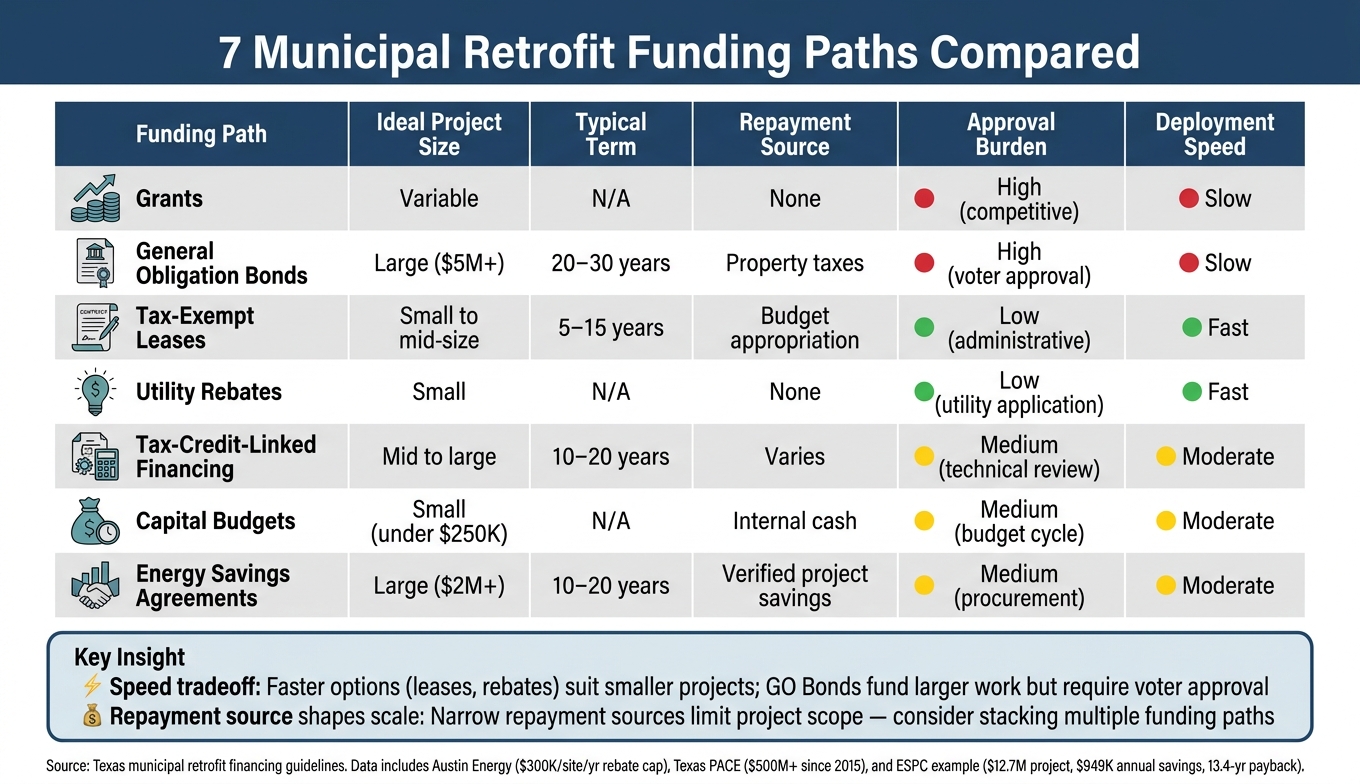
7 Municipal Retrofit Funding Paths Compared: Speed, Size & Approval
Looking at each funding path one by one is helpful. But the bigger picture gets a lot clearer when you compare them side by side by project size, approval burden, repayment source, and how fast the money can be put to work.
| Funding Path | Ideal Project Size | Typical Term | Repayment Source | Approval Burden | Deployment Speed |
|---|---|---|---|---|---|
| 1. Grants | Variable | N/A | None | High (competitive) | Slow |
| 2. General Obligation Bonds | Large ($5M+) | 20–30 years | Property taxes | High (voter approval) | Slow |
| 3. Tax-Exempt Leases | Small to mid-size | 5–15 years | Budget appropriation | Low (administrative) | Fast |
| 4. Utility Rebates | Small | N/A | None | Low (utility application) | Fast |
| 5. Tax-Credit-Linked Financing | Mid to large | 10–20 years | Varies | Medium (technical review) | Moderate |
| 6. Capital Budgets | Small (under $250K) | N/A | Internal cash | Medium (budget cycle) | Moderate |
| 7. Energy Savings Agreements | Large ($2M+) | 10–20 years | Verified project savings | Medium (procurement process) | Moderate |
Two trends jump off the page.
First, speed usually comes with a tradeoff. The faster options tend to be easier to approve, but they often fit smaller projects. Tax-exempt leases and utility rebates move fast, which makes them a good match for tighter scopes. General Obligation Bonds can support much bigger projects, but they usually take longer because they have to move through voter approval.
Second, the repayment source shapes scale. That piece matters more than many teams expect. General Obligation Bonds rely on property taxes. Revenue bonds rely on system revenues. Energy savings agreements rely on verified project savings. If the repayment source is narrow, the project scope often has to be narrow too.
That’s why many retrofit projects work best when they use more than one funding path. One source may cover a base layer, while another helps close the gap or speed up deployment. The next section walks through how to stack those options together.
How to Combine Funding Sources for Better Retrofit Economics
No single funding path pays for everything a city needs. The best approach is usually to layer funding sources so grant and rebate dollars cut down the share that needs financing, and the financed piece is paired with the right term and repayment setup.
Use Grants and Rebates to Lower the Financed Amount
The upside comes from stacking sources, not picking just one. Grants and rebates reduce the amount that has to be financed. Use grants to bring down principal before debt is issued. Then use rebates for fast-payback measures like LED lighting.
Match Each Measure to the Right Funding Source
Fund each retrofit measure based on how long it takes to pay off. Pair long-life assets with long-term debt. Put utility work under utility-specific financing. Use performance-based contracts or TX-PACE for upgrades backed by savings. In practice, that means coordination matters just as much as the funding mix itself.
Coordinate Design, Procurement, and Incentive Timing
Once the funding stack is in place, timing becomes the last big constraint. Design, procurement, and incentive applications need to move in sync.
Utility rebate programs often require pre-approval before equipment is bought or installed, so cities should check those rules during the design phase. Grant programs run on their own application cycles, and some projects need to be ready well before a funding round opens. If specs are locked in too early or the application goes in too late, part of the stack can disappear.
Common Funding Mistakes to Avoid
These mistakes tend to pop up when cities mix grants, rebates, debt, and savings-based financing without lining them up in the right order. In most cases, the problem isn’t a lack of money. It’s bad timing, poor sizing, or weak verification.
Do Not Treat Grants as the Default Answer
Don’t let grant funding set the project timeline. Cities should pick projects and build cost estimates early instead of waiting for uncertain grant awards before starting scope and budget work.
Do Not Assume Rebates Will Cover a Large Share of Cost
Think of rebates as cost offsets, not the main funding source.
Do Not Mismatch Term Length and Asset Life
Line up the financing term with the asset’s useful life so annual payments stay in step with expected savings.
Do Not Skip Measurement and Verification in Savings-Based Projects
If repayment depends on savings, the city needs a baseline and an M&V plan. Without both, cities can’t verify savings or settle disputes if numbers are questioned.
Conclusion
There’s no one-size-fits-all funding route for every Texas city or every retrofit job. The right fit comes down to a few plain factors: project size, the level of financial risk the city can take on, available staff time for applications and compliance, and the incentives offered in that utility area.
The strongest move is often a capital stack. San Marcos shows how layered funding can help push a large retrofit program ahead.[4]
Pick the funding route based on the measure, the scale, and the repayment source. That mix shifts with project size and payback timeline. For single projects, revolving funds work well for repeatable small upgrades, performance contracts fit larger multi-system retrofits, and TX-PACE makes sense for savings-backed efficiency work. Intentional stacking works better than falling back on the most familiar option.
Texas cities that define scope early, line up payback with asset life, and combine funding sources can ease budget pressure and complete more retrofit work. When matched well, these seven tools can lower project cost, protect cash flow, and keep municipal retrofits moving.
FAQs
How do cities choose the right funding mix?
Cities should match the funding mix to the project’s scope, budget limits, and long-term financial goals. In many cases, the best move is to blend sources. For example, a city might use utility rebates to cut upfront costs, then pair that with a low-interest option like SECO LoanSTAR to cover the rest over time.
E3 Design-Build Contractor can help public entities work through procurement systems like TIPS and spot incentives that may be available for energy-efficient upgrades.
When should a city use bonds instead of leases?
Cities should use bonds for big, long-term capital infrastructure projects that serve the community over the asset’s useful life. Since bonds often need voter approval and are backed by the city’s taxing power, they make sense for major projects where it’s reasonable to spread costs across future residents who will also use the asset.
A lease-purchase can be a better fit when a city needs a faster path or wants to avoid the administrative work that comes with a bond election.
What data is needed for savings-based financing?
You’ll usually need a detailed Utility Assessment Report (UAR). It points out places to cut energy use and helps show whether the project qualifies for funding programs.
Because savings-based financing is tied to how the project performs, the report needs to estimate energy reductions with care. That can include kilowatt-hour savings, demand reduction in kilowatts, or recovered energy capacity.