
Texas schools can cut heating and cooling costs by 30% to 50% with geothermal, while also getting longer equipment life and quieter classrooms. From what I see in these district examples, the main story is simple: when a school already has a major HVAC or campus project planned, geothermal can lower long-term costs if the site has room for wells and the team plans the work early.
Here’s the short version:
- I found Birdville High School reported about $0.58 per square foot in annual heating and cooling cost, versus $0.92 to $1.04 at similar schools with standard systems.
- I saw Fort Worth ISD report 30% to 50% utility savings on geothermal campuses, plus 100+ metric tons less CO₂ per campus each year.
- I noted Ray Braswell High School in Denton ISD used 1,110+ wells, each about 300 feet deep, and posted the district’s lowest first-year EUI.
- I also found a big funding point: under current federal direct-pay rules, some tax-exempt districts may recover up to 50% of qualifying project costs. One Texas district received about $10.1 million on $20.2 million in qualifying geothermal costs.
If you’re judging whether geothermal makes sense for a Texas school, I’d focus on four things first:
- Site space for the bore field
- Upfront budget and bond timing
- Long-term ownership of the building
- Staff training and commissioning after install
New sprawling high school fueled by geothermal energy opens in North Texas
sbb-itb-034f8e1
Quick Comparison
| District/School | Campus Size | Main Result | Key Design Point |
|---|---|---|---|
| Birdville High School | ~300,000 sq. ft. | About 50% lower heating/cooling cost | Distributed pumping |
| Ray Braswell High School (Denton ISD) | 452,868 sq. ft. | Lowest first-year EUI in district | 1,110+ wells, central pumping with VFDs |
| Fort Worth ISD / Benbrook Middle School | Various | 30%–50% utility savings | Wells placed under track, field, and parking |
What this case study shows, in plain terms, is that geothermal is not just an equipment swap. It works best as a campus planning decision tied to land use, funding, installation timing, and the full life of the building.
Texas Context: Energy Demand, Policy, and Delivery Methods
Why School Districts Are Looking at Geothermal
In Texas, school starts when the heat is still intense. That means cooling demand hits hard right at the start of the year, and HVAC problems become obvious FAST. When a campus air-conditioning system goes down in August or early fall, students feel it, teachers feel it, and families hear about it.
A lot of districts are also dealing with aging equipment that’s past its useful life. Midland ISD, for example, identified more than $50 million in HVAC and renovation needs [6]. As Kellie Spencer, Chief of Administrative Services at Midland ISD, said:
"We were getting a lot of negative feedback as school started in August and into mid-fall when equipment failures were having a significant impact on our learning environments. The bottom line was our teachers and students were hot and the word was getting around the community." [6]
There’s also a long-term ownership case here. Geothermal systems last 25 to 30 years, compared with 10 to 15 years for conventional rooftop units [2]. So when a district is already planning a full HVAC replacement, geothermal can look like a smart fit, not just a different piece of equipment.
Funding and Incentives for Texas Public Schools
For many Texas school districts, the biggest geothermal projects move forward through voter-approved bond programs. Fort Worth ISD’s geothermal expansion, for instance, was part of a $593.6 million bond [1]. Denton ISD’s Ray Braswell High School – a 452,868-square-foot campus with over 1,110 geothermal wells – was funded through a 2013 voter-approved bond and opened in August 2016 [4].
Federal policy has changed the math too. Under the IRA, tax-exempt districts can receive direct IRS payments, called elective pay, instead of tax credits they couldn’t use, and bonus rules can bring the effective credit rate to 50% [3]. One Texas district identified $20.2 million in qualifying geothermal costs from a $271 million high school project and received $10.1 million in direct-pay payments [3].
That can take a big bite out of upfront cost. But money is only part of the story. On school campuses, delivery still comes down to planning, timing, and keeping many moving parts lined up.
How Design-Build Delivery Supports School Upgrades
Geothermal projects tend to go more smoothly when one team handles coordination from day one. These jobs involve drilling, loop piping, heat-pump installation, controls, and campus scheduling and logistics [3][5]. If those pieces drift apart, the project can get messy in a hurry.
That’s why design-build can make sense for school upgrades. It puts drilling, mechanical systems, controls, and site logistics under one coordinated approach. E3 Design-Build Contractor supports Texas public entities with integrated HVAC, building automation, and infrastructure upgrades for projects that need close coordination.
Project Profiles: Geothermal in Texas Schools
These projects show how Texas districts used big building projects to make geothermal work on actual school campuses.
Starting Conditions and Project Drivers
Each district started from a different need. Birdville needed a full HVAC system for a new 300,000-square-foot campus. Benbrook Middle School became part of Fort Worth ISD’s districtwide geothermal effort. Ray Braswell High School needed a system built for a 452,868-square-foot campus and the challenge of Texas humidity.
The pattern is pretty clear: a major capital project opened the door, and districts picked geothermal to cut operating costs and get more years out of the system.
But that choice only paid off when drilling, piping, and the school calendar were planned together from day one.
System Design, Construction, and Campus Coordination
On school sites, space drives a lot of the design. Well fields often need ground area close to the building footprint [1]. That can get tricky fast on an active campus.
Fort Worth ISD dealt with that at Benbrook Middle School by placing 11 well fields under the track, football field, and parking lots. That kept the borefield out of the way of day-to-day school activity [1]. Ray Braswell High School took on a much larger layout with 20 well fields and more than 1,110 individual wells, each drilled to 300 feet, with HDPE piping used across the loop system [4].
Pumping setup mattered too. Birdville used distributed pumping, which helped avoid the efficiency loss that can come with centralized schemes. Ray Braswell went the other direction with a centralized setup that used parallel pumps and variable frequency drives (VFDs). That approach also let the design team use prefabricated pump stands, which saved space in the mechanical room [4].
The Ray Braswell project also relied on Revit MEP and clash detection during design. That helped the team sort out complex piping runs across a large campus before construction crews got into the field [4].
Put simply, these three projects tackled the same Texas pressures in different ways. Birdville focused on pumping efficiency for one campus. Benbrook dealt with land use inside a district program. Ray Braswell tied together large-campus drilling and mechanical design on a much bigger scale.
Measured Results Across the Featured Projects
The numbers all point in the same direction. Birdville High School reported annual heating and cooling costs of $0.58 per square foot, compared with $1.04 and $0.92 per square foot at two other Birdville ISD high schools with conventional systems [2]. Ray Braswell posted the district’s lowest first-year EUI in Denton ISD [4]. Fort Worth ISD reported 30% to 50% utility savings across its geothermal campuses, and each campus cut carbon dioxide output by more than 100 metric tons per year [1].
The strongest results showed up when the design fit the campus instead of forcing a one-size-fits-all setup.
| Project | Facility Size | Reported Energy Impact | Key Outcome |
|---|---|---|---|
| Birdville High School | ~300,000 sq. ft. | About 50% lower operating cost vs. comparable campuses | Distributed pumping; lowest cost/sq. ft. in district [2] |
| Ray Braswell High School | 452,868 sq. ft. | Lowest EUI in district | Humidity control; more than 1,110 wells [4] |
| Fort Worth ISD campuses, including Benbrook Middle School | Various | 30–50% utility savings | 100+ metric tons CO₂ reduction/year [1] |
There was also a maintenance angle. With more equipment indoors, districts reduced roof traffic and some of the wear that comes with servicing rooftop units.
"I think our roofs are going to last much longer because there’s not going to be as much activity on them, as there is with [maintaining] traditional rooftop units."
- Walter Dansby, School Superintendent, Fort Worth ISD [1]
Economics and Lessons for Future Texas District Projects
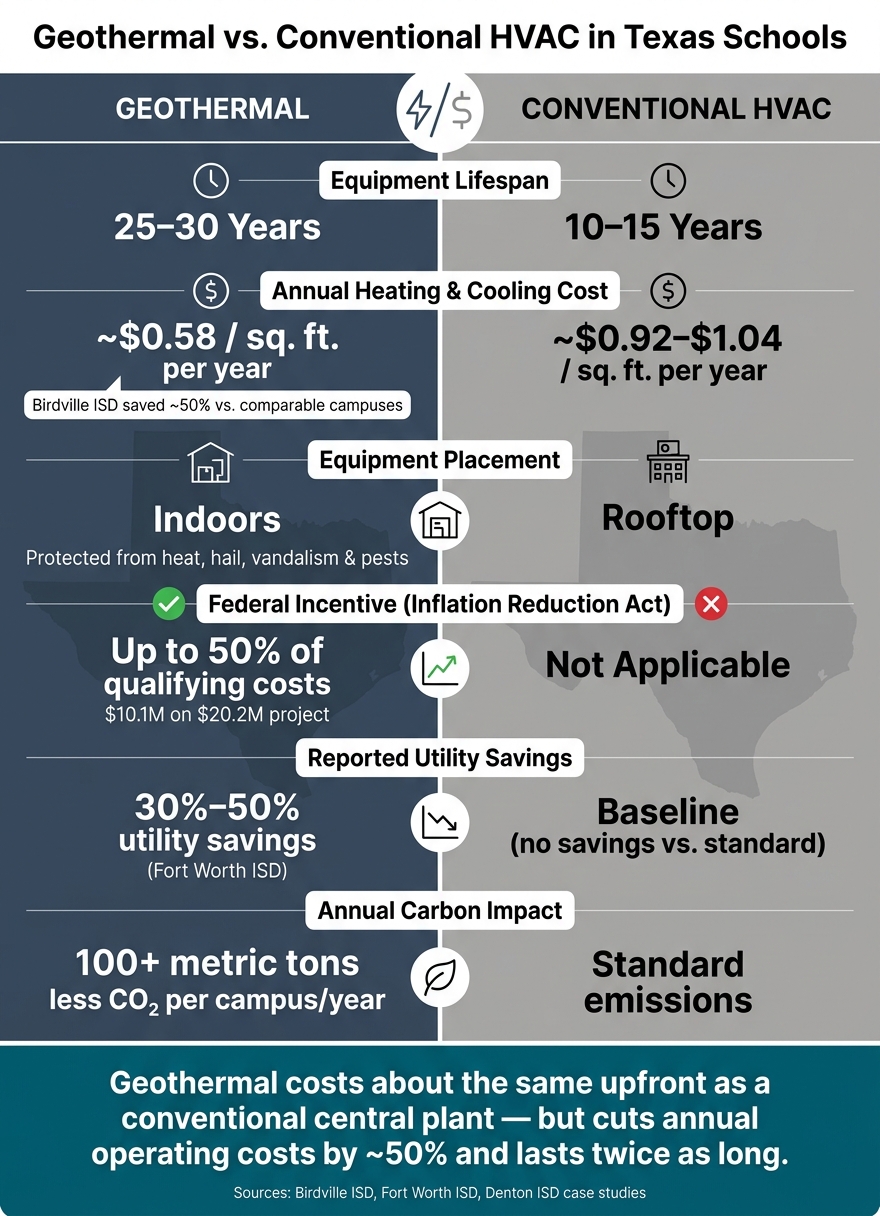
Geothermal vs. Conventional HVAC in Texas Schools: Cost, Life & Savings
Capital Cost, Savings, and Lifecycle Value
The case studies point to a plain takeaway: geothermal makes the most sense when districts look at lifecycle cost, not just the price tag on day one. The up-front cost can look high. But the picture shifts once districts factor in energy use, maintenance, and equipment life. Birdville, Denton, and Fort Worth all show the same thing: geothermal works best when the system fits the campus design, site layout, and day-to-day operating plan.
Birdville ISD found that its geothermal capital cost was nearly the same as a conventional central pumping plant, while annual operating costs dropped by about 50% [2]. That kind of drop adds up fast. At Birdville High School, operating cost came in at $0.58 per square foot, compared with $1.04 at Haltom High School and $0.92 at Richland High School, both of which used conventional systems in the same district [2].
The equipment life is also a big part of the math. Geothermal systems last 25 to 30 years, which is about twice the life of conventional HVAC systems at 10 to 15 years [2]. Maintenance costs can drop too, since the equipment stays indoors instead of sitting on rooftops in Texas heat and weather [2][1].
For school leaders, the issue isn’t just, "Does geothermal cost more to install?" It’s whether it cuts total ownership cost across the full life of the campus.
Federal support can shift the math even more. Under the Inflation Reduction Act, tax-exempt school districts can get direct payments from the IRS instead of using tax credits. One Texas district secured $10,118,729 in direct payments on $20.2 million in qualifying geothermal costs [3]. If a project meets prevailing wage, apprenticeship, and bonus rules, the effective credit can reach 50% of qualifying costs [3].
| Factor | Geothermal | Conventional HVAC |
|---|---|---|
| Service life | 25–30 years [2] | 10–15 years [2] |
| Operating cost (high school) | ~$0.58/sq. ft. [2] | ~$0.92–$1.04/sq. ft. [2] |
| Equipment location | Indoors [2] | Rooftop [2] |
| IRA direct pay potential | Up to 50% of qualifying costs [3] | Not applicable |
Those savings don’t happen by accident. Small planning choices can make a big difference.
Technical and Operational Lessons from the Case Studies
A few technical choices kept showing up in the projects that performed well.
Pumping strategy matters more than many districts expect. Central pumping can cut expected savings by about 20%. Distributed pumping avoids that hit [2]. If a district has to use centralized pumping, prefabricated pump stands with backup pumps and dedicated variable frequency drives can make service work easier without shutting the whole system down [4].
Commissioning isn’t optional. District staff also need hands-on training with geothermal equipment, not just the routines they’d use for boilers and standard HVAC systems [5]. Makeup water meters on each well field can help teams spot water loss and find leaks fast [4].
How Texas Public Entities Can Plan Similar Projects
Planning should start with site layout, funding rules, and long-term operations, not the drilling itself. In practice, that means checking a few things early:
- Well-field space
- IRA direct-pay eligibility
- Commissioning scope
- Staff training
- Post-occupancy monitoring [1][3][4][5]
Well fields can often go under parking lots or athletic fields, which helps limit disruption to the parts of campus students and staff use every day [1]. And from day one, the building management system should track EUI so districts can confirm performance and catch drift before it turns into a bigger problem [4].
Conclusion: Key Takeaways for Texas School Leaders
Across these Texas projects, the pattern is pretty clear: geothermal works best when the campus, the system design, and the long-term budget fit together. Birdville shows what that can look like at the campus level, with lower operating costs across a full site. And Birdville, Denton, and Fort Worth all lead to the same takeaway.
Comfort matters too. When systems are built for quiet, classroom-friendly sound levels, the equipment moves indoors instead of sitting on loud rooftops. That can make the learning space calmer and less distracting [2][1]. Keeping equipment indoors also helps shield it from hail, heat, vandalism, and pests [2][1]. For district leaders, that quieter day-to-day operation is a big part of the appeal.
The money side looks better now as well. Under the Inflation Reduction Act, tax-exempt districts can receive direct pay incentives that may cover up to 50% of qualifying project costs [3]. That changes the math in a big way, because it lowers upfront cost in ways districts didn’t have before.
For districts looking at a first project, two questions should come first:
- Is there enough site area for the well field?
- Will the district own the building long enough to benefit from lifecycle savings?
That puts geothermal in the planning bucket, not just the HVAC replacement bucket.
FAQs
How much land does a school need for geothermal wells?
Geothermal systems need a lot of space for well fields. In many cases, the land needed is roughly on par with the size of the building being heated and cooled.
For example, a 100,000-square-foot school may need about 100,000 square feet of land for its well field.
The good news? That space doesn’t always have to be set aside on its own. Well fields can often go under parking lots, in green areas, or around athletic tracks and playing fields.
When does geothermal make financial sense for a district?
Geothermal makes financial sense when long-term operating savings are greater than the upfront cost. For many school districts, that math works out well: annual utility costs are often 30% to 50% lower than with standard HVAC systems.
The numbers can look even better when federal incentives come into play. Inflation Reduction Act tax credits and direct pay options can cut the initial cost, while lower maintenance needs and long-lasting well fields help reduce expenses over time.
What does a school need to do after installation?
After installation, school districts should bring in third-party commissioning to verify that geothermal and other mechanical systems are fully integrated and running as intended.
From there, the work shifts from setup to day-to-day use. Districts should train mechanical technicians and electricians, track energy use intensity, and put system data to work in practical ways.
That can include:
- classroom lessons built around live building data
- community training events that show how the systems work and what they deliver
This step matters because a new system on paper isn’t the same as a system that performs well in the field.