
If I had to sum it up in one line: schools get better comfort and lower heating waste when each classroom can control its own temperature and the system follows actual room use.
Here’s the short version:
- Classroom-level zoning works better than one thermostat for a whole wing.
- Room use matters. Classrooms, gyms, cafeterias, and offices should not all run the same schedule.
- BAS and DDC controls help by matching heat output to occupancy, weather, and time of day.
- Setbacks can cut heating use during nights, weekends, and breaks.
- Radiant and low-temperature hot-water systems tend to hold steadier room temperatures.
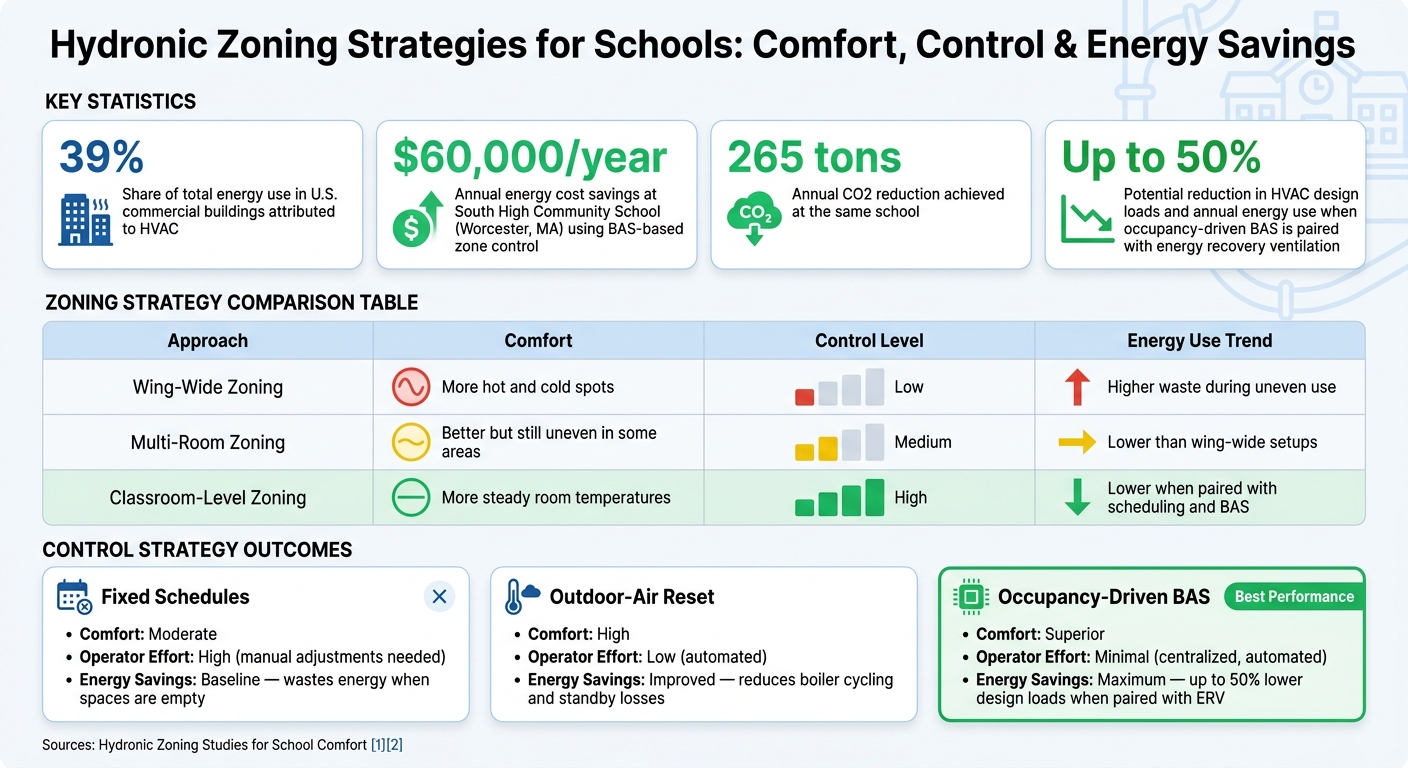
- In one school example, BAS-based zone control cut energy costs by about $60,000 per year and reduced CO2 by 265 tons. These upgrades are often streamlined through design-build projects for schools to ensure performance and cost-efficiency.
- HVAC accounts for about 39% of total energy use in U.S. commercial buildings, so better zoning can have a big effect.
What I take from these studies is simple: the best results came from room-by-room control, distribution matched to space type, and schedules tied to actual occupancy.
Quick comparison
| Approach | Comfort | Control | Energy use trend |
|---|---|---|---|
| Wing-wide zoning | More hot and cold spots | Low | Higher waste during uneven use |
| Multi-room zoning | Better, but still uneven in some areas | Medium | Lower than wing-wide setups |
| Classroom-level zoning | More steady room temperatures | High | Lower when paired with scheduling and BAS |
If you want the plain answer, it’s this: schools tend to perform better when heating is split into smaller zones and those zones run only when spaces are in use.
Hydronic Zoning Strategies for Schools: Comfort, Control & Energy Savings
Findings on Room-by-Room Temperature Control
How Classroom-Level Zoning Affects Comfort
When a single thermostat controls an entire wing, comfort usually slips. Some rooms get too warm, while others stay chilly. Field studies show that classroom-by-classroom zoning cuts down on those hot and cold spots. With individual zone valves and room sensors, each classroom can follow its own setpoint instead of being tied to a wing-wide average.
That kind of room-by-room control matters even more when classrooms deal with different heating loads. Sunlight, occupancy, and exterior exposure can all change how a room feels over the course of a day.
You see the gap most clearly during weather swings. A south-facing classroom can warm up from afternoon sun, while a north-facing room may still need heat. A shared zone can’t handle both conditions at the same time. Solar gain and exterior exposure lead to uneven heating across classrooms, and room-level zoning lets each space respond on its own.
The same idea applies to radiant and low-temperature hydronic systems, which tend to hold steadier temperatures across occupied areas.
Radiant Systems and Low-Temperature Hot Water
Radiant floors and slabs help keep temperatures steadier, and low-temperature hot water supports that steady heat output. Air-to-water heat pumps can also fit into existing hydronic systems.
Zoning Levels in Schools: A Side-by-Side Look
| Factor | Poorly Zoned (Wing-Wide) | Multi-Room Zoning | Classroom-Level Zoning |
|---|---|---|---|
| Temperature Drift | High – rooms drift above or below setpoint | Reduced, but some unevenness remains | Minimal – each room can track its own setpoint |
| Uniformity | Uneven, especially in buildings with different orientations | Better, but still limited by larger zones | More consistent across classrooms |
| Control Precision | Low | Moderate | High – room sensors and zone valves support individual control |
How those zones are spread across the building has a big effect on whether those comfort gains hold up day to day.
sbb-itb-034f8e1
Hydronic Distribution Setups in School Buildings
Zoning Layouts by Space Type
Room-level control works best when the distribution layout lines up with how each part of a school is actually used. A school isn’t one uniform space. Classrooms, gyms, cafeterias, and offices often need different schedules and control zones because their occupancy patterns, ventilation needs, and load profiles are different. Grouping spaces by use, schedule, and load is one of the simplest ways to improve control.[2]
When that match is in place, scheduling gets easier and zone control gets simpler.
Retrofits from Steam to Hot-Water Hydronic Control
In older school buildings, replacing steam or constant-flow hot-water systems with modulating hydronic loops improves setpoint control. Modern hydronic distribution also works with a broad mix of energy sources, including geothermal heat pumps, water-source heat pumps, and thermal storage. That makes it easier to shift to lower-carbon heat sources without replacing the full distribution network.[1]
In older schools, converting steam or constant-flow hot water to modulating hot-water loops improves zone-level control and cuts oversupply.
Those distribution changes also make occupied scheduling and setback control work better.
Heat Delivery Options: A Side-by-Side Look
| Delivery Option | What the Studies Emphasize |
|---|---|
| Radiant | Steady output for uneven loads, including schools with varying room sizes and occupancy schedules [1] |
| Panel/Convector | Another hydronic distribution setup examined in school studies |
| Modulating Hot-Water Loops | Improves zone-level setpoint control in retrofitted and new school buildings |
Distribution layout sets the control range. Occupied schedules decide when each zone should run.
Occupied Schedules, Setbacks, and Building Automation
What Studies Show About Scheduling and Setbacks
School schedules shift all day long, so hydronic zoning has to follow actual occupancy, not just the label on the room. A classroom at 10:00 a.m. doesn’t behave the same way as that same room after school, during a weekend event, or over winter break. Each change in use brings a different heating load. And once that happens, recovery timing becomes the next big control issue.
Radiant and low-temperature hydronic systems often need an earlier morning warm-up period. Thermal storage can help handle that morning recovery window [1].
When buildings are unoccupied – at night, on weekends, and during holiday breaks – setback temperatures can cut heating energy use. Recovery logic tends to work better when it also reacts to outdoor weather instead of following a fixed timer alone.
How BAS Improves Zone Control
A Building Automation System (BAS) ties together direct digital controls, modulating dampers, occupancy signals, outdoor-air reset, and variable-flow pumping [2]. In plain terms, it gives schools a way to run classroom, gym, and holiday schedules automatically instead of relying on constant manual changes.
That matters because BAS turns a schedule on paper into day-to-day zone control. South High Community School in Worcester, MA, used its existing BAS for zone-by-zone DDC and modulating dampers after replacing aging HVAC equipment. The school saved about $60,000 per year and cut CO2 by 265 tons [2].
When energy recovery ventilation is tied into BAS-based zoning, the payoff can be much larger. In some cases, HVAC design loads and annual energy use can drop by as much as 50% [2].
Control Strategies: A Side-by-Side Look
| Control Strategy | Comfort | Operator Effort | Energy-Saving Trend |
|---|---|---|---|
| Fixed Schedules | Moderate; prone to temperature swings during partial occupancy. | High; requires manual adjustment for holidays/events. | Baseline; wastes energy when spaces are empty. |
| Outdoor-Air Reset | High; adjusts water temperature based on weather to prevent swings. | Low; automated based on external sensors. | Improved; reduces boiler cycling and standby losses. |
| Occupancy-Driven BAS | Superior; uses occupancy signals and modulating dampers for real-time precision. | Minimal; centralized management with automated logic. | Maximum; as much as 50% lower design loads and annual energy use when paired with ERV [2]. |
Put side by side, the pattern is pretty clear: the more closely controls match how the building is actually used, the better the comfort and energy results tend to be in the field. The next section looks at how those controls showed up in measured comfort and energy performance.
Field Results Tied to School Use and Operations
Measured Comfort and Energy Outcomes
These control strategies don’t just look good on paper. They show up in day-to-day building performance.
When zoning lines up with how a school is used, districts can measure the impact. At South High Community School in Worcester, Massachusetts, zone control through an existing BAS cut annual energy costs by about $60,000 and reduced CO2 by 265 tons [2].
That lines up with the study’s main finding: BAS-based zone control improves comfort by matching system output to occupancy [2].
### Zone-Based Energy Management for Public Facilities
For districts, the day-to-day upside is pretty simple. Hydronic systems use universal, non-proprietary components, so any qualified HVAC technician can service them [1].
That’s a big deal for schools working with lean maintenance teams and tight budgets. The study suggests hydronic systems can deliver low lifecycle cost because their components are standard and serviceable by qualified HVAC technicians [1].
Conclusion: Key Takeaways from Hydronic Zoning Studies
The studies point to the same pattern. The strongest results came from:
A Survey of Hydronic Zoning Methods
FAQs
How many zones should a school have?
There’s no fixed number of zones a school needs. The right setup depends on the building’s layout and how each space is used.
Schools should create separate zones for areas with different heating and cooling needs. That includes spaces with large windows, multi-level sections where temperatures can shift from one floor to another, and rooms with uneven occupancy, such as gymnasiums, auditoriums, and band halls.
Can older school heating systems be zoned?
Yes. You can often zone older school heating systems by adding zone dampers, thermostats for specific areas, and a zone control panel.
In many cases, these upgrades work with the existing ductwork and building automation system. That means schools can get better room-by-room temperature control based on how each space is used and when it’s occupied.
How does BAS improve classroom comfort?
Building Automation Systems (BAS) help make classrooms more comfortable by using real-time occupancy data to control temperatures with better precision. When BAS works with HVAC zoning, it sends heating and cooling where students and staff actually are, which helps keep room temperatures steady.
It also handles temperature setbacks automatically, moves some energy use to off-peak hours, and gives facility teams a way to monitor systems, make adjustments, and spot faults from a distance.