
If I had to sum it up in one line: hospital LED retrofits often pay for themselves in about 2 to 5 years, and some 24/7 projects land in under 2 years.
If you run or manage a hospital, the math usually comes down to four things:
- Lower power use: LEDs can cut lighting energy by 40% to 70%
- Lower maintenance: fewer lamp and ballast replacements
- Lower cooling load: LEDs put out less heat
- Better controls: sensors, dimming, and scheduling can push savings higher
I’d also look at the project in two ways:
- Simple payback: when the upfront cost is paid back
- Total cost over 10 to 15 years: what the hospital saves after energy, labor, cooling, and avoided replacement costs are added up
A few numbers stand out:
- Average hospital LED payback: 2.8 years
- Average installed cost: about $2.00 per sq. ft.
- Average annual savings: about $0.66 per sq. ft.
- Networked controls average lighting savings: 47%
- One cited project saved more than $340,000 per year on a $670,000 job
What changes the return most? Project scope, 24/7 runtime, utility rates, rebates, controls, and install planning in clinical spaces.
Here’s the short version: if I’m judging hospital LED ROI, I would not look at fixture price alone. I’d look at energy, labor, cooling, infection-control constraints, BAS tie-in, and how the job is phased so the savings on paper still show up after install.
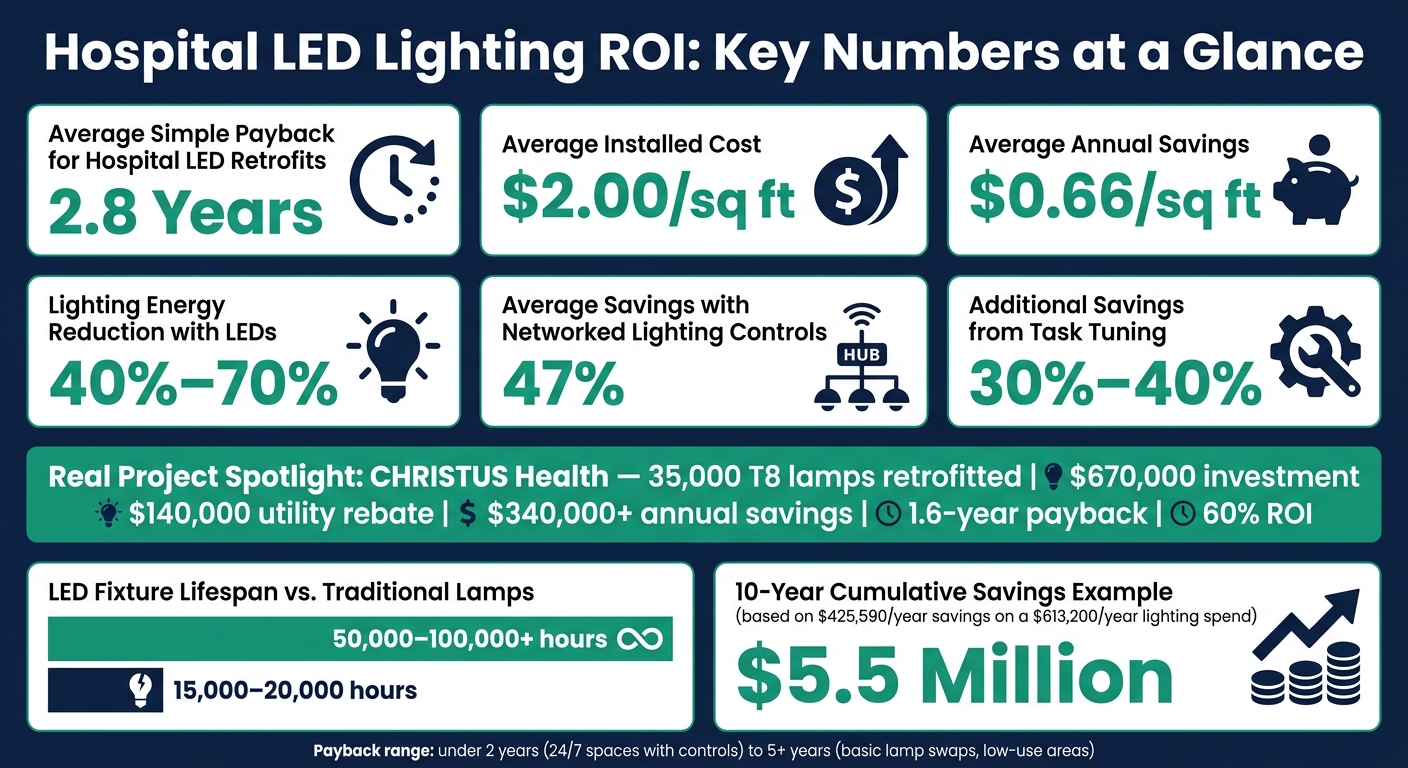
Hospital LED Lighting ROI: Key Numbers at a Glance
The Problem: Why Legacy Lighting Costs Hospitals More
Legacy lighting costs hospitals money in three places: energy use, maintenance, and day-to-day disruption.
Where Hospitals Lose Money With Older Lighting
With 8,760 operating hours per year, older fluorescent, halogen, and metal halide fixtures get expensive fast. They use far more wattage than LEDs and usually don’t offer useful dimming. So lights often stay at full power, even in empty corridors and stairwells [3].
Maintenance is the other big drain. Older lamps burn out more often, ballasts wear down, and teams get stuck in a constant cycle of replacements. In a 20-fixture operating room, annual maintenance and relamping costs can fall from about $4,000 to about $800 after an LED upgrade [1]. Spread that across a full hospital campus, and the cost gap gets hard to ignore.
Then there’s the labor issue. Getting to fixtures in ORs and ICUs isn’t simple. Each lamp change can mean added staff time, tighter scheduling, and more infection-control steps. CBRE Healthcare‘s John Beeck says fewer lamp changes reduce patient disruption and infection-control risk [7]. That kind of friction adds cost and slows payback.
How Lighting Quality Affects Staff, Patients, and Compliance
Older systems often stay at full output even when a space doesn’t need that much light [3]. That’s wasteful, but it also affects how the building works for people inside it.
Dignity Health has linked controllable lighting and embedded sensors to better patient outcomes and staff effectiveness [5]. In plain terms, control isn’t just a nice add-on. If a hospital can’t match light levels to the space and the moment, it loses money and leaves part of the return on the table.
Why ROI Uncertainty Delays Lighting Projects
Many hospitals put off LED projects because they don’t have a clear payback model, a total cost of ownership estimate, or a solid view of rebate options [3]. And that delay isn’t free. Every year a retrofit gets pushed back means another year of high energy bills, surprise maintenance costs, and lost incentive dollars.
Utility incentive programs can cut upfront project costs by a lot, but hospitals can miss those savings when the financial modeling hasn’t been done [3].
Real projects show what this looks like in practice. CHRISTUS Health retrofitted 35,000 T8 linear fluorescent lamps to LED across its facilities and saved more than $340,000 per year on a $670,000 investment. The payback period was less than 1.6 years [7]. That’s why hospitals need a full ROI model before the project goes up for approval.
sbb-itb-034f8e1
The Solution: How LED Retrofits Cut Costs and Improve Performance
LED retrofits address those losses in a pretty direct way: they use less power and need less upkeep.
Energy and Maintenance Savings That Drive ROI
LED retrofits cut hospital costs by lowering energy use and trimming maintenance work. When energy demand drops, payback gets shorter. Maintenance costs also fall because LEDs last much longer. Fixtures offer lifespans of 50,000 to 100,000+ hours, compared with 15,000–20,000 hours for traditional commercial lamps [1] [8].
That gap matters. It means far fewer bulb replacements, fewer service calls, and less labor tied up in routine lighting work. In a hospital, where staff time is already stretched, that can make a big difference. Put simply, lower utility bills plus fewer lamp changes are what drive the project’s payback.
Clinical Lighting Benefits That Support Daily Operations
The upside isn’t only financial. LED fixtures also behave differently in ways that matter on the floor every day.
High color accuracy (CRI) values help with tissue differentiation in operating rooms. They also make it easier for staff to read labels and assess skin tone [1] [9]. LEDs can provide more even light levels across a space as well, which helps reduce eye strain for clinical staff during detail-heavy tasks [1].
Patient areas can benefit too. Tunable white and dimming options let teams adjust patient rooms in ways that support patient sleep [3]. That’s not just a comfort issue. It supports care quality while adding to the retrofit’s long-term return.
How Controls and Automation Affect Payback
Controls push savings further by cutting runtime in spaces that aren’t used all the time. When LEDs are paired with occupancy sensors, daylight harvesting, scheduling, and building automation system integration, energy use can drop even more.
Here’s where the numbers get interesting:
- Networked lighting controls provide an average lighting energy savings of 47% [3].
- Task tuning – capping output at 60% to 70% in spaces that do not need full brightness – can cut energy usage by an additional 30% to 40% [3].
There’s another plus here. Frequent switching does not shorten LED life, so occupancy-based control strategies work without any trade-off on fixture longevity [3]. That makes LEDs a strong fit for low-use rooms, corridors, storage areas, and other spaces where lights don’t need to run at full output all day.
What Hospitals Can Expect: ROI, Payback, and Life-Cycle Value
The Inputs That Shape a Hospital LED ROI Model
Start with the hospital’s own numbers. The model should use facility-specific data, including baseline lighting load, operating hours by space, utility rate, maintenance costs, rebates, and cooling savings. Hospitals paying $0.07/kWh or more often see the strongest returns [7].
It also helps to include installed cost, plus fluorescent disposal and recycling costs.
Those inputs shape the result. In some cases, the savings support a project in under 2 years. In others, payback can stretch to more than 5 years.
Typical Payback Ranges for U.S. Hospitals
Once the model is in place, hospitals can compare their numbers with results from actual projects.
The average simple payback for a hospital LED retrofit is 2.8 years. Installed costs are roughly $2 per square foot, and annual savings average $0.66 per square foot [6]. Basic lamp swaps in mixed-use areas often come in around 4 to 5 years, while full retrofits with controls in 24/7 spaces can drop below 2 years.
Actual projects back that up. CHRISTUS Health completed an interior retrofit of 35,000 T8 LED lamps at a cost of $670,000 before a $140,000 utility rebate. The project generated more than $340,000 in annual savings and delivered a net payback of less than 1.6 years, along with a 60% ROI [7].
Why Total Cost of Ownership Matters More Than Simple Payback
Payback shows when the project earns back its cost. TCO shows what the project is worth over time.
Simple payback answers one question: When do we break even? It does not show the full financial picture. A 10- to 15-year view includes cumulative energy savings, years of avoided lamp and ballast replacements, lower cooling costs, and fewer maintenance calls that interrupt patient care.
That long-range view can change how a project looks. LED lighting with controls can generate multi-million-dollar annual savings in a single facility [3]. For hospital finance teams, that matters because it lines up with capital planning cycles and the way leaders think about equipment life.
A project that seems modest on a simple payback basis can look much stronger when you model 10 years of avoided costs. For example, a hospital spending $613,200 per year on lighting could save $425,590 per year with LEDs and controls, adding up to nearly $5.5 million over 10 years [3].
Implementation Factors and Conclusion: Protecting ROI in Active Healthcare Facilities
Hospital-Specific Design and Installation Factors
Even a project with solid payback on paper can fall apart if the retrofit is planned or installed the wrong way.
In hospitals, lighting upgrades have to meet clinical needs, safety rules, and controls requirements at the same time. If any of that gets missed, ROI takes a direct hit. Operating rooms and exam spaces need fixtures with CRI 90+, emergency circuits must remain functional, and the new system has to work with the existing BAS [1] [4] [10].
Heat matters too. It’s easy to focus on watt savings and forget what happens inside the fixture. A 10°C increase in LED junction temperature can cut fixture lifespan by up to 50%. When fixtures fail early, labor costs go up and payback gets weaker [10].
Then there’s installation phasing. In active clinical spaces, crews need to avoid breaking sterile zones. In more sensitive areas, like surgery suites, hospital maintenance staff may be the better fit for the work [7] [6]. A pilot install in one room or one patient wing before a full rollout can help confirm that the lighting works with clinical workflows and sterile-space rules. It can also cut downtime and help keep services running without disruption [1]. Those extra steps cost money up front, but they help protect the savings model.
Common Mistakes That Reduce Savings
Most lost savings don’t come from the fixtures themselves. They come from planning and commissioning mistakes that could have been avoided.
| Pitfall | Likely Effect on ROI | Practical Mitigation Step |
|---|---|---|
| Poor fixture/driver selection | Flickering, early failure, higher maintenance costs [8] | Specify industrial-grade drivers and premium-rated fixtures with 5–10 year warranties [8] [10] |
| Skipping controls and high-end trim settings | Leaves major energy savings unused | Add occupancy sensors, daylight harvesting, and high-end trim settings from the start [3] |
| Underestimated installation complexity | Labor overruns, unexpected scissor lift costs ($500–$1,500/day), and clinical disruption [8] [10] | Use a design-build delivery model to lock in costs early [4]; pilot one area first [1] |
| Weak commissioning | Controls may fail to integrate with BAS or emergency circuits [1] | Verify BAS and emergency power integration before closeout [1] [4] |
| Wrong phase order | Starting with low-use areas slows payback | Prioritize 24/7 spaces like hallways and emergency departments in the first phase [2] |
Conclusion: Key Takeaways for Hospital Leaders
Hospital payback is often near 2.8 years, but that number depends on execution [6]. Fixture selection, controls integration, phasing, and commissioning all shape whether the job delivers the savings it promised. That’s why a site-specific analysis should come first in any financial model.
The strongest hospital retrofits protect ROI by lining up technical design with day-to-day clinical use. E3 Design-Build Contractor‘s work at Goodall-Witcher Healthcare in Clifton, TX, shows what that looks like in practice: dimmable patient-room lighting, exterior safety lighting, and BAS integration that support both reliability and comfort [4].
FAQs
How do rebates affect hospital LED payback?
Utility rebates can take a big bite out of the upfront cost of LED lighting retrofits. That means a shorter payback period and better ROI for healthcare facilities.
When you include available rebates in total cost of ownership models, the numbers often look a lot better. It shows faster profitability and can make it easier to get funding approved.
In one hospital program, $140,000 in utility rebates cut net payback to less than 1.6 years.
Which hospital areas should be upgraded first?
To get the most from the spend, hospitals should start with spaces that run 24/7/365. That usually means parking garages, large parking lots, and long hallways, where the chance to cut energy use is often highest.
It also makes sense to focus on areas that sit empty much of the time. Restrooms, stairwells, service areas, and mechanical plants are strong candidates for occupancy sensors. And when it comes to lighting upgrades, hospitals are often better off starting with easy-to-reach spaces like waiting rooms before moving into sensitive patient-care or surgical areas.
What can delay LED ROI in clinical spaces?
In clinical spaces, LED ROI can take longer to show up because the upfront cost is often higher. That’s especially true when a facility needs full fixture replacements instead of simple bulb swaps.
Hospitals also have a way of slowing payback. Work has to fit around sterile environment rules and emergency power systems, which can add labor time or create downtime. And if teams choose the wrong areas first – or skip photometric modeling – the project may deliver less efficiency than expected, which pushes savings further out.