
LED lighting costs more upfront but saves money over time. While older systems like Metal Halide or fluorescent bulbs are cheaper to buy, they come with hidden expenses like frequent replacements, high energy use, and costly maintenance (e.g., $500/day for scissor lift rentals). LEDs, on the other hand, last over 100,000 hours, use less energy, and require minimal upkeep, often paying for themselves in 14–22 months.
Key Takeaways:
- LED Upfront Costs: $3–$8 per bulb, plus $50–$150 for installation per unit.
- Traditional Bulbs: $1–$2 per bulb but need frequent replacements and higher energy use.
- Maintenance Savings: LEDs reduce expenses like lift rentals and replacements.
- Energy Efficiency: LEDs save 1 watt of cooling energy for every 3 watts of lighting energy saved.
- Rebates: Up to 30% of LED installation costs can be offset through incentives.
Switching to LEDs is a smart long-term investment that lowers energy bills, reduces maintenance, and improves efficiency, especially for facilities with high ceilings or large lighting needs.
LED Lighting Upfront Costs
LED System Cost Breakdown
When it comes to LED lighting, the upfront costs can be divided into three main areas: LED lamps, fixtures (like housing and industrial-grade drivers), and installation labor. LED bulbs generally range from $3 to $8 per unit, offering quality components designed to avoid issues like flickering or premature burnout. For larger facilities, especially those with high ceilings, installation costs can climb due to additional needs like scissor lift rentals (which can cost $500 or more per day) and the safe disposal of hazardous materials like old bulbs [1].
An important point to consider is the quality of LED drivers. As Evan Carter from Bright LED explains:
A cheap LED might save you money today, but it will fail just like a traditional bulb [1].
Spending more on durable, high-quality components upfront can save you from frequent replacements and added expenses down the line.
Benefits of LED Systems
While the initial costs for LED systems may seem steep, the long-term savings and reduced maintenance make the investment worthwhile. Modern LEDs are built to last, with lifespans exceeding 100,000 hours, and they maintain about 90% of their brightness for up to 50,000 hours. This durability means minimal maintenance for 10–12 years [1]. Plus, most commercial LED systems come with warranties ranging from 5 to 10 years, covering the LEDs, housing, and drivers.
For public entities, rebates of up to 30% on installation costs can ease the financial strain [2]. LEDs also reduce energy use in more ways than one. By emitting less heat, they decrease cooling demands – saving 1 watt of cooling energy for every 3 watts of lighting energy saved. In states like Texas, most commercial LED projects recover their costs within 14 to 22 months [1].
When you factor in these savings, the higher upfront cost of LEDs becomes a smart investment for both the short and long term.
sbb-itb-034f8e1
Traditional Lighting Upfront Costs
Traditional System Cost Breakdown
Traditional lighting options, such as incandescent bulbs, compact fluorescent lamps (CFLs), and Metal Halide (HID) fixtures, are often chosen for their low upfront costs. For example, incandescent bulbs typically cost around $1 to $2 per unit, while CFLs range from $2.40 to $4.00 each [3]. These prices can seem appealing, especially for facilities purchasing in bulk with tight budgets. However, these initial savings are quickly overshadowed by additional expenses, such as maintenance and operational costs.
One of the major hidden costs is the "lift tax." Facilities with high ceilings, like gymnasiums or warehouses, often need scissor lifts to replace bulbs. Renting a scissor lift can cost $500 or more per day [1]. Over five years, a 100-fixture Metal Halide system can accumulate approximately $4,500 in replacement parts (bulbs and ballasts) and $6,000 in labor and lift rental costs [1].
Additionally, fluorescent and HID lamps contain mercury, which requires specialized recycling processes that add to disposal costs [1]. These hidden expenses reveal the inefficiencies that come with traditional lighting systems.
Limitations of Traditional Systems
Traditional lighting is inherently wasteful. For instance, incandescent bulbs convert only 10% of the energy they use into light, with the remaining 90% lost as heat [4]. Similarly, HID bulbs generate significant heat, requiring an extra 1 watt of cooling energy for every 3 watts consumed [1]. The internal temperature of a single HID bulb can reach 1,000°F, essentially turning it into a heat source that forces HVAC systems to work harder.
The lifespan of traditional bulbs is another drawback. Incandescent bulbs last just 1,000 to 1,200 hours, CFLs between 8,000 and 10,000 hours, and Metal Halide lamps 15,000 to 20,000 hours [1][3]. However, Metal Halide lamps lose up to 50% of their brightness after 10,000 hours [1]. This means facilities often pay full energy costs for lights that are only delivering half their original output.
These inefficiencies lead to higher cumulative costs and strain budgets. To reduce maintenance visits, some facilities opt for group re-lamping – replacing all bulbs at once – even if some bulbs are still functional. While this approach minimizes disruptions, it increases waste and fails to address the fundamental inefficiencies of traditional lighting [1].
Direct Cost Comparison
Cost Comparison Table
When you put LED lighting systems next to traditional options, the upfront costs tell an interesting story. Here’s a breakdown of what 100 units might cost across various lighting technologies:
| Bulb Type | Average Bulb Price ($) | Fixture Cost ($) | Installation per Unit ($) | Total for 100 Units ($) |
|---|---|---|---|---|
| LED (A19/T8) | $2 – $15 | $100 – $150 | $50 – $150 | $15,200 – $31,500 |
| Incandescent | $1 – $2 | $30 – $70 | $40 – $100 | $7,100 – $17,200 |
| Fluorescent (T8) | $3 – $8 | $50 – $90 | $50 – $120 | – |
The table highlights that LED systems can cost three to five times more upfront compared to traditional options when installing 100 units. But why is there such a price gap? Let’s dig into the factors driving these costs.
Understanding the Cost Differences
The higher price of LED systems comes down to their advanced design. LEDs rely on intricate components like semiconductors, heat sinks, and precision drivers, which make them more expensive to produce [4]. On the other hand, traditional bulbs like incandescent and fluorescent rely on simpler materials – such as tungsten filaments and basic glass housings – keeping their manufacturing costs relatively low [4].
But here’s the catch: focusing only on the initial price doesn’t tell the whole story. Over its lifetime, just one LED bulb can save between $50 and $100 in energy costs compared to an incandescent bulb [5]. In fact, many businesses in Texas recover their investment in LED lighting within 14 to 22 months [1]. When you factor in energy savings, fewer replacements, and reduced maintenance (like avoiding costly lift rentals and labor), the overall cost of traditional systems can skyrocket over time.
Why You Need to Swap Your Bulbs to LED (Calculate Your $$ Savings)
Factors That Affect Initial Costs
When evaluating the costs of switching to LED systems, it’s not just the base price of the fixtures that matters. Factors like the size of your building and available financial incentives can significantly shape the overall initial investment.
Facility Size and Fixture Quantity
The size of your facility and the number of fixtures required can have a major impact on upfront expenses. For example, a small office might only need about 20 fixtures, while a large warehouse or municipal building could require 200 or more. Multiply the cost of LEDs across hundreds of units, and the initial investment can grow quickly.
For facilities with tall ceilings, like those often found in Texas, installation costs can rise due to what’s sometimes referred to as a "lift tax" – the added expense of using specialized equipment to install fixtures at greater heights [1].
That said, the savings potential in larger facilities is huge. LEDs are particularly effective at reducing peak demand charges, which are common in many Texas commercial electricity plans. These plans often bill based on your highest usage spike. Because LEDs use far less energy, they help lower that peak, translating to additional savings [1].
Available Rebates and Incentives
Financial incentives can significantly cut the upfront costs of LED installations. Programs like the Energy Efficiency Program 2025 offer rebates covering up to 30% of installation costs for commercial buildings [2]. Some utilities even provide "Instant Rebates", where the discount is applied directly to your invoice – no extra paperwork required [6].
On-Bill Financing (OBF) is another useful option. These programs offer interest-free loans ranging from $5,000 to $400,000 (and up to $6 million in special cases) [6]. The loan is repaid through your monthly energy savings, making the upgrade effectively "bill-neutral." Public entities, such as schools and government buildings, often qualify for additional programs that include technical assistance to meet state energy goals [6].
These incentives make it easier to craft cost-effective solutions tailored to the specific needs of your facility.
Custom Solutions from E3 Design-Build Contractor

E3 Design-Build Contractor specializes in creating customized lighting solutions for public entities in Texas. They take a comprehensive approach, evaluating factors like fixture quantity, ceiling height, and the existing electrical setup. Beyond installation, they handle securing rebates and integrating the lighting system with other energy-efficient technologies. This personalized process ensures that both the initial investment and long-term operational costs are optimized, making LED upgrades a smart and strategic choice.
Example: Texas School District Lighting Upgrade
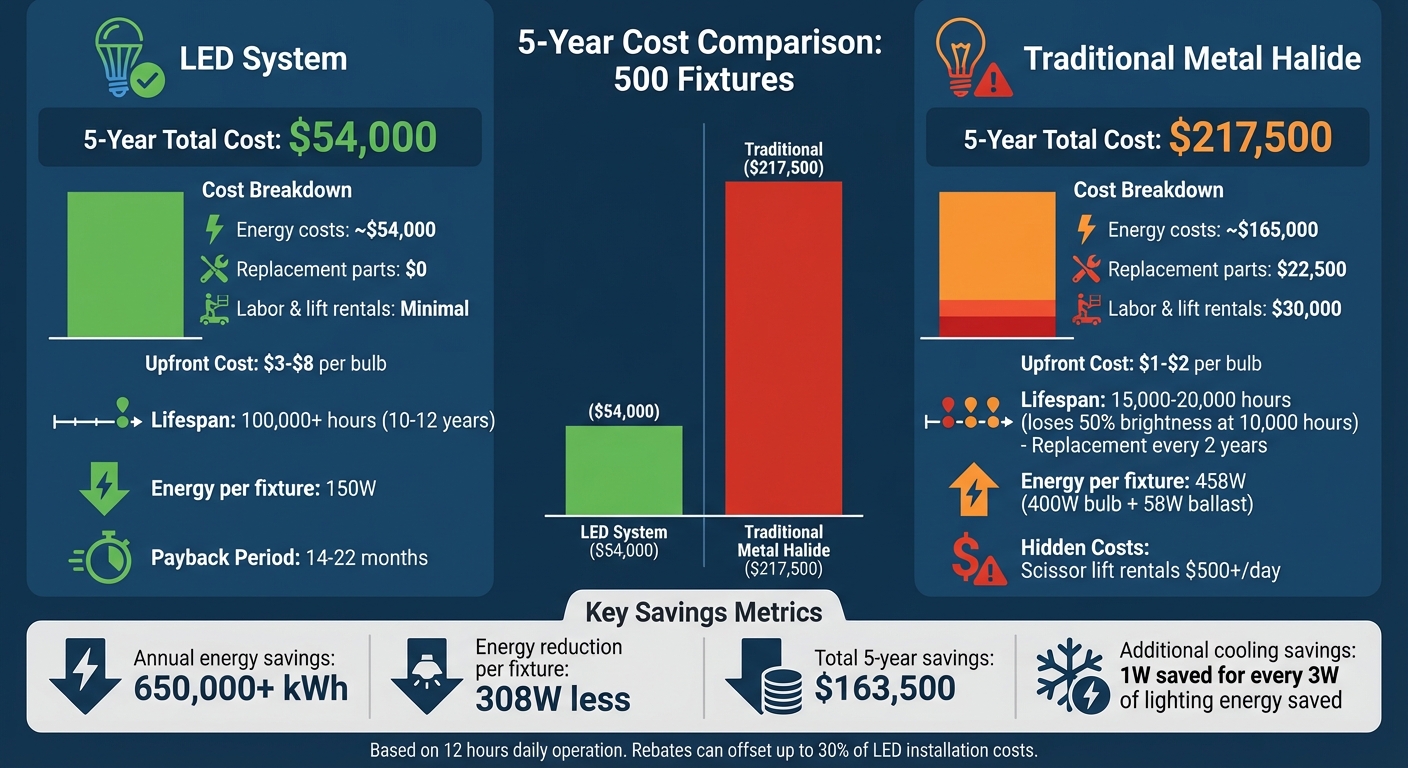
LED vs Traditional Lighting 5-Year Cost Comparison for 500 Fixtures
A Texas school district’s decision to upgrade 500 fixtures highlights how LED systems can dramatically reduce five-year ownership costs compared to traditional metal halide systems.
LED vs. Traditional Cost Totals
For this 500-fixture project, the five-year total cost for traditional metal halide systems is around $217,500. This includes approximately $165,000 for energy, $22,500 for replacement parts, and $30,000 for labor and scissor lift rentals [1]. In contrast, LED systems cost only about $54,000 over the same period, with nearly all expenses tied to energy and minimal costs for maintenance or replacement parts [1].
Although LEDs have a higher upfront cost – typically $3 to $8 per bulb compared to $1 to $2 for traditional bulbs [2] – the long-term savings are undeniable. For facilities with high ceilings, scissor lift rentals alone can exceed $500 per day, adding significantly to the cost of maintaining traditional systems [1]. Additionally, traditional fixtures require replacement every two years, while industrial-grade LEDs can operate for over 100,000 hours, equating to 10–12 years of maintenance-free use [1].
Energy savings further widen the cost gap. A 400W metal halide lamp consumes 458W (including a 58W ballast), while a 150W LED providing comparable brightness uses 308W less per fixture. Over 500 fixtures running 12 hours daily, this translates to annual energy savings of more than 650,000 kWh [1].
How E3 Helps Public Entities
E3 Design-Build Contractor simplifies the transition to LED systems for public entities, ensuring maximum long-term benefits. They work closely with Texas school districts to uncover hidden costs associated with inefficient lighting and reduce demand charges by promoting lower peak energy usage with LEDs [1].
E3 also addresses logistical hurdles that districts might overlook. They handle the eco-friendly disposal of outdated metal halide and fluorescent bulbs, secure rebates that can cover up to 30% of installation costs [2], and provide 5- to 10-year warranties on LED housing, bulbs, and drivers [1]. This comprehensive approach enables districts to break even within 14 to 22 months while significantly cutting ongoing maintenance expenses.
Conclusion
Main Points
LED systems might have a higher initial price tag – ranging from $3 to $8 per bulb compared to $1 to $2 for traditional options [2] – but the upfront cost is just one piece of the puzzle. The bigger picture becomes clear when you assess the Total Cost of Ownership (TCO), which factors in lifetime energy use, maintenance, and operational expenses. For instance, equipment rentals like scissor lifts, often needed for maintenance, can cost over $500 per day [1]. Metal Halide lights, while cheaper initially, lose up to 50% of their brightness after just 10,000 hours but still consume the same amount of energy [1]. This inefficiency leads to mounting hidden costs over time.
In Texas, most commercial LED projects recover their costs in just 14 to 22 months [1]. After this point, facilities can enjoy up to a 75% reduction in lighting-related energy expenses [2]. Plus, for every 3 watts of lighting energy saved, an additional watt of cooling energy is typically conserved [1]. These savings highlight the long-term value of LED systems, especially when factoring in the hidden costs of traditional lighting.
"Utility bills reveal the cost of inefficiency – waiting means extra costs." – Evan Carter, Bright LED TX [1]
Partnering with E3 for Optimal Efficiency
E3 Design-Build Contractor offers more than just a switch to LED fixtures – they help public entities understand the full scope of long-term savings. Their in-depth TCO analyses uncover hidden costs, such as demand charges and HVAC-related benefits, that many overlook. E3 collaborates with Texas school districts, healthcare systems, and municipalities to secure government and utility rebates, which can offset up to 30% of installation costs [2]. By tailoring solutions to each client, E3 ensures both immediate and lasting financial benefits, making the shift to LED systems a smart and strategic investment.
FAQs
What’s the real payback period for LEDs in my building?
The typical payback period for installing LEDs in your building ranges from 1.5 to 3 years, according to industry data. This quick recovery is thanks to a combination of energy savings, lower maintenance costs, and potential utility rebates. The exact timeline can vary depending on factors like the type of lighting being replaced and the specific energy savings achieved. In general, upgrading to LEDs is a smart investment with fast financial returns.
How do high ceilings affect the true cost of traditional lighting?
High ceilings can drive up the cost of traditional lighting systems. To illuminate spaces effectively over longer distances, these setups require fixtures with higher wattage, which means increased energy usage. This is especially true for expansive areas like warehouses, where frequent bulb replacements also add to the expense. Traditional options like metal halide or high-pressure sodium lights tend to lose efficiency in such settings, further inflating both energy and maintenance costs.
Which rebates or financing options can cut my LED upfront cost?
To help reduce the upfront cost of switching to LED lighting, there are several rebate and incentive programs available across the U.S. These include options like instant discounts, custom rebates tied to energy savings, and fixed rebates per fixture. For example, some utilities provide incentives such as up to $150 per fixture or $207 per kilowatt of demand reduction. These programs can make upgrading to LEDs much more budget-friendly by cutting down the initial investment.
Related Blog Posts
- 7 Ways LED Lighting Cuts Energy Costs in Schools
- LED Lighting Savings Calculator
- How Smart LEDs Reduce Energy Costs in Warehouses
- LED Chip Advancements: What Facility Managers Need to Know