
If you run a school building, the lowest first cost is often not the lowest long-term cost. In this comparison, replace-in-kind RTUs cost less up front, but systems like high-efficiency RTUs, VRF/VRV, and ground-source heat pumps can cut energy use by about 40% to 41% and may lower repair costs over time.
Here’s the short version:
- Replace-in-kind RTUs cost the least up front, but usually bring the highest utility costs and limited room control.
- High-efficiency RTUs sit in the middle on price and can save about $25,600 per year in one school example.
- VRF/VRV systems give classroom-by-classroom control, better humidity handling, and about 40% energy savings, but often cost more and may need specialized service.
- Ground-source heat pumps usually have the highest first cost, but they can last about 25 years and post some of the lowest long-term costs.
- Design-build delivery can help districts package HVAC, lighting, controls, and financing into one project and time work around the school calendar.
The article also looks at the numbers districts care about most:
- Upfront installed cost
- Annual energy savings
- Payback period
- Lifecycle cost
- Service life
- Comfort, humidity, and zoning
- Fit for campus layout, staff, and budget
For example, a standard RTU system for a 24,000-square-foot school can cost about $1.23 million with soft costs, while a VRF/DOAS setup may cost more but cut annual energy costs from about $67,433 to $38,857. And when schools look beyond simple payback, system life matters a lot: some RTU and VRF systems are often planned around 15 years, while GSHP systems may run for about 25 years.
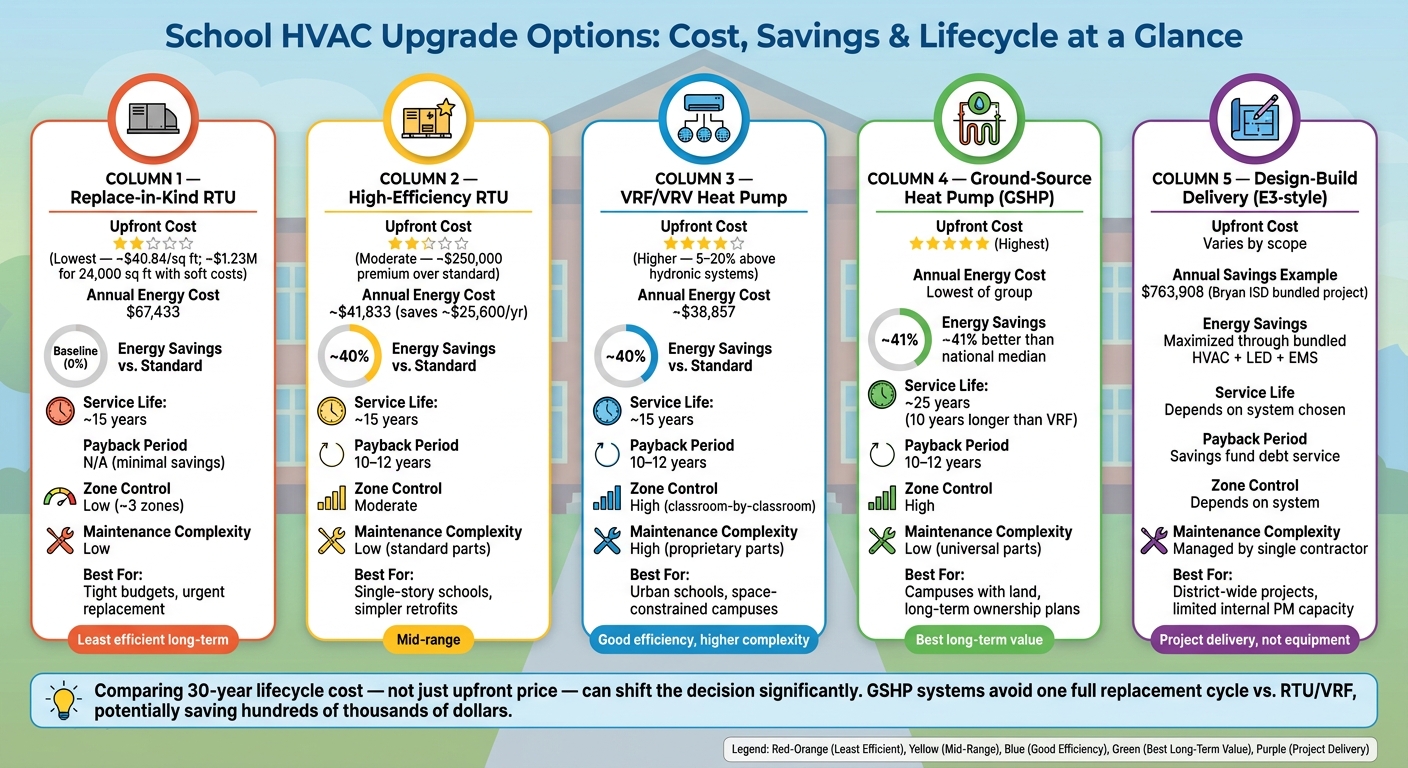
School HVAC Upgrade Options: Cost, Savings & Lifecycle Comparison
BetterBricks Industry Voices: Monument School HVAC Upgrade
sbb-itb-034f8e1
Quick Comparison
| Upgrade Path | Upfront Cost | Energy Use | Expected Life | Main Tradeoff | Best Fit |
|---|---|---|---|---|---|
| Replace-in-Kind RTU | Lowest | Highest of the group | ~15 years | Low first cost, weak long-term savings | Tight budgets, urgent replacement needs |
| High-Efficiency RTU | Mid-range | About 40% lower than standard RTU in one case | ~15 years | Better savings without a full system change | Single-story schools, simpler retrofits |
| VRF/VRV | Higher | About 40% lower | ~15 years | Better zone control, higher service complexity | Schools that want room-by-room control |
| Ground-Source Heat Pump | Highest | About 41% better than national median for similar schools | ~25 years | High first cost, lower long-term cost | Campuses with land and a long ownership plan |
| Design-Build Delivery | Varies by scope | Can improve total project savings | Depends on system chosen | One team handles design, install, and funding support | District-wide projects with tight schedules |
Bottom line: if you only compare first cost, replace-in-kind may win. If you compare 30-year cost, energy use, repairs, and classroom comfort, high-efficiency RTUs, VRF/VRV, or GSHP may come out ahead depending on your campus and budget.
1. Replace-in-Kind Legacy System
A replace-in-kind upgrade means swapping old equipment for similar new units. Districts usually go this route when keeping the building running the same way matters more than cutting energy use.
Upfront Cost
Installed cost for standard packaged RTUs is about $40.84 per square foot. For a 24,000-square-foot school, that comes to about $980,000 before soft costs and about $1.23 million with a 25% soft-cost factor.[2][4]
That first price tag is lower than an advanced VRF/DOAS setup, which runs about $53.01 per square foot.[4] But a lower first cost doesn’t always mean the cheaper option over time.
Annual Operating Savings
Savings on utility bills are limited here because the new system performs a lot like the old one. A standard RTU system for a 24,000-square-foot school has an annual energy cost of about $67,433. A high-efficiency VRF/DOAS system comes in at about $38,857.[4]
So the math is pretty simple: if energy use stays close to the legacy setup, the payback story leans less on lower utility bills and more on avoided repair work. That gap is a big reason replace-in-kind projects and higher-efficiency upgrades land in different places on payback.
Payback and Lifecycle Value
The main upside is steady service, not energy payback. Midland Independent School District (Midland ISD) ran a four-phase, $32 million HVAC refresh across 25 campuses between 2022 and 2024, replacing 12 chillers, 40 RTUs, and 23 boilers. The district saw a substantial decrease in maintenance requirements and a significant reduction in comfort calls from staff.[3]
Comfort and Campus Fit
Standard RTUs usually divide a small school into about three zones.[4] That can make classroom-level control tough. When fewer zones cover more space, it gets harder to keep room temperatures steady from one classroom to the next.
That zoning limit is one of the main pain points higher-efficiency rooftop units try to fix.
2. High-Efficiency Rooftop Units
High-efficiency RTUs build on the zoning limits of standard RTUs, but they do a better job with control and utility use. For schools, that makes them a solid middle-ground option: better control, lower energy use, and no need for a full system redo. In many projects, the first step isn’t swapping equipment right away. It starts with demand-control ventilation and load reduction, then moves to replacement.
Upfront Cost
A high-efficiency HVAC system with an optimized design can add about $250,000 to a Dallas elementary school project.[5] That higher first cost is the tradeoff. You pay more up front, but operating costs can drop over time.
Public schools may also be able to trim some of that added cost through direct payments and rebates tied to the 2022 Inflation Reduction Act (IRA) for energy-efficiency installations.[5]
Annual Operating Savings
In the same case study, annual energy savings were estimated at $25,600, or about 40%.[5] For a school district, that can mean more room in the M&O budget for staffing, repairs, and day-to-day building needs.
Payback and Lifecycle Value
Over a full budget cycle, the main issue is simple: do the savings cover the added cost before the unit needs to be replaced?
In Texas, payback usually falls in the 10 to 12 year range, helped by electricity rates that are about 30% below the national average.[5] That timing matters because many DX rooftop units last about 15 years, so schools should plan for replacement around year 15.[6]
Comfort and Campus Fit
High-efficiency RTUs work well for schools that want a simpler upgrade path. They use standard parts, which makes service easier for local technicians. Their simpler controls can also cut down on override risk and wasted energy.[6]
3. VRF/VRV Heat Pump Systems
When schools need tighter room-by-room control than rooftop units can offer, VRF/VRV is usually the next step up. Each classroom gets its own temperature control, which can cut noise, improve comfort, and work well in humid areas.[2]
That matters more than it may seem at first glance. In a school, one room may be full of students after lunch while another sits half empty during planning period. A one-size-fits-all setup often struggles with that. VRF/VRV handles those swings much better, especially in hot, humid climates where dehumidification has to stay on point.[2]
Upfront Cost
VRF/VRV systems cost more upfront. But there’s a tradeoff: they can remove the need for on-campus gas piping and combustion equipment.
So the higher first cost tends to make sense only when a district puts a lot of weight on better comfort control and lower operating costs over time.
Annual Operating Savings
These systems can cut annual energy use by about 40% and lower maintenance and operating costs.[5]
For district teams, that’s the big draw. You pay more at the start, but the system may chip away at utility and service costs year after year.
Payback and Lifecycle Value
Payback usually lands in the 10- to 12-year range, which matters a lot in buildings expected to last 50 to 100 years.[5]
That’s why the main question isn’t just, “What does it cost now?” It’s whether the payback lines up with the school’s planned life, budget, and campus goals.
Comfort and Campus Fit
VRF/VRV is a strong match for campuses that want classroom-by-classroom control and better humidity management.[2]
In plain terms, if a district wants quieter classrooms, tighter temperature control, and better moisture control, this option deserves a close look.
4. Ground-Source Heat Pump Systems
For districts planning for the long haul, GSHPs change the conversation. Instead of focusing only on first cost, they push teams to look at total cost over time. Ground-source heat pump (GSHP) systems can deliver one of the lowest 30-year lifecycle costs because they use less energy and tend to last longer.[6]
Upfront Cost
GSHPs usually cost more at the start. But in all-electric projects, part of that added cost can be offset by removing gas piping and combustion equipment from the plan.[5]
Annual Operating Savings
This is where GSHPs start to make their case. In schools, they have shown strong energy performance, cutting utility use by about 41% below the national median for elementary and middle schools.[6]
Payback and Lifecycle Value
Yes, payback matters. But with GSHPs, service life often matters more.
Typical payback periods fall in the 10 to 12 year range.[5] The bigger story is how long the system can keep going. GSHP systems are expected to operate for about 25 years, which is roughly 10 years longer than VRF systems. VRF systems are often replaced at the 15-year mark.[6]
"The replacement cost allocation also acknowledged that the tested hydronic systems operate effectively for approximately 25 years, as opposed to the 15-year replacement estimation for VRF systems." – Kyle DelPiano, Market Development Manager, Xylem [6]
That longer service life is why a 25- to 30-year lifecycle cost analysis gives a much better picture than upfront cost alone. If a district can avoid one full replacement cycle, the long-term project value can shift in a big way.[6]
Comfort and Campus Fit
Energy use is only part of the story. Serviceability also shapes long-term value. Because these systems use standard components, any qualified HVAC technician can usually service them. That can lower long-term maintenance risk for the campus.[6]
5. E3 Design-Build Contractor

After districts compare equipment options, they still have to answer a tougher question: Who’s going to put the whole project together and get it done? That means packaging the work, lining up financing, and finishing installation on a school-friendly schedule. E3 Design-Build Contractor serves as a design-build partner for school HVAC upgrades, covering both the engineering analysis and the installation. That setup helps when a district wants one team to estimate savings, line up funding, and keep the project moving during a tight school calendar.
Upfront Cost
E3 prepares Utility Assessment Reports (UARs) that show utility use and projected savings. Those reports can help districts qualify for funding programs such as SECO LoanSTAR. In Bryan ISD, the UAR helped the district secure a 2% fixed-rate loan for a $6,421,852 district-wide energy efficiency project[7].
Annual Operating Savings
E3 pairs HVAC upgrades with LED lighting, building automation, and indoor air quality work to push annual savings higher. In Bryan ISD, the district projected $763,908 in annual savings from bundled LED, EMS, and ventilation upgrades[7]. Lake Worth ISD projected $207,246 in annual savings from HVAC, lighting, roof, and EMS work[8].
Payback and Lifecycle Value
Energy savings are only part of the story. The financing setup often decides whether a project works on paper and in practice. E3 uses projected savings to help support debt service[7]. In Lake Worth ISD, annual savings funded repayment of a Maintenance Tax Note, which let the district preserve its Fund Balance for other priorities[8].
At that point, the big issue is pretty simple: can the savings cover the financing costs?
Comfort and Campus Fit
In schools, timing matters just as much as equipment performance. Retrofit windows are tight because classes, testing, and campus operations don’t stop. E3 schedules most mechanical work during summer break to avoid class disruption, then carries any remaining phases into the fall semester when needed[8]. In Bryan ISD, E3 completed work in occupied schools without disrupting classes[7].
Cost, Savings, and Long-Term Value: A Side-by-Side Look
Simple payback is a good place to start. You take the added upfront cost and divide it by the yearly savings. But that only gives you part of the picture. LCCA goes further by factoring in replacement, maintenance, and operating costs across the life of the equipment, along with classroom comfort and day-to-day campus operations [1].
A simple LCCA formula is: LCC = IC + RepC + OC + MRC, where IC is the investment cost, RepC is the planned replacement cost, OC is operating cost (adjusted to present value), and MRC is annual maintenance and repair cost [1].
For most school leaders, the main tradeoffs come down to four things: first cost, energy use, service demands, and expected life. That’s why equipment life can swing the math so much. A system that costs more upfront may still make more sense if it lasts longer, uses less energy, or needs less service over time.
| Upgrade Path | Life Expectancy | Energy Performance | Maintenance Complexity | Upfront Cost Trend |
|---|---|---|---|---|
| Replace-in-Kind (Legacy RTU) [6] | ~15 years | Baseline | Low to moderate | Lowest |
| High-Efficiency Rooftop Units [5] | ~15 years | ~40% savings vs. standard RTU | Low; standard parts | Moderate; higher than replace-in-kind |
| VRF/VRV Heat Pump [6] | ~15 years | Varies | High; proprietary service | 5%–20% higher than hydronic systems [6] |
| Ground-Source Heat Pump [6] | ~25 years | 41% better than the national median for elementary and middle schools [6] | Low; universal parts | Higher initial investment [6] |
Funding is a big part of the decision too. Public districts often layer capital budgets, federal funds, and energy savings to help pay for projects without raising taxes. Midland ISD is a clear example: it used $10 million in federal ESSER funds and $5 million from its general budget to support a $15 million HVAC capital replacement program across 25 schools, covering 12 chillers, 40 rooftop units, 23 boilers, and 25 pumps, while also upgrading to MERV 13 filtration and new building automation controls district-wide [9]. In plain terms, lower energy and service costs can help cover debt payments or ease strain on the operating budget.
Pros and Cons by Upgrade Path
Each path swaps a lower first cost for a different mix of savings, service needs, and comfort. The goal here is simple: match the upgrade to your district’s budget, staff capacity, climate, and expected building life. The table below turns those tradeoffs into a quick selection guide.
One point matters more than it may seem: pick systems your maintenance team can run with confidence. If training is weak and overrides happen all the time, a lot of the expected efficiency can disappear.
VRF/VRV works well when zoning is tight and building space is limited. GSHP makes more sense for long-range projects with open land and a much larger capital budget.
High-efficiency rooftop units sit in the middle. They’re often a practical option for single-story campuses that don’t have much mechanical room space.
Project delivery can also change how much savings a district actually sees. Why? Because schedule and coordination shape the end result. Design-build tends to work best when a district wants one bundled scope, a summer installation window, and one team handling cost, schedule, and performance.
Use this summary to line up each path with district priorities.
| Upgrade Path | Major Advantages | Major Drawbacks | Best Fit |
|---|---|---|---|
| Replace-in-Kind (Legacy) | Lowest upfront cost; familiar to existing staff | High energy and maintenance costs; shortest lifespan | Districts with extreme budget constraints and no long-term capital plan |
| High-Efficiency RTU | Improved efficiency over legacy; standard installation | Limited lifecycle compared with hydronic systems; roof-load requirements | Small districts or single-story buildings with limited mechanical room space |
| VRF/VRV Heat Pumps | Individual zone control; no large mechanical rooms needed | 5%–20% higher upfront cost than hydronic systems; 15-year life; proprietary parts; performance depends on installation quality [6] | Urban districts with severe space constraints for piping/ductwork |
| Ground-Source Heat Pump (GSHP) | Highest energy savings (41% better than the national median for elementary and middle schools); 25-year life [6] | Very high upfront cost; requires significant land for well fields | Districts with available land and a 25+ year occupancy horizon |
| Design-Build Delivery | Integrated energy modeling; bundled HVAC, LED, and EMS; summer-timed delivery minimizes disruption [8] | Requires a high level of initial coordination and district-wide commitment | Districts needing comprehensive infrastructure renewal with limited internal project management capacity |
Conclusion
No single HVAC path fits every district. The right move depends on upfront cost, energy savings, repair burden, service needs, and campus constraints. So the first step is pretty simple: start with the campuses where energy waste, repair issues, and comfort complaints are hitting hardest.
Focus first on the buildings with the most waste, the most maintenance trouble, or the most comfort problems. Then compare HVAC options using lifecycle cost, not payback alone. Payback can help, sure, but it doesn’t tell the whole story. Districts need to look at lifecycle cost and campus fit side by side.
The best upgrade balances payback, lifecycle cost, utility use, comfort, and the district’s ability to maintain the system. In plain terms, the best choice is the one that cuts total cost while improving comfort and dependability over the building’s remaining life.
FAQs
How should we compare payback vs. lifecycle cost?
Payback and lifecycle cost make the most sense when you use them together.
Payback is the quick check. You take the installation cost and divide it by the yearly energy savings plus operations and maintenance savings. That gives you a simple estimate of how long it may take to earn that money back.
But payback only tells part of the story. It doesn’t show long-term value.
That’s where lifecycle cost comes in. It looks at the total costs and benefits across the system’s full life, not just the first few years. This can make a strong case for higher-performance upgrades, especially when those upgrades cut maintenance, improve indoor air quality, and deliver steady utility savings over time.
Which HVAC system is best for our campus layout?
The best HVAC system depends on your campus layout, existing infrastructure, budget, and long-term goals. There’s no one-size-fits-all answer.
The smart way to compare options is with a lifecycle cost analysis. That means looking beyond the purchase price and weighing energy use, maintenance, and equipment lifespan too.
For example, geothermal heat pumps may lead to lower costs over time. Hydronic systems, on the other hand, often come with lower upfront costs and give midsize and large facilities more flexibility.
What funding or rebates can help lower project costs?
School leaders can cut upfront HVAC costs with utility rebates, which is why it pays to look at those options early in the planning process.
Some districts also look at financing models like power purchase agreements, on-utility bill financing, and revolving loan funds. Over time, energy savings can be put back into future infrastructure projects, sometimes with little to no net cost for the district.