
If I had to sum this up in one line: schools usually get the most long-term savings from owning solar, but PPAs and leases are often the easiest way to start with little or no upfront cost.
U.S. public schools spend about $8 billion a year on energy, so the financing choice can shape school budgets for years. In this guide, I’d boil the decision down to four questions: Who owns the system? Who pays upfront? Which budget covers it? Who takes the risk?
Here’s the short version:
- Cash purchase: highest upfront cost, full ownership, full savings
- Bond financing: school owns the system, but pays over time
- Loans / green-bank financing / TELPs: school owns, payments often come from the operating budget
- PPA: no upfront cost, developer owns the system, school buys the power
- Solar lease: no or low upfront cost, fixed payments, third-party ownership in most cases
- Roof/site lease: school leases space to a developer and gets rent instead of power value
- Grants and IRA Direct Pay: these reduce cost, but they are not a stand-alone financing method
One number matters right away: under current IRA rules, tax-exempt schools may get 30% or more of project cost back through Direct Pay, but owner-financed projects usually get the most from that setup.
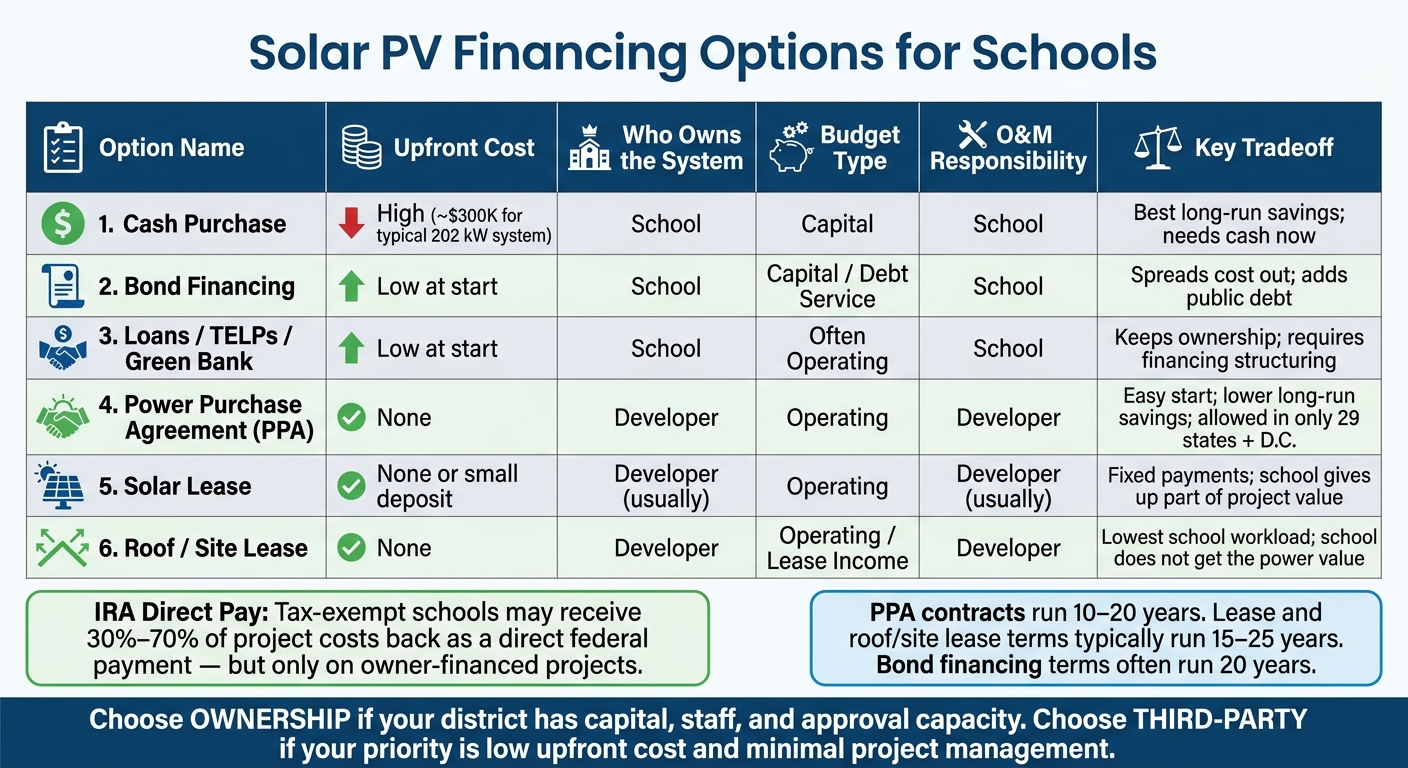
Solar PV Financing Options for Schools: Side-by-Side Comparison
Third-Party Financing of Solar on College and University Campuses
sbb-itb-034f8e1
Quick Comparison
| Option | Upfront Cost | Owner | Budget Type | O&M | Main Tradeoff |
|---|---|---|---|---|---|
| Cash purchase | High | School | Capital | School | Best long-run savings, but needs cash now |
| Bond financing | Low at start | School | Capital/debt service | School | Spreads cost out, but adds debt |
| Loans / TELPs / green bank | Low at start | School | Often operating | School | Keeps ownership, but needs financing work |
| PPA | Very low | Developer | Operating | Developer | Easy start, but lower long-run savings |
| Solar lease | Very low | Developer in most cases | Operating | Developer in most cases | Fixed payments, but school gives up part of project value |
| Roof/site lease | Very low | Developer | Operating / lease income | Developer | Lowest school workload, but school does not get the power value |
If I were reading this to make a decision fast, I’d use this rule: pick ownership if your district can handle the money, staff time, and approval steps; pick third-party financing if your main goal is low upfront cost and less project work.
1. Direct Cash Purchase
A direct cash purchase means the school pays the full cost upfront. For a typical 202 kW school solar project, that’s about $300,000, or around $1.50 per watt [9]. For a lot of districts, that price tag is the sticking point.
This is the simplest ownership setup: the district pays, the district owns the system, and the district keeps the savings. The big issue is pretty simple – can the school handle the upfront cost and wait for the payoff?
Upfront Cost
The upfront price is steep, but the Inflation Reduction Act (IRA) changes the picture in a big way. Under the IRA’s Direct Pay provision, tax-exempt schools can get a direct federal payment worth 30% to 70% of project costs [9][10]. On a $300,000 project, that comes out to about $90,000 back.
Even with Direct Pay, the school still keeps full ownership and control of the system.
"Buying solar arrays outright can cost schools upward of hundreds of thousands of dollars, a steep price most can’t afford." – Akielly Hu, Canary Media [7]
Ownership and O&M
With this model, the school owns the solar system from day one. It also keeps all the electricity the system produces, along with any renewable energy credits tied to it [11]. The district holds the equipment warranties directly too, and those often run for 25 years [3].
The catch? Operations and maintenance sit fully with the district. In practice, many schools hire a third-party provider to handle that work [11].
Budget Treatment and Term
Cash purchases usually come from capital budgets or reserve funds, not day-to-day operating budgets [7][2]. They also tend to need approval from district leadership and the school board [4].
There’s another detail here. Schools aiming for the top credit rate must meet Safe Harbor timing rules before the construction deadline [4]. So this path tends to fit districts that already have unused capital funds and enough room in their approval process to move the project along.
Long-Term Savings and Risk
A direct purchase usually leads to the most savings over the life of the project because the school avoids interest costs and developer markup [1][2]. Many systems reach payback in about 12 years, which can leave roughly 13 years of low-cost electricity within a 25-year system life [9].
The main risk is meeting federal sourcing rules [4]. Still, for districts that can cover the upfront cost, this option often delivers the strongest lifetime value.
When cash isn’t workable, many districts look at bond-financed ownership next.
2. Bond-Financed Ownership
When a district can’t pay cash for a solar project, bond financing offers another path to ownership. The district issues bonds to cover the upfront cost, then pays that debt back over time with energy bill savings [11]. So instead of draining reserves on day one, the district spreads the cost out over years.
Upfront Cost
The bond covers the full upfront cost, which means the district doesn’t need to tap its reserves. Municipal bonds also tend to come with lower interest rates because investors are willing to accept tax-exempt government debt [2]. On top of that, Direct Pay can help shrink the bond balance faster [3].
Ownership and O&M
With this setup, the district owns the system and is responsible for O&M, often through a service contract [11][3].
Bond issuance isn’t cheap, though. Transaction costs can be high, so many districts fold solar into a larger capital package. That might include roof replacements, HVAC upgrades, or both. The idea is simple: if you’re going to the bond market, it often makes sense to finance several building projects at the same time to get more from the effort [2][3].
Budget Treatment and Term
Debt service is often set up to mirror what the district used to pay the utility. In plain English, the dollars that once went out as monthly power bills are redirected to pay back the bond instead [6]. Terms often run 20 years [6].
The type of bond matters too:
- General Obligation (GO) bonds are backed by the district’s taxing authority. They usually have lower interest rates, but they often require a public referendum.
- Revenue bonds don’t need voter approval, but they usually come with higher interest rates [2].
Long-Term Savings and Risk
Bond-financed ownership can lead to strong lifetime savings because the district keeps the incentives and the bill savings. The flip side is that the district also takes on the debt and the system’s performance risk [6].
If a district wants to own the system but doesn’t want to issue bonds, low-interest loans and green-bank financing are the next option.
3. Low-Interest Loans and Green-Bank Financing
For districts that want to own their solar system but can’t pay the full cost all at once, low-interest loans and green-bank financing offer a solid middle ground. The basic idea is simple: the school pays for the project over time, and the repayment is supported by energy savings. Green banks and state finance authorities can also help districts get access to capital when private debt is hard to secure [1]. The big issue comes down to timing. Can the district get the money now and wait for the reimbursement later?
Upfront Cost
The loan covers the upfront project cost. Then, once the system is placed in service, Elective Pay can return 30% or more of that cost [7][8]. If there’s a delay between project completion and reimbursement, bridge financing can fill that gap.
Ownership and O&M
Under this setup, the district owns the system and keeps the energy savings. That’s the upside.
The tradeoff is that the district also takes on operations and maintenance. To reduce performance risk, many districts combine the loan with an ESPC. In that model, an ESCO guarantees savings, which gives the district more certainty about project results [2].
Budget Treatment and Term
TELPs can make this route easier to approve while still letting the district keep ownership. A Tax-Exempt Lease Purchase (TELP), sometimes called a municipal lease, often isn’t treated as long-term debt. That can remove a lot of friction.
Payments usually come from the operating budget instead of the capital budget, so many districts may be able to move ahead without a public referendum [2][6]. TELPs can also package solar together with other building upgrades and repay the full project through guaranteed energy savings over a 20-year term.
Long-Term Savings and Risk
Once the financing is paid off, the district owns the system outright and keeps all future savings. That’s the main draw here: after the repayment period, the value stays with the school.
The main risks are underperformance and sourcing compliance. Equipment must meet Prohibited Foreign Entity (PFE) rules, or the district could put federal tax credit eligibility at risk [4][12]. Districts that don’t want to take on direct ownership usually look next at third-party structures.
4. Power Purchase Agreement (PPA)
For districts that want to go solar without taking on debt, a PPA puts the financing and project risk on the developer. The school doesn’t buy the system. Instead, a third-party developer pays for it, builds it, owns it, and maintains it. The school then buys the electricity the system produces at a set rate, which is often lower than the local utility’s retail rate [3].
Upfront Cost
PPAs usually come with no upfront cost. The developer covers construction and gets paid back in part through federal tax benefits that schools can’t use on their own.
Ownership and O&M
The developer owns the system for the entire contract term and takes care of operations and maintenance. That setup matters. If the system isn’t producing power, the developer isn’t earning, so it has a clear reason to keep things running well.
Budget Treatment and Term
PPA payments are treated as an operating expense. Most agreements run 10 to 20 years [15].
Long-Term Savings and Risk
A PPA can cut costs right away, which is a big draw for many districts. But over the long run, savings are usually lower than with direct ownership because the developer keeps the tax benefits and the system’s asset value. There’s also a legal catch: PPAs are allowed in only 29 states and Washington, D.C. [7]
5. Solar Lease
If a district wants third-party ownership and also wants steady, easy-to-plan payments, a lease is often the next step. With a solar lease, a third party pays for the system, but the school pays a fixed monthly amount instead of a per-kWh charge.
Upfront Cost
Solar leases usually need no upfront payment or just a small deposit [14].
Ownership and O&M
In a standard lease, the developer pays for, owns, and maintains the system. In a municipal lease, the district takes title when the agreement is signed, which can move maintenance responsibility to the district [2][3].
Budget Treatment and Term
Lease payments are usually made from operating budgets instead of capital budgets, and they often aren’t treated as long-term debt [2]. Most true leases also come with a buyout option at the end of the term [11].
Long-Term Savings and Risk
Leases can be cash-flow positive from day one. That said, long-term savings are often lower than with direct ownership because the lessor keeps the tax benefits, even though part of that value may be passed through in lower payments [11][14].
If the district would rather make money from its roof or site space than buy the system, the next option is a roof and site lease.
6. Roof and Site Lease
A roof or site lease lets a school district rent out roof or ground space to a developer that pays for, owns, and maintains the solar system [14]. It’s a good fit for districts that want solar without using capital funds or taking on ownership of the system.
Upfront Cost
These deals usually come with little or no upfront cost for the district [14][13]. The developer pays for the installation.
Ownership and O&M
The developer owns the system and takes care of all operations and maintenance for the full agreement term [14][13]. That matters because schools can’t use the federal Investment Tax Credit on their own, so the developer uses that tax credit to help the project pencil out [13].
Budget Treatment and Term
Most agreements run for 20 to 25 years [13]. Since the developer takes on the cost and maintenance risk, the district sidesteps the work and obligations that come with owning the system.
Long-Term Savings and Risk
The tradeoff is pretty simple: the district gives up direct ownership during the lease term, but it also avoids the technical and financial work of running the system. When the term ends, the district can:
- extend the agreement
- buy the system
- have the system removed [13]
Next, compare these financing paths with grants and incentives that can improve any of them.
7. Grants and Incentives as Overlays
Grants and incentives are not separate financing paths. They work more like a layer on top of the main deal, lowering the net cost of a project across different funding setups. But there’s a catch: only owner-financed projects can collect the full federal payment directly. So the main issue isn’t just whether incentives exist. It’s which financing setup can actually use them.
Upfront Cost
The Inflation Reduction Act’s Elective Pay, also called Direct Pay, allows tax-exempt schools to receive federal solar tax credits as cash after the project is placed in service [7][10]. For schools that own their systems, that can cut the net project cost in a big way. Some projects may also qualify for bonus credits, which can add even more value [7][10][12].
Ownership and O&M
If a third party owns the system, that third party claims the credits and may pass along part of that value through lower rates [7][10]. Schools that want to keep the full incentive value need to own the system themselves – and take on the O&M work that comes with ownership [7].
That’s the tradeoff. Keep the full incentive, or hand off system duties and share the financial upside.
Budget Treatment and Term
Two timing rules matter here.
- Solar projects must be placed in service by December 31, 2027, to qualify for the Section 48E Clean Electricity Investment Credit [12].
- Schools must also pre-register with the IRS before filing for Elective Pay [12].
PFE rules now affect sourcing, financing, and licensing, so schools need tax and legal review before they file [12].
Long-Term Savings and Risk
Schools can stack incentives by combining IRA Direct Pay with state-level grants, which can lower net project costs even more [7]. That sounds great on paper. In practice, the compliance work can get messy.
Under Section 48E, Prohibited Foreign Entity (PFE) rules require schools to confirm that no funds or project control flow to countries of national concern. That review can touch hardware sourcing, debt issuances, and licensing agreements [12]. In plain English, this isn’t something to sort out at the last minute. Bring in tax and legal counsel early to help protect eligibility.
Side-by-Side Analysis by Decision Factors
After looking at each option on its own, it helps to see how these paths differ in day-to-day terms. This section boils the tradeoffs down to the decision factors that usually matter most.
Upfront Cost and Funding Access
Direct ownership comes with the biggest upfront price tag. But it also offers the strongest long-term return. Bond financing spreads that cost over time. General Obligation bonds usually need voter approval, while revenue bonds are repaid through set project revenue or savings and often don’t need a referendum [2].
PPAs and solar leases usually don’t require upfront capital. Roof and site leases also don’t require capital. Low-interest loans and green-bank financing sit somewhere in the middle. The district still owns the system, pays over time, and keeps the project’s long-term value.
Put simply, funding access shapes what a district can do first. Ownership then decides who handles the work.
Ownership and Operations Responsibility
With an owned system, the district handles O&M, performance tracking, and warranty management. In third-party setups, the developer takes on those jobs.
Under a PPA, the school buys power. Under a solar lease, it pays a set lease fee. Under a roof or site lease, it collects rent.
That split in ownership doesn’t just affect workload. It also affects how the deal shows up in the budget.
Budget Treatment and Contract Term
Cash purchases and bond-financed projects are capital expenditures (CapEx). PPAs, leases, and roof/site leases are usually treated as operating expenditures (OpEx). That can make a big difference for districts that want to cover energy costs through existing utility budgets.
PPA and lease terms often last 15 to 25 years [3][7]. For districts with limited debt capacity, that setup can be a good fit.
Long-Term Savings and Risk
The basic tradeoff is pretty clear: ownership brings more control and more savings, while third-party setups lower risk and remove much of the upfront cost.
| Criterion | Strongest Fit |
|---|---|
| Strongest lifetime savings | Direct cash purchase, bond financing |
| Lowest upfront cost | PPA, solar lease, roof/site lease |
| Highest administrative burden | Direct cash purchase, bond financing |
| Best for limited debt capacity | PPA, solar lease |
Direct ownership delivers the highest lifetime value because the school keeps all energy savings and federal incentive value [3]. Third-party models reduce total savings because the developer keeps part of the project value in exchange for taking on the capital and production risk. Roof and site leases usually bring the lowest financial return, since the school earns lease income while the developer keeps the energy value.
Pros and Cons of Each Financing Path
Below are the main tradeoffs for each financing path. The goal is simple: match the financing setup to the district’s access to capital, debt room, and need for control.
Direct Cash Purchase
This path delivers the lowest long-term cost and gives the district full control over the system. The catch is pretty clear: it demands the most cash upfront, and the district takes on full O&M responsibility from day one.
Bond-Financed Ownership
Bond financing spreads project costs over time, which helps protect cash reserves. The tradeoff is added public debt, plus the chance of referendum risk in some cases, especially with General Obligation bonds [2].
Low-Interest Loans and Green-Bank Financing
This option lets the district own the system without making a large upfront payment. It can also open the door to favorable public-finance terms. The downside is that it usually takes more structuring and due diligence than a cash purchase or bond financing [1].
If a district wants no upfront cost and no ownership, third-party models move both the cost burden and day-to-day operations away from the school.
Power Purchase Agreement (PPA)
A PPA means no upfront cost, the developer handles O&M, and savings can start right away. The tradeoff is that the district does not own the system, cannot claim incentives directly, and must commit to a long contract [7].
Solar Lease
A solar lease gives the district fixed payments and may include a lease-to-own option at the end of the term. The downside is straightforward: the district pays the same amount even in years when production comes in low [2][11].
Roof and Site Lease
With a roof or site lease, the district does not need capital and does not take on O&M work. The tradeoff is that the district receives lease income while the developer keeps the energy value [14][13].
Treat grants and incentives as cost reducers, not as a financing path on their own.
Grants and Incentives as Overlays
Grants and incentives lower net project cost and can stack with other financing setups. The tradeoff is that grant funding is often competitive and comes with a lot of paperwork [2].
Conclusion
There’s no one-size-fits-all financing path for every school district. The best option comes down to a few plain factors: access to capital, available debt room, staff capacity, and how much risk the district is willing to take on.
If you compare these options through the lens of ownership, cost, and control, direct ownership usually delivers the best long-term value. That includes a cash purchase, bond financing, or a low-interest loan. With the Inflation Reduction Act’s Direct Pay, tax-exempt schools may get back 30% or more of total project cost [12][7]. Other incentives may push net cost down even more [5][1].
That said, PPAs and lease structures still make sense for many districts. If upfront capital is tight, or the district doesn’t have the staff to operate and maintain the system, those paths can be the most practical fit. They can also produce real savings while limiting financial exposure.
Before picking a structure, districts should look closely at:
- how the budget is set up
- debt capacity
- procurement rules
- O&M capacity
- whether solar is part of a larger facility upgrade [2][7]
State law can also restrict third-party ownership. And timing matters more than many teams expect. Depending on where a district is in its planning process, some financing paths may no longer be available [7].
FAQs
Which solar financing option is best for my school?
The right choice comes down to your district’s budget, long-term goals, and one big question: Do you want to own the system?
Recent changes under the Inflation Reduction Act have made direct ownership more appealing for public schools through elective pay. For many districts, that shifts the math in a meaningful way.
You can also look at power purchase agreements, bonds, and lease-to-own financing. Each path comes with trade-offs around cost, control, and timing. Since every district is dealing with a different set of constraints, talk with tax and legal professionals before you decide.
Can public schools really get 30% or more back through Direct Pay?
Yes. Public school districts can get major federal reimbursement for solar projects through Direct Pay, which is also called Elective Pay.
Under this Inflation Reduction Act provision, tax-exempt entities like school districts may receive cash payments from the IRS for up to 70% of project costs, depending on how the project qualifies.
There is a catch, though: districts need to register with the IRS and follow current federal rules. That includes Prohibited Foreign Entity rules for projects that begin construction after July 4, 2026.
What should a district review before choosing a PPA or lease?
Before committing to a PPA or lease, districts need to look closely at how much energy they actually use, what they pay under current utility rates, and how those costs stack up against the long-term savings they might get from direct ownership.
They should also review the contract terms and transaction costs in detail. Just as important, they need to check whether site lease limits, roof condition, and infrastructure needs fit with the district’s broader facility master plans.