
If you need the short answer, here it is: LEED is about using less water, and WELL is about making sure people can drink and use water safely.
If I were choosing between them, I’d frame it this way:
- LEED helps cut potable water use, often by 20% or more against the EPAct 1992 baseline.
- WELL looks at water people actually use, with checks for items like lead, arsenic, turbidity, coliforms, taste, and odor.
- LEED leans on fixture flow rates, flush rates, and product submittals.
- WELL leans on testing, drinking water access, maintenance, and repeat verification.
- Public owners in Texas may want LEED for utility budgets and policy goals, WELL for schools and healthcare spaces, or both when they need water savings and user health at the same time.
Put another way: LEED asks, “How much water does the building use?”
WELL asks, “Is the water safe, easy to get, and likely to be used?”
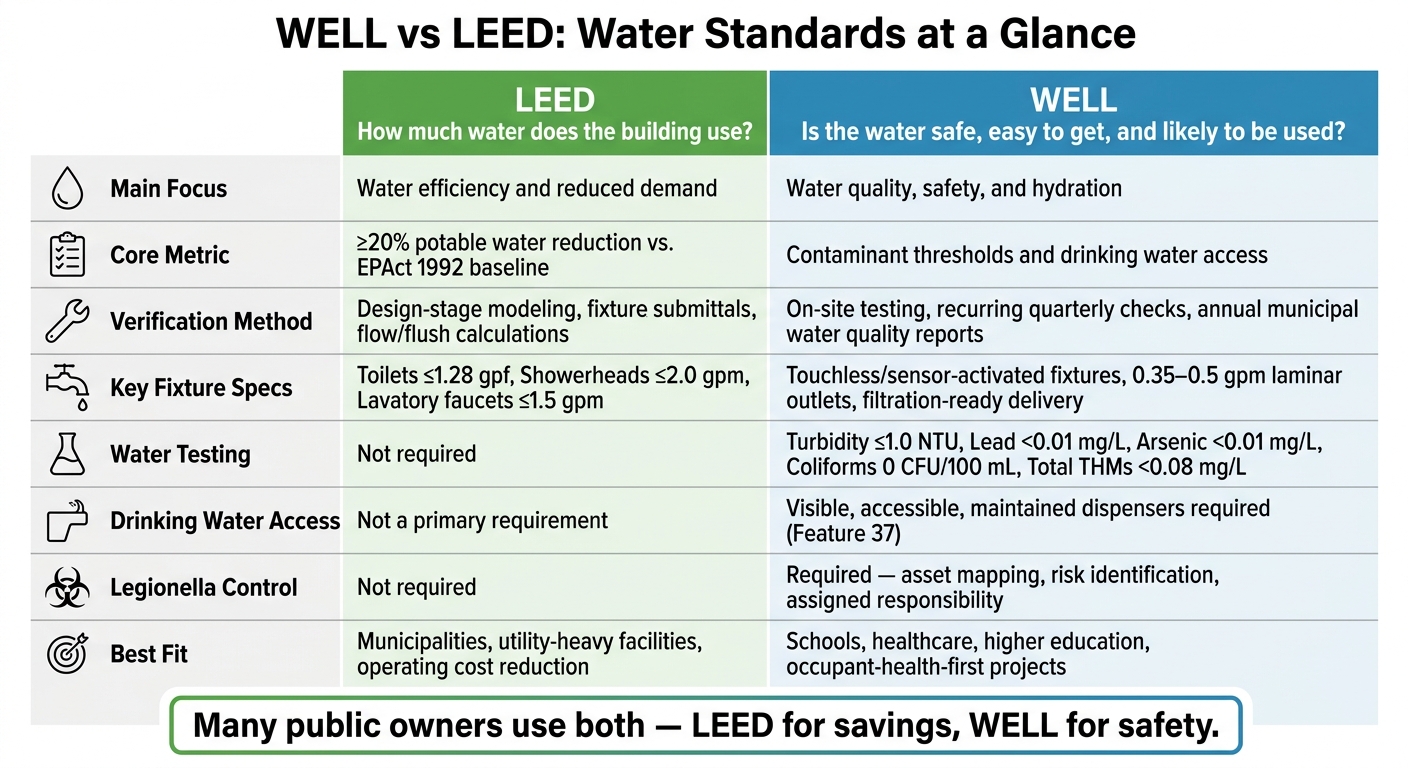
WELL vs LEED: Water Standards Compared for Public Buildings
LEED + WELL: A Streamlined Certification Process
Quick Comparison
| Criteria | LEED | WELL |
|---|---|---|
| Main focus | Water efficiency | Water quality and hydration |
| Core metric | Lower potable water demand | Water health thresholds and access |
| Verification | Modeling, fixture data, submittals | On-site testing and repeat checks |
| Drinking water access | Not a main focus | Visible, accessible, maintained dispensers |
| Fixture focus | Low-flow, WaterSense-style performance | Hygiene, usability, touchless options, safe delivery |
| Best fit | Utility cost control and reporting | Schools, healthcare, and occupant-first projects |
The bottom line is simple: LEED helps you save water; WELL helps you watch the water people drink and touch. For many public projects, that’s not an either-or call. It’s a scope decision.
WELL’s Approach to Water Health
Unlike LEED, which leans toward water savings, WELL treats water as a day-to-day health issue. The standard focuses on a simple idea: the water people drink should be safe, pleasant to drink, and easy to get. And WELL doesn’t leave that to guesswork. It ties those goals to testing and repeat checks over time.
Occupant Health Goals and Hydration Outcomes
WELL builds its water features around the people in the building every day – students, staff, patients, and visitors. It sets strict limits for contaminants because exposure to lead and other pollutants is linked to documented health effects [3].
It also looks at taste, odor, and appearance because those factors shape whether people actually drink the water. If tap water smells off or tastes metallic, people tend to avoid it. That’s why WELL sets limits for substances like iron, chloride, and manganese [3]. In WELL, those sensory standards sit inside the same compliance system as health-based ones. They’re not treated as a side preference.
Testing, Thresholds, and Ongoing Verification
WELL relies on on-site verification, not just what was planned on paper. A trained assessor checks that filtration and distribution systems are doing their job. To keep certification, projects also have to submit local municipal water quality reports to WELL each year [3][4].
WELL turns its water goals into measurable thresholds across four categories:
| Contaminant Category | WELL Threshold Examples | Why It Matters |
|---|---|---|
| Fundamental Quality | Turbidity ≤ 1.0 NTU; Coliforms 0 CFU/100 mL | Shows filtration is working and helps prevent waterborne illness [3] |
| Dissolved Metals | Lead < 0.01 mg/L; Arsenic < 0.01 mg/L | Helps protect against neurodevelopmental harm and toxicity [3] |
| Disinfectant Byproducts | Total THMs < 0.08 mg/L; HAAs < 0.06 mg/L | Lowers health risks linked to chlorine byproducts [3] |
| Taste and Odor | Iron < 0.3 mg/L; TDS < 500 mg/L | Makes water taste and smell better, which can support daily hydration [3] |
High turbidity isn’t just a visual problem. It can point to microbial risk and reduce treatment performance [3]. WELL also requires a Legionella control program. That means mapping water assets, spotting risk points, and assigning clear responsibility for prevention [3].
That people-first model sets up a direct contrast with LEED’s efficiency-first approach.
sbb-itb-034f8e1
LEED’s Approach to Water Efficiency
Where WELL focuses on what people drink, LEED focuses on how much water a building uses. It treats water as a conservation target, not a health metric. In plain terms, LEED is trying to cut potable water demand, improve fixture performance, and give owners numbers they can use for utility planning and sustainability reporting.
Conservation, Metering, and Reduced Potable Water Demand
LEED’s main indoor water benchmark is the Indoor Water Use Reduction credit. To meet it, a project must cut potable water use by at least 20% compared with the EPAct 1992 baseline [5][2].
To check fixture efficiency, LEED leans hard on the EPA WaterSense label. The targets are pretty clear:
- Toilets must flush at ≤ 1.28 gallons per flush (gpf), down from the 1.6 gpf code minimum
- Showerheads drop from 2.5 gallons per minute (gpm) to ≤ 2.0 gpm
- Private lavatory faucets go from 2.2 gpm to ≤ 1.5 gpm [5]
Those limits help projects earn LEED points. They also give owners a simple way to trim water use without changing how people use the building day to day.
LEED also gives credit for metering that tracks consumption over time. That matters for public owners. Good meter data can help spot waste, manage utility budgets, and support sustainability reporting. But there’s a catch: efficient fixtures can cut water use, yet they don’t tell anyone whether the water is safe to drink or easy to reach when they need it.
Where LEED Falls Short on Occupant-Facing Water Health
LEED stops at efficiency. It does not evaluate drinking-water safety, access, or day-to-day quality.
More specifically, LEED does not test drinking water, set contaminant limits, or require drinking-water access near occupied areas. In public facilities, that matters. Water quality shapes daily use in a very direct way. And when you compare LEED side by side with WELL, the gap stands out fast, especially around WELL’s water testing and drinking-water access requirements.
Water Testing and Drinking Water Access: A Direct Comparison
The clearest WELL vs. LEED split comes down to this: WELL checks the water people actually use, while LEED focuses on how much water fixtures use.
How WELL and LEED Differ on Water Testing
You can see the gap right away in a side-by-side view.
| Testing Factor | WELL | LEED |
|---|---|---|
| Verification Method | Recurring on-site testing | Design-stage modeling and fixture submittals |
| Measured Inputs | Turbidity, coliforms, lead, arsenic against fixed thresholds | GPM (gallons per minute), GPF (gallons per flush) |
Under WELL Feature 35 (Periodic Water Quality Testing), facilities test quarterly and keep records on hand for response planning [6]. LEED handles verification through documentation, with a focus on fixture submittals and flow rate calculations.
That people-first approach also shows up in where drinking water has to be available.
Drinking Water Access, Placement, and Hydration Support
WELL Feature 37 (Drinking Water Promotion) requires dispensers to be easy to spot and kept in working order to support hydration [6]. For education projects, WELL includes an optimization for outdoor drinking water access [6]. WELL also deals with taste and odor through WELL Feature W04 (Enhanced Water Quality) [3].
In plain terms, WELL requires drinking-water points that are visible, accessible, and maintained. LEED does not set a matching standard for occupant access.
That gap can shape an owner’s decision, especially when choosing between fixture plans built around efficiency and ones built around health.
Fixture Strategy and How Public Owners Can Choose
Fixture Priorities: Efficiency vs Safe Delivery
Once testing and access are locked in, fixture selection is the next call.
This is where the difference between LEED and WELL gets pretty easy to see. LEED leans toward water savings. WELL leans toward safe delivery and day-to-day use. That gap shows up right in the fixture specs.
| Fixture Factor | LEED Priority | WELL Priority |
|---|---|---|
| Fixture Type | WaterSense-labeled, low-flow (0.35–0.5 gpm) [1][7] | Touchless, sensor-activated to reduce contact spread [7][8] |
| Water Quality | Reducing potable water demand [5] | Filtration, routine testing, and safe delivery [4] |
| Verification | Flow/flush calculations and product cut sheets [1] | On-site test results and maintenance records [1][4] |
| Operational Impact | Lower utility consumption and reduced operating costs [5] | Maintained hydration access and hygiene outcomes [1][4] |
Some fixtures can check both boxes. Touchless faucets and 0.35–0.5 gpm laminar outlets can meet LEED efficiency goals while also supporting WELL hygiene goals [7][8].
When Texas Public Owners Should Choose WELL, LEED, or Both
After the fixture spec is set, the last step is deciding which certification lines up with the facility’s main goals.
LEED is often the better fit when the project is focused on utility savings and lower operating costs. WELL makes more sense when water quality, hygiene, and occupant health sit at the center of the project. Put simply, LEED looks at demand reduction, while WELL looks at the drinking and handwashing experience more closely.
For school districts and healthcare systems, occupant health, hygiene, and cognitive performance tend to matter most. In those cases, WELL’s occupant-first requirements often carry more weight. For municipalities and utility-heavy facilities, LEED’s conservation focus can be a stronger match, especially because LEED v4.1 requires a minimum 20% reduction compared to the EPAct 1992 baseline [5].
Higher education campuses often land in the middle. They may want lower water use, but they also need safe hydration access across a mix of building types. That’s why many colleges and universities get the most out of using both.
That makes the best path less about picking a side and more about matching the certification to the job at hand.
Conclusion: The Core Difference Between WELL and LEED on Water
WELL prioritizes water quality and access. LEED prioritizes water efficiency and reduced demand. Public owners often need both.
FAQs
Can a project pursue both WELL and LEED for water goals?
Yes. A project can pursue both WELL and LEED for water goals, but it takes careful coordination because they focus on different things.
LEED puts the spotlight on cutting potable water use with efficient, low-flow fixtures. WELL, on the other hand, leans into occupant health through water quality testing and easy access to hydration.
The good news? You can work toward both at the same time. It just helps to use an integrated design approach so the project can balance water savings with water quality and user access.
Does WELL require ongoing water testing after certification?
Yes. The WELL Building Standard requires ongoing water quality testing to keep certification.
Feature 35 calls for periodic testing, including quarterly testing for certain project types. Projects also need to keep water quality records and show that they responded properly to any findings.
So this isn’t a one-and-done task. It’s an ongoing part of building operations.
Which standard makes more sense for schools or healthcare buildings?
It comes down to your main goal: WELL puts more weight on the health of the people inside the building, while LEED puts more weight on sustainability and resource use.
For schools and healthcare settings, WELL may be a better fit for things like hydration and hand hygiene. LEED, on the other hand, gives owners a strong system for running buildings with less waste and better efficiency.
That’s why many public owners use both. One helps support health and day-to-day comfort, and the other helps guide building performance and resource management.