
Retro-commissioning helps schools address rising energy costs and aging infrastructure by improving the efficiency of mechanical, electrical, and plumbing systems. This process identifies inefficiencies, reduces energy bills, and creates more comfortable learning environments for students and teachers. Schools typically see electricity savings of 5–15% and gas savings of 1–23%, with payback periods as short as four months. Additional benefits include lower maintenance costs, extended equipment life, improved indoor air quality, and fewer repair calls. Retro-commissioning also supports funding requests for future upgrades by providing detailed performance reports.
Key takeaways:
- Energy Savings: Up to 20% reduction in energy bills.
- Quick Payback: Costs recouped in 4–20 months.
- Comfort: Stabilized temperatures and better air quality.
- Maintenance: Fewer breakdowns and lower repair costs.
- Sustainability: Reduced carbon footprint and energy waste.
Retro-commissioning is a cost-effective way for schools to optimize operations and improve the learning environment while saving money.
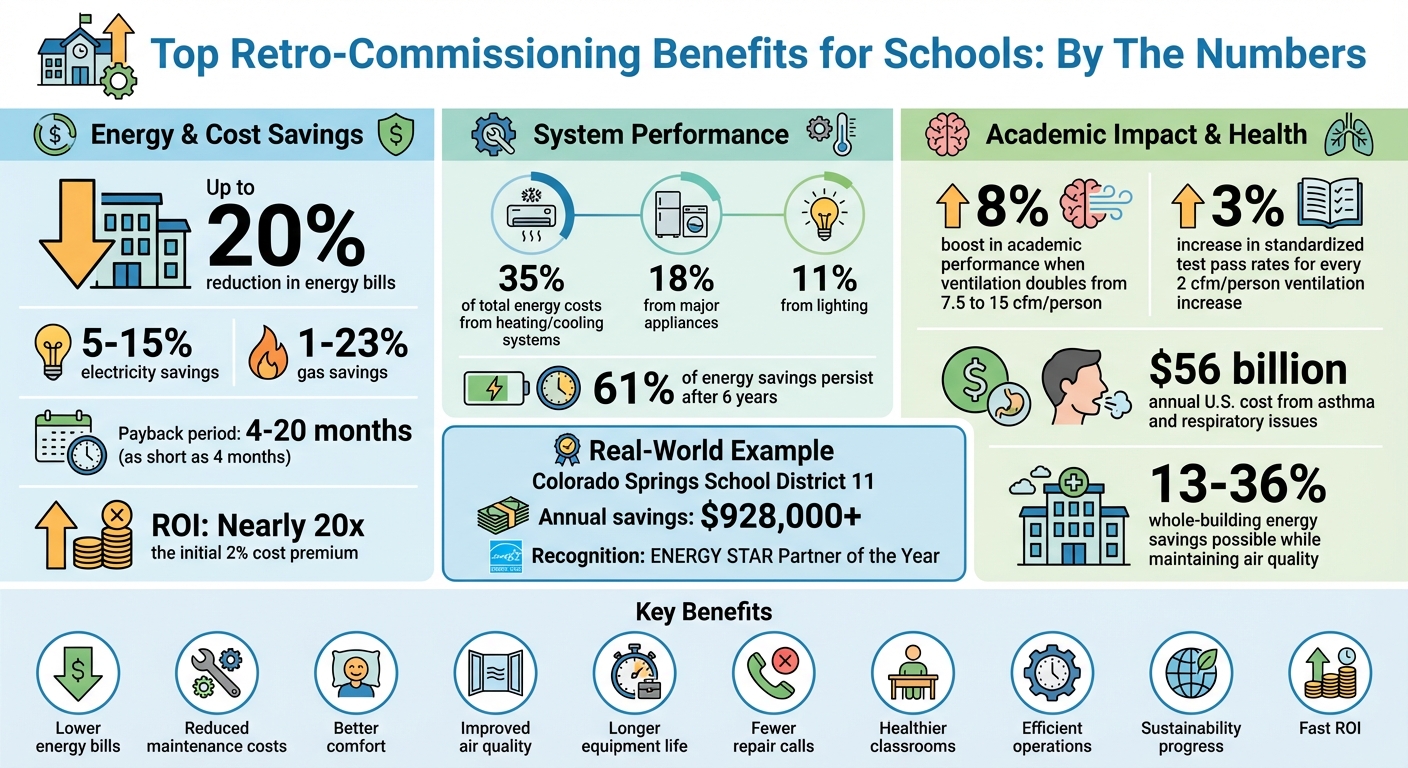
Retro-Commissioning Benefits for Schools: Energy Savings and ROI Statistics
1. Lower Energy Bills
Energy Efficiency Improvements
Retro-commissioning focuses on improving the performance of the systems that consume the most energy. For example, heating and cooling systems account for 35% of total energy costs, while major appliances and lighting contribute an additional 18% and 11%, respectively [4]. This process identifies and fixes specific inefficiencies, such as outdated components, malfunctioning thermostats, and poorly calibrated daylight sensors, which can lead to energy waste. By fine-tuning HVAC equipment schedules, adjusting temperature set points, and restoring economizer functions, schools can regain efficiency that may have been lost over time. These adjustments directly cut down energy consumption, leading to noticeable cost savings.
Cost Savings Potential
Retro-commissioning can lower a facility’s energy bills by up to 20% [6]. The best part? Most of these adjustments are low-cost and typically pay for themselves within two years or less through electricity savings [7]. Programs like SRP Retrocommissioning Solutions offer additional support, helping customers save as much as 15% on their energy costs [7].
A great example comes from the Colorado Springs School District 11, which adopted an energy management program in 2005. Through commissioning HVAC systems and performance-based contracting, the district achieved over $928,000 in estimated annual energy savings. Not only did this reduce costs, but it also improved indoor air quality, earning the district recognition as an ENERGY STAR Partner of the Year [5].
Operational and Maintenance Benefits
The benefits of retro-commissioning go beyond just cutting energy bills. It also ensures long-term operational improvements. A study of 28 different sites revealed that 61% of the initial energy savings were still in place six years later [3]. Schools can sustain these savings by managing their building automation systems effectively and providing staff with proper training. This ensures that the efficiency gains remain intact well after the initial upgrades.
sbb-itb-034f8e1
2. Lower Maintenance Costs
Operational and Maintenance Benefits
Retro-commissioning doesn’t just save energy – it also turns maintenance from a reactive headache into a more strategic and efficient process. By pinpointing small issues like broken sensors, leaking valves, or malfunctioning economizers early on, it helps facility managers address problems before they spiral into costly repairs [6][7]. A Senior Engineer highlighted that depending on patchwork repairs can drive up maintenance expenses over time [1].
Rather than waiting for equipment to break down, retro-commissioning provides a thorough analysis that allows managers to create a proactive maintenance plan [4]. This approach not only avoids expensive emergency repairs but also helps schools and other facilities manage their budgets more effectively. It even corrects operational missteps – like systems simultaneously heating and cooling – which can overwork equipment and cause unnecessary wear and tear [6][7]. These adjustments don’t just prevent breakdowns – they also translate into real financial savings.
Cost Savings Potential
The cost benefits extend well beyond quick fixes. For example, optimizing HVAC scheduling and set points reduces equipment runtime and stress, which means fewer repairs and a longer lifespan for critical components [6][7]. This optimization helps cut down on replacement part expenses over the long haul.
Another bonus? Retro-commissioning involves on-site operations and maintenance staff in the process, giving them hands-on experience and better technical skills to maintain improvements over time [7]. With a more skilled in-house team, facilities can reduce their dependence on outside contractors, further stretching their maintenance budgets [3][7].
Intro to Retro Commissioning
3. Better Comfort for Students and Teachers
Retro-commissioning does more than just cut costs – it transforms the learning environment by improving comfort for both students and teachers.
Impact on Comfort and Air Quality
Creating a comfortable classroom goes beyond setting the thermostat. It’s about fixing the mechanical problems that often cause discomfort. Neumann Monson Architects highlights this issue:
"Thermal comfort complaints often point to a mechanical problem. Broken parts and pressure issues cause uneven temperatures." [4]
Chris Duranceau, a Senior Engineer, paints a vivid picture of the challenges many schools face:
"Rooms are too cold, too hot, too humid, or overly dry. Often, the environment differs greatly from room to room. Students, teachers, and staff suffer the daily frustrations." [1]
Retro-commissioning addresses these frustrations by tackling the root causes of temperature inconsistencies. Whether it’s outdated system tweaks or equipment that’s no longer functioning as it should, the process identifies and resolves the issues impacting comfort. [1][4]
Energy Efficiency Improvements
By fine-tuning systems like outdoor air supply and cleaning cooling coils, retro-commissioning not only ensures consistent temperature, humidity, and airflow but also improves indoor air quality. These adjustments help eliminate musty odors and create a healthier atmosphere. [1][2]
When heating and cooling systems are properly calibrated, everyone benefits. Teachers and students enjoy a stable, comfortable environment that promotes focus and productivity. Plus, these changes reduce energy waste, which is especially important since heating and cooling systems contribute to 35% of a building’s total energy costs. [4] Beyond comfort, these optimizations extend the life of the systems themselves, ensuring long-term efficiency and reliability.
4. Better Indoor Air Quality
Improving indoor air quality does more than just enhance comfort – it plays a key role in supporting student health and academic performance.
Impact on Comfort and Air Quality
Retro-commissioning ensures HVAC systems are working efficiently, which is critical for proper ventilation and filtration. It identifies common issues like clogged coils, dirty filters, and sensor miscalibration – problems that can negatively affect air quality [2].
Studies show that doubling classroom ventilation rates from 7.5 to 15 cfm/person can boost academic performance by about 8%. Additionally, for every 2 cfm/person increase, there’s nearly a 3% rise in the percentage of students passing standardized math and reading tests [5][8].
Operational and Maintenance Benefits
Retro-commissioning doesn’t just improve air quality in the short term; it equips facility staff with updated operations and maintenance manuals as well as hands-on training to maintain these standards over time. According to the US EPA, commissioning ensures buildings perform as intended [2].
The process also addresses humidity control and dust removal, which are crucial for preventing mold and musty odors. Regular calibration of dampers and cleaning of filters help reduce asthma triggers and respiratory issues – health problems that cost the U.S. over $56 billion annually in medical bills and lost school days [5][8]. These steps not only protect air quality but also contribute to better energy performance.
Energy Efficiency Improvements
Beyond health and comfort, retro-commissioning offers significant energy savings. By balancing ventilation needs with energy efficiency, schools can achieve whole-building energy savings ranging from 13% to 36% without compromising air quality [9]. Investments in these green initiatives often deliver financial returns nearly 20 times their small upfront costs [5][8].
5. Longer Equipment Life
Operational and Maintenance Benefits
Retro-commissioning shifts schools from a reactive approach to a more proactive maintenance strategy. It identifies underperforming mechanical, electrical, and plumbing systems, allowing for timely repairs instead of relying on temporary fixes. Facility operators are actively involved, equipping them with the skills needed for ongoing system care. Meanwhile, commissioning engineers evaluate equipment for accessibility, functionality, and parts availability, while also tracking issues to prevent small problems from escalating into major failures [1]. These efforts not only reduce costs but also extend the lifespan of school assets, ensuring systems remain reliable over time.
Cost Savings Potential
By extending the life of equipment, retro-commissioning helps schools delay costly capital replacements and avoid expensive emergency repairs. Buildings naturally lose efficiency over time – just like cars or homes – but retro-commissioning helps recover lost energy savings and prevents systems from breaking down prematurely [3]. With heating and cooling systems making up 35% of a building’s total energy expenses [4], keeping these systems efficient is essential for managing school budgets. One study involving 28 sites found that energy savings persisted at an average rate of 61% [3]. Experts recommend scheduling retro-commissioning every five to ten years to counteract system wear and tear. Additionally, these findings can support funding requests for government capital improvement projects. This approach reduces unexpected repair costs and system downtimes, helping schools maintain smooth operations and protect their budgets.
Beyond cost savings, retro-commissioning fine-tunes systems, ensuring they operate at their most efficient levels.
Energy Efficiency Improvements
Routine system evaluations prevent minor inefficiencies from snowballing into energy waste. Instead of addressing symptoms, commissioning agents focus on identifying and resolving the root causes of mechanical issues. This ensures equipment continues to operate at peak performance, conserving energy and reducing unnecessary strain on systems [4].
6. Fewer Repair Calls
Operational and Maintenance Benefits
Retro-commissioning doesn’t just cut down on maintenance costs – it also reduces the number of emergency repair calls, leading to smoother day-to-day operations. According to Chris Duranceau, Senior Engineer, this process works by identifying potential issues early, preventing them from turning into major problems [1].
The process includes functional testing of equipment and controls to confirm they’re working as intended. This helps catch problems before they result in system failures. It also assesses whether equipment is easy to access and service, checks parts availability, and ensures schools avoid being burdened with specialized equipment that’s hard or costly to repair. This proactive approach not only boosts system reliability but also supports meaningful cost savings.
Cost Savings Potential
By addressing the root causes of mechanical issues – like pressure imbalances, broken components, or faulty thermostats – retro-commissioning minimizes the need for frequent repairs. As Matt Krieger from Neumann Monson points out:
"Thermal comfort complaints often point to a mechanical problem" [4].
This method provides a clear maintenance plan, allowing managers to budget for small adjustments rather than costly emergency fixes. Additionally, it ensures that equipment warranties only start once the school district formally accepts properly commissioned systems, protecting schools from unexpected repair expenses tied to poorly installed equipment.
7. Healthier Classrooms
Impact on Comfort and Air Quality
Retro-commissioning plays a key role in uncovering air quality issues that can affect the health of students and teachers. It addresses problems like clogged cooling coils, dirty air handling units, and insufficient outdoor air supply – factors that often contribute to uncomfortable and unhealthy classroom conditions.
For example, during an EPA commissioning check at a school facility, an agent detected a musty smell and noted inadequate outdoor air supply in "Zone 2." Upon investigation, the repair team discovered that construction dust had clogged the cooling coil, disrupting moisture removal and airflow. By cleaning the coil during the retro-commissioning process, the school not only eliminated potential health risks but also protected its building materials from further damage [2].
This effort highlights how retro-commissioning not only boosts energy efficiency but also supports the well-being of everyone in the classroom.
Operational and Maintenance Benefits
The benefits of retro-commissioning extend beyond immediate health improvements. By optimizing system controls, schools can ensure their classrooms remain safe and functional over time. For instance, properly calibrated sensors and control devices help maintain ideal humidity levels, reducing the risk of mold and mildew. Additionally, the process ensures that exhaust systems, such as kitchen and fume hoods, effectively remove pollutants and odors from the environment.
A great example comes from Colorado Springs School District 11, which combined energy efficiency with improved indoor air quality through effective HVAC commissioning. This initiative not only enhanced classroom air quality but also saved the district over $928,000 annually in energy costs. Their efforts earned them the title of 2005 ENERGY STAR Partner of the Year [5][8].
8. More Efficient Building Operations
Energy Efficiency Improvements
Retro-commissioning takes a fresh look at how school buildings operate by performing an integrated system review. Instead of analyzing heating, cooling, electrical, and renewable energy systems in isolation, it evaluates how they function together. This approach often reveals inefficiencies that quietly inflate energy costs.
By fine-tuning interconnected systems like HVAC, lighting, and appliances, schools can reclaim energy that’s been wasted due to outdated equipment or poor settings. Typical upgrades might include tweaking temperature set points, optimizing airside economizers, verifying system schedules, and stopping the unnecessary overlap of heating and cooling. These adjustments not only reduce energy consumption but also simplify daily operations.
Operational and Maintenance Benefits
When systems work in harmony, maintenance becomes easier and more predictable. Retro-commissioning provides maintenance teams with better tools, such as updated manuals, accurate system diagrams, and hands-on training. This empowers staff to troubleshoot complex HVAC and control systems more effectively, cutting down on those frequent “too hot” or “too cold” complaints that often stem from deeper operational issues.
"Retro-commissioning (RCx) is a systematic process for investigating, analyzing and optimizing the performance of building systems through operational and maintenance improvements." – Spaces4Learning [10]
Additionally, retro-commissioning includes a maintenance guide that helps schools plan budgets for both small repairs and larger upgrades, making long-term upkeep more manageable.
9. Progress Toward Sustainability Goals
Retro-commissioning plays a key role in helping schools achieve their long-term sustainability objectives by improving operational efficiency and reducing environmental impact.
Energy Efficiency Improvements
Through retro-commissioning, schools can significantly lower their carbon footprint without resorting to costly system replacements. By evaluating renewable energy systems like solar panels and geothermal pumps alongside traditional HVAC setups, schools can pinpoint inefficiencies that lead to wasted energy. This approach focuses on the systems that consume the most energy, enabling schools to cut down on CO2 and greenhouse gas emissions. These reductions align with both local and national sustainability targets [11][12].
Cost Savings Potential
The environmental benefits of retro-commissioning also come with financial perks. By identifying low-cost or no-cost adjustments, schools can achieve substantial energy savings. These quick wins translate into immediate cost reductions, which, in turn, support broader financial and sustainability goals.
Using detailed retrofit performance reports, administrators can project energy savings tailored to their specific climate zone, whether urban or rural. This data-driven method helps justify investments and ensures that resources are allocated effectively for future improvements [11].
Operational and Maintenance Benefits
Retro-commissioning shifts schools from a reactive approach to maintenance toward a proactive, sustainability-centered strategy. It provides a clear roadmap for capital improvements and maintenance planning, ensuring that buildings operate efficiently over the long term. By addressing minor issues early, schools can avoid costly equipment failures that could derail both budgets and sustainability efforts.
The U.S. Environmental Protection Agency highlights that integrating energy efficiency with indoor air quality (IAQ) goals during planning and execution allows schools to achieve strong results while keeping costs in check [5]. This integrated strategy supports certifications like ENERGY STAR® and aligns with programs from the U.S. Green Building Council Center for Green Schools. Combined with earlier efficiency and maintenance improvements, these measures create a solid framework for resilience across school districts.
10. Fast Return on Investment
Cost Savings Potential
Retro-commissioning offers a quick return on investment by cutting energy and maintenance costs. According to Neumann Monson, energy savings can offset the upfront costs in just a few months [4]. The process focuses on affordable tune-ups instead of pricey equipment replacements, making it a cost-effective solution.
The benefits don’t stop there. A study of 28 retro-commissioned sites showed that energy savings lasted over time, with an average persistence of 61% for electricity and natural gas across six years [3]. On top of that, many utility programs provide rebates to make the deal even better. For example, incentives might include $0.05 per kilowatt-hour for the first year of electricity savings or $100 per average peak kW saved [7].
Energy Efficiency Improvements
Heating and cooling systems alone account for 35% of a building’s energy costs, while major appliances and lighting contribute 18% and 11%, respectively [4]. Retro-commissioning hones in on these high-impact areas, addressing issues like outdated mechanical components, faulty thermostats, and inefficient sensors that waste energy. Financially, this approach can yield returns estimated at 20 times the initial 2% cost premium [5].
Take Colorado Springs School District 11 as an example. Back in 2005, they implemented an energy management program that combined efficient design, regular maintenance, and HVAC commissioning. The result? More than $928,000 in estimated annual energy savings. They funded these improvements through performance-based contracting and were later recognized with the ENERGY STAR Partner of the Year Award [5].
Operational and Maintenance Benefits
Retro-commissioning also enhances operational efficiency. By optimizing equipment to operate at peak performance, schools can reduce repair needs, extend the lifespan of their systems, and delay expensive replacements. This proactive approach to maintenance and capital planning not only lowers operational costs but also solidifies retro-commissioning as a smart investment for long-term savings.
How E3 Design-Build Contractor Supports Retro-Commissioning

E3 Design-Build Contractor brings a comprehensive approach to retro-commissioning, particularly for Texas schools, ensuring cost savings and improved operational performance. Their in-house engineers handle every aspect of the project, designing systems where HVAC upgrades, LED lighting retrofits, and building automation work together seamlessly. The goal? To maximize energy efficiency and optimize building performance – all while addressing the energy savings and operational benefits previously discussed [13].
Between 2019 and 2021, E3 delivered impressive results. For Donna ISD, they executed a $7.9 million energy-efficiency program that included mechanical retrofits across nine campuses, replacing over 80 HVAC units at Veterans Middle School, and installing building automation in six campuses. These efforts led to $716,984 in annual savings [14]. Similarly, their 2020–2021 work with Bryan ISD achieved $763,908 in yearly savings through $6.4 million in energy upgrades. These upgrades included optimizing Energy Management Systems at 19 campuses and installing bipolar ionizers at 18 campuses to improve indoor air quality [15].
One of E3’s standout qualities is their ability to execute retrofits during the school year without interfering with classes. Rudy Rodriguez, Director of Maintenance, shared:
"They came in on nights and weekends so we never disrupted any classes" [13].
E3 also ensures cost-effective financing for their projects. For example, Bryan ISD secured upgrades with a 2% interest rate through SECO LoanSTAR [15]. Their integrated solutions often reduce energy consumption by 20–40%, with a payback period of less than three years [16].
Their approach includes district-wide LED retrofits – installing over 21,000 fixtures – and centralized building automation for real-time monitoring [14]. This integrated strategy ensures that retro-commissioning improvements remain effective over time, maintaining peak system performance.
Conclusion
Retro-commissioning offers a smart way for school districts to tackle aging infrastructure while staying within tight budget constraints. Instead of relying on temporary fixes or postponing upgrades, this approach pinpoints inefficiencies in mechanical, electrical, and lighting systems. The result? Energy savings that often pay off within months. Beyond the numbers, it creates better classroom environments, improves comfort, and extends the lifespan of equipment[4].
Chris Duranceau, Senior Engineer, highlights its broader impact:
"The retro-commissioning report then can be used as evidence of need for the sake of securing government funds. Furthermore, the report makes it easier to appropriately budget for approved capital improvement projects."[1]
These reports not only validate immediate savings but also serve as a long-term planning tool, transforming retro-commissioning into a strategy for continuous improvement.
For districts overseeing multiple aging facilities, conducting retro-commissioning every five to ten years ensures systems stay efficient and avoids expensive breakdowns[4]. Heating and cooling systems, which often drive energy costs, are key areas for improvement[4]. By addressing inefficiencies, districts reduce costs, meet current energy codes, and ease the taxpayer burden – all while staying within budget.
School leaders aiming for efficient operations and sustainable practices should seize the opportunity to enhance their facilities’ performance without the need for large-scale investments.
FAQs
How is retro-commissioning different from an energy audit?
Retro-commissioning is all about improving how a building’s current systems operate. This process involves repairing, adjusting, and fine-tuning equipment to ensure everything works efficiently and as originally intended. Think of it as giving your building a performance boost without replacing major systems.
On the other hand, an energy audit focuses on analyzing a building’s energy use. It identifies areas where energy is being wasted and suggests ways to save. However, it stops short of actually making repairs or adjustments to the systems.
In short, retro-commissioning is hands-on, ensuring systems run smoothly, while an energy audit provides a roadmap for potential improvements without directly fixing anything.
Will retro-commissioning disrupt classes or require building shutdowns?
Retro-commissioning is designed to enhance the performance of existing building systems without causing major disruptions. It doesn’t typically interfere with classes or require shutting down the building, making it a practical and efficient process for improving system operations while maintaining normal activities.
How do schools measure and maintain energy savings after retro-commissioning?
Schools achieve energy savings after retro-commissioning by following structured evaluation protocols. These protocols involve regular monitoring, detailed audits, and an in-depth analysis of building features and management practices. This systematic approach helps maintain energy savings over time, ensuring they remain effective while also supporting long-term energy efficiency and smoother operations.