
Want to modernize your facilities and cut utility costs while meeting energy goals? Here’s a quick breakdown of how public entities can upgrade buildings effectively:
- Audit Current Performance: Start with a detailed review of energy use and identify inefficiencies. Tools like energy management systems can pinpoint waste and save money.
- Set Clear Goals: Define measurable targets like reducing Energy Use Intensity (EUI) or cutting carbon emissions. Focus on metrics that align with financial and operational priorities.
- Prioritize Upgrades: Use ROI analysis to rank projects by impact and cost-effectiveness. For example, LED lighting and efficient HVAC systems often deliver quick returns.
- Work with Experts: Partner with experienced design-build contractors to ensure smooth implementation of upgrades like automation systems and renewable energy solutions.
- Monitor and Engage: Track results using energy data systems and involve stakeholders through regular updates and training.
Key Stat: Improving energy performance by 20% in state and local buildings could save $5.4 billion annually. Even a modest 2% improvement saves over $580 million each year.
These steps don’t just save money – they also create better spaces for occupants and support long-term energy goals.
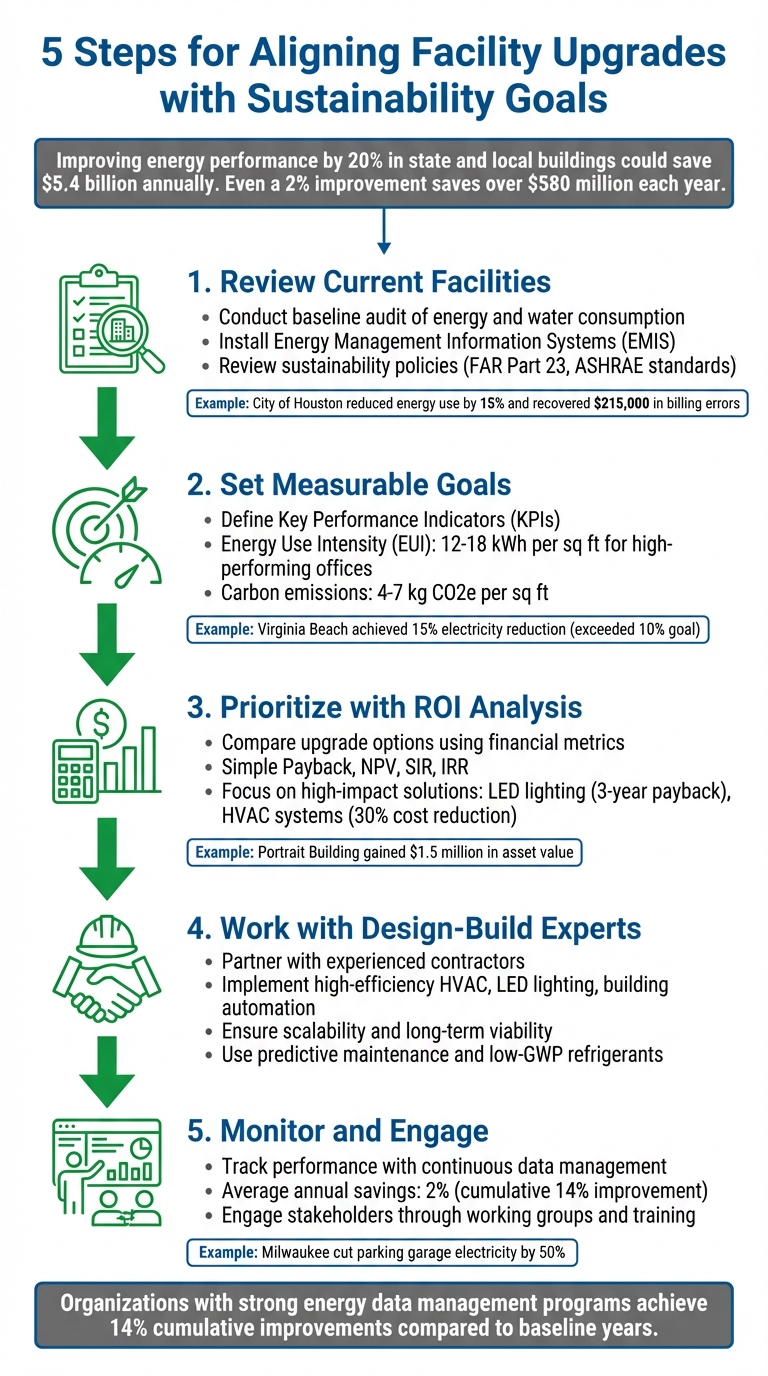
5-Step Process for Aligning Facility Upgrades with Sustainability Goals
Getting Started with Energy Efficiency : Where Should Facility Managers Begin
sbb-itb-034f8e1
Step 1: Review Current Facilities and Sustainability Policies
Before diving into upgrades, you need a clear understanding of how your facilities are currently performing. Start with a detailed assessment of your infrastructure and identify which sustainability policies apply. Without this groundwork, you risk making investments that don’t align with your goals.
Conduct a Baseline Audit
Begin by looking at historical utility data to establish a baseline for energy and water consumption. This step helps uncover patterns, inefficiencies, or even billing errors. For instance, the City of Houston, Texas, managed to reduce energy use by 15% between 2008 and 2019 by upgrading mechanical equipment and lighting systems. They also recovered $215,000 by identifying incorrect utility tariff rates through a detailed review of historical data [2].
Consider installing an Energy Management Information System (EMIS) to monitor real-time energy usage. Focus submetering efforts on high-consumption areas, such as chiller plants, renewable energy systems, and specific plug loads, rather than trying to cover every area. Schools implementing similar strategies have saved over $1 million in utility costs [2].
Don’t stop there – conduct system-level assessments of critical areas like lighting, HVAC, and plumbing. Predictive maintenance tools, such as thermography and ultrasonic analysis, can help evaluate equipment conditions. Ensure that your ventilation systems meet ASHRAE Standard 62.1 and that thermal conditions comply with ASHRAE Standard 55 [3]. Inspections often uncover issues like uninsulated HVAC pipelines, which are a major source of heat loss and energy waste [4]. Once you’ve established a thorough baseline, turn your attention to relevant sustainability policies to guide your next steps.
Review Applicable Sustainability Policies
With a clear picture of your facility’s performance, align your findings with key sustainability mandates. Check FAR Part 23 for standards on energy, water efficiency, and environmental performance [3]. Additionally, review the Guiding Principles for Sustainable Federal Buildings, which outline best practices for high-performance design and operations [1]. For a broader perspective, consider how your upgrades can support the UN Sustainable Development Goals, particularly SDG-7, which focuses on affordable and clean energy [4].
Use tools like the "Checklist for Existing Buildings" from the Guiding Principles to benchmark your current conditions against high-performance standards [1]. Regular reassessments – ideally every four years – are recommended to ensure ongoing compliance and to spot new performance gaps [1]. This proactive approach not only keeps you aligned with evolving standards but also opens doors to potential funding opportunities through federal or state sustainability programs.
Step 2: Set Measurable Energy Efficiency Goals
Once you’ve established a baseline, the next step is setting clear, measurable goals. These targets help turn broad sustainability ideas into actionable outcomes. Without them, it’s tough to justify spending, measure progress, or show value to stakeholders.
Define Key Performance Indicators (KPIs)
Start by identifying KPIs that align with your organization’s priorities. A key metric for building performance is Energy Use Intensity (EUI), which measures annual energy consumption divided by gross floor area. High-performing office buildings often aim for an EUI between 12–18 kWh per square foot [6]. For organizations focused on reducing environmental impact, carbon emissions intensity is another critical KPI, with typical targets ranging from 4–7 kg CO2e per square foot [6].
Your KPIs should reflect the interests of different teams within your organization. For example:
- Finance teams are interested in utility cost savings and the ROI of energy projects.
- Facility managers focus on metrics like reduced comfort complaints and the ratio of planned to reactive maintenance [5].
- If renewable energy is part of your strategy, track the percentage of total energy consumption coming from clean sources like solar or wind.
The key is to ensure that KPIs are meaningful to both financial and operational stakeholders, clearly demonstrating the value of energy efficiency efforts.
Take Virginia Beach, Virginia, as an example. In 2008, the city faced rising utility costs and set a specific target: reduce electricity use in city buildings by 10% from a 2007–2008 baseline within five years. By 2013, they exceeded their goal, achieving a 15% reduction in electricity consumption [5]. Similarly, the State of Maryland showed how focusing on measurable goals can lead to significant reductions, justifying continued investment in sustainability efforts [2].
Once you’ve defined your KPIs, rank these goals to focus on the most impactful and cost-effective improvements.
Rank Goals Based on Impact
With KPIs in place, prioritize your goals by considering their ROI and overall impact. Not all energy efficiency initiatives will deliver the same benefits. Focus on upgrades that provide the best return, meet regulatory requirements, and align with long-term sustainability plans. The DOE Energy Data Management Guide offers this advice:
An effective strategy is to use your energy data management program to target the low-hanging fruit to quickly realize energy and cost savings [5].
Start with no- or low-cost operational changes that deliver quick payback. For instance, Aurora Public Schools in Colorado used an energy information system to monitor after-hours energy use and adjust equipment schedules. Between 2014 and 2019, they improved energy performance by 14% and avoided over $1 million in utility costs from 2014 to 2017 [2]. These early successes build momentum and help secure leadership buy-in for larger, more expensive projects.
Use tools like submetering to focus on high-consumption areas, such as chiller plants, renewable energy installations, and major plug loads [7]. Gillette, Wyoming, offers another success story. After joining the DOE Better Buildings Challenge in 2012, the city achieved an 18% reduction in energy use by 2015, working toward its long-term goal of a 20% reduction by 2022 [5]. Prioritizing based on impact ensures that your efforts lead to measurable results and justify ongoing investment.
Step 3: Prioritize Upgrades with ROI Analysis
The next step is to prioritize upgrades by conducting an ROI analysis. This helps identify which projects will deliver the most impact and which ones may yield lower returns.
Compare Upgrade Options
Start by analyzing each potential upgrade with financial metrics that align with your organization’s goals. Here are some key metrics to consider:
- Simple Payback: This metric divides the upfront cost by the annual savings to show how quickly you can recover your investment. While it’s great for quick evaluations, it doesn’t factor in the time value of money.
- Net Present Value (NPV): By adjusting future savings to their present value using your discount rate, NPV gives a more realistic picture of long-term benefits.
- Savings-to-Investment Ratio (SIR): This ratio compares the present value of savings to the present value of costs, making it useful for ranking multiple projects.
- Internal Rate of Return (IRR): IRR identifies the discount rate at which NPV equals zero, helping you compare energy projects to other capital investments.
For example, at the Portrait Building in Washington, D.C., property managers implemented energy upgrades in October 2017. These improvements not only enhanced tenant satisfaction but also boosted the building’s asset value by an estimated $1.5 million [8]. Additionally, don’t forget to factor in utility rebates, state loan programs that can cover 30%–40% of costs, maintenance savings, reduced greenhouse gas emissions, and improved occupant comfort [10].
| Metric | Description | Best Use Case |
|---|---|---|
| Simple Payback | Initial cost divided by annual savings | Quick screening of simple projects [9] |
| Net Present Value (NPV) | Future savings minus initial costs, adjusted for discount rate | Long-term projects where time value of money matters [8] |
| Savings-to-Investment Ratio (SIR) | Present value of savings divided by present value of costs | Prioritizing when comparing multiple high-impact options [8] |
| Internal Rate of Return (IRR) | Discount rate that makes NPV equal to zero | Comparing energy projects against other capital investments [8] |
Once you’ve evaluated the numbers, focus on the upgrades that promise the biggest impact.
Focus on High-Impact Solutions
High-impact solutions are those that not only offer quick paybacks but also align with your broader sustainability objectives.
Take LED lighting retrofits, for example. These upgrades typically pay for themselves in under three years, making them a great starting point to build momentum for larger initiatives [10]. Similarly, high-efficiency HVAC systems can reduce energy costs by 30% annually, especially when replacing equipment that’s either outdated or nearing the end of its lifespan [11]. Consider this: about 25% of HVAC and mechanical systems in commercial buildings are already past their useful life, while 50% are over 15 years old [10]. Waiting until failure often leads to costly emergency replacements and operational disruptions.
Another high-impact option is building automation systems, which allow for real-time energy optimization. When paired with other upgrades, these systems can double the lifecycle savings [12]. A case in point: Georgia Institute of Technology upgraded ventilation and fume hood controls in their STEM labs, cutting energy use by 74% in the Biomedical Engineering building and 53% in the Environmental Science & Technology building between 2024 and 2025. These upgrades are projected to save $11.7 million overall [11]. Similarly, a manufacturing company achieved a 2.8-year payback in July 2025 by bundling HVAC and controls upgrades while leveraging utility incentives [10].
"Energy efficiency projects typically don’t fail because they’re bad ideas; they fail because the path forward isn’t clear." – Richard Prinz, Mantis Innovation [10]
To strengthen your case for investment, consider bundling quick-payback projects like LED lighting with longer-payback upgrades such as HVAC systems. This approach balances immediate wins with long-term goals, making it easier to gain leadership approval for the entire package [10].
Step 4: Work with Design-Build Experts for Implementation
Once you’ve completed the ROI analysis, the next step is to move into the implementation phase. This is where partnering with experienced design-build experts can make all the difference. Their expertise ensures upgrades are executed effectively, aligning with both operational efficiency and sustainability goals.
Partner with Experienced Contractors
The design-build model simplifies the process by combining design and construction under one contract. This eliminates the typical coordination issues between architects, engineers, and contractors, making it a practical choice for complex projects. It bridges the gap between planning and execution, ensuring your sustainability goals are integrated into every stage.
Take E3 Design-Build Contractor as an example (https://e3es.com). They specialize in energy-efficient solutions for public entities in Texas, such as school districts, healthcare facilities, universities, and municipalities. Their offerings include:
- High-efficiency HVAC systems: Featuring variable air volume (VAV) units and wireless thermostats that adjust temperature based on occupancy.
- LED lighting systems: Specified from the DesignLights Consortium Qualified Products Lists for maximum energy savings.
- Building automation systems: Integrated with Energy Management Information Systems (EMIS) for real-time energy monitoring.
A skilled contractor will also ensure integrated system commissioning, where all electrical loads and controls are unified into a single plan. This ensures that systems work cohesively from the start. For HVAC upgrades, they might design zoning systems with occupancy sensors, which automatically adjust temperatures in spaces like private offices or conference rooms. This approach balances energy efficiency with occupant comfort.
Additional advanced techniques include active daylighting with photo-sensors and automatic shading to reduce energy waste. Plumbing upgrades, such as faucet aerators (0.5 gpm), showerheads (2.0 gpm), and dual flush toilets (0.8/1.28 gpf), can also be implemented. Contractors often ensure HVAC systems use filtration media with a MERV 13 rating to improve indoor air quality [7].
Ensure Scalability and Long-Term Viability
Energy efficiency upgrades should be designed with flexibility and future needs in mind. For instance, wireless thermostats and submetering equipment can be easily relocated or integrated into existing building automation systems as facilities evolve. Grid-ready submetering is gaining traction, using revenue-grade electric meters with web capabilities to identify inefficiencies and energy anomalies. High-use areas, like chiller plants and renewable systems, are prime targets for such technology, and the data gathered can guide energy-saving measures.
Forward-thinking contractors also use predictive maintenance technologies, such as thermography and ultrasonic analysis, to identify potential problems before they escalate into costly failures. When replacing or retrofitting cooling systems, selecting designs that use low global warming potential (GWP) refrigerants is critical for environmental responsibility.
Finally, investing in training for facility teams is essential. Building managers and system operators should be knowledgeable about the latest technologies and maintenance strategies. Occupants can also be engaged through real-time dashboards that display energy usage, encouraging sustainable behaviors and helping you maximize your investment [7].
Step 5: Monitor Progress and Engage Stakeholders
Facility upgrades demand ongoing monitoring and active involvement from stakeholders to ensure their long-term success.
Track and Measure Performance
To effectively track progress, it’s important to shift from occasional audits to a continuous data management program that aligns with your organization’s goals. Data shows that organizations implementing strong energy data management programs achieve average annual savings of about 2%, with cumulative improvements reaching 14% compared to baseline years [2]. For state and local buildings, this could translate into over 60 trillion Btu in energy savings and $580 million annually [2].
A key tool for this is an Energy Information System (EIS). These systems monitor utility bills, pinpoint after-hours energy usage, and optimize equipment scheduling. For example, the City of Houston used such strategies to cut energy use by 15% between 2008 and 2019, while also recovering $215,000 in utility overcharges by auditing historical data with a consultant [2].
Starting with focused showcase projects can deliver quick wins and measurable results. In 2012, the City of Milwaukee’s Energy Reduction Team made a simple change to a parking garage’s ventilation protocol, cutting the facility’s electricity use by nearly 50% compared to 2011 [13]. Wins like these build credibility and encourage stakeholders to embrace data tracking, even those who may initially view it as intrusive [5].
Sustained monitoring helps ensure that energy savings and efficiency gains don’t fade over time. Integrating Building Automation Systems (BAS) with Computerized Maintenance Management Systems (CMMS) creates an auditable record of how maintenance activities contribute to reduced environmental impact. Sheila Sheridan, Principal at Sustainable Facility Strategies, highlights the value of this integration:
"The CMMS is the sustainability tool. Every work order closed with a measured outcome is an environmental data point" [14].
This approach transforms sustainability from a one-time initiative into an ongoing process, turning data into actionable insights. Clear communication across teams is essential to make this happen.
Engage Facility Teams and Stakeholders
Once performance data is collected, sharing it effectively is key to driving continuous improvement. Stakeholder engagement ensures broad support and collaboration [5]. Start by identifying key stakeholders – such as Executive Leadership, Finance, Facilities, and IT – and plan how to gather their input and keep them informed.
Collaborative working groups can be a powerful tool. For instance, Virginia Beach, Virginia, created a Joint Energy Committee in 2008, chaired by the deputy city manager and including representatives from city departments, schools, and the local electric utility. By 2013, this teamwork had reduced cumulative electricity consumption by 15% and saved an estimated $1 million in utility costs [5].
Tailor your communication. Different stakeholders need different types of information. Executives want updates on greenhouse gas reductions and cost savings. Facility managers benefit from metrics like Energy Use Intensity (EUI) and cost trends at the facility level. Department leaders respond well to peer comparisons that show how their performance measures up [13]. Use tools like color-coded monthly reports to flag facilities with increased energy use and provide quarterly updates to keep department heads accountable and motivated.
Training is another critical piece. Offering Building Operator Certification (BOC) training equips facility teams with the skills they need to maintain efficiency. Georgia State Government partnered with Gwinnett Technical College to provide BOC training, which led to seven state facilities reducing energy use by over 2 billion Btus and saving an average of $3,300 annually per facility [5]. Recognizing these efforts – through newsletters, websites, or formal awards – can further motivate teams to achieve sustainability goals [13].
Conclusion
The five-step framework – from initial audits to consistent monitoring – provides a clear path for ensuring public facility upgrades align with sustainability goals. By following this structured approach, facilities can turn upgrades into a cycle of continuous energy efficiency improvements.
Starting with baseline audits and policy evaluations, organizations lay the groundwork with data-driven insights. These steps help establish measurable KPIs and identify upgrades that deliver the best value. This foundation ensures that every decision is both informed and impactful.
When it comes to implementation, working with expert contractors like E3 Design-Build Contractor can make all the difference. For public entities across Texas, E3 offers tailored solutions, including high-efficiency HVAC systems, LED lighting, building automation, and infrastructure upgrades. Their expertise serves a range of facilities, from schools and healthcare centers to universities and municipal buildings.
The process doesn’t stop there. Ongoing monitoring and active stakeholder involvement are essential to maintaining progress. Tools like energy management systems provide real-time data to identify inefficiencies and guide future improvements. As Gayle Head from the International Facility Management Association wisely states:
"What doesn’t get accounted for, what’s not measured and doesn’t get changed" [15].
FAQs
Which KPI should we track first: EUI, costs, or emissions?
The first metric to monitor is Energy Use Intensity (EUI). This serves as the foundation for assessing and benchmarking energy performance. By tracking EUI, you establish a baseline that highlights areas for potential energy efficiency improvements. Addressing these areas not only supports measurable reductions in emissions but can also result in operational cost savings. While costs and emissions are crucial considerations, EUI stands out as the most direct starting point for aligning system upgrades with sustainability objectives.
How do we pick upgrades when budgets are tight?
When money is tight, it’s smart to focus on upgrades that deliver the most bang for your buck. Tools like cost savings calculators and energy audits can help pinpoint projects that offer the best return on investment. Start with affordable solutions like energy management systems or scheduling controls to boost performance without breaking the bank. This way, you can ensure every dollar goes toward improvements that enhance efficiency and support sustainability goals.
What’s the simplest way to keep savings from fading over time?
To keep your savings intact over the long haul, you need consistent management and monitoring strategies. Start by putting a facility sustainability policy in place. Then, make it a habit to track energy performance regularly.
Using tools like energy management systems can streamline this process, while routine audits can help you spot and fix any inefficiencies. By staying proactive and using technology effectively, you can maintain operational efficiency and ensure those savings stick around.