
Smart LED lighting systems are transforming public facilities, offering energy savings of 40-60% and cutting costs by $1-2 per square foot annually. But these benefits come with risks. The connectivity of IoT-enabled LED systems exposes them to cyber threats, with vulnerabilities like default credentials, firmware weaknesses, and susceptibility to advanced attacks like DDoS and side-channel exploits.
Here are the five major threats to these systems:
- DDoS Attacks: Overwhelm networks, disrupt lighting, and even cause safety hazards like high-frequency strobing.
- Default Credential Exploitation: Hackers use factory-set passwords to take control of devices and networks.
- Firmware Injection: Malicious updates can permanently compromise devices and spread across networks.
- Eavesdropping and Data Interception: Light-based communication can leak sensitive data from secure environments.
- Side-Channel Attacks: Exploit physical properties like light intensity to extract encryption keys or sensitive information.
Public facilities often prioritize cost savings over security, leaving systems exposed to attacks that can disrupt operations, compromise data, and even endanger safety. Organizations can mitigate risks by updating credentials, segmenting networks, and working with experts to install secure systems.
Quick Fact: IoT devices face an average of 1,400 attacks per month, and 80% of them have high-severity vulnerabilities. Taking proactive measures can protect the energy-efficient infrastructure that facilities increasingly rely on.
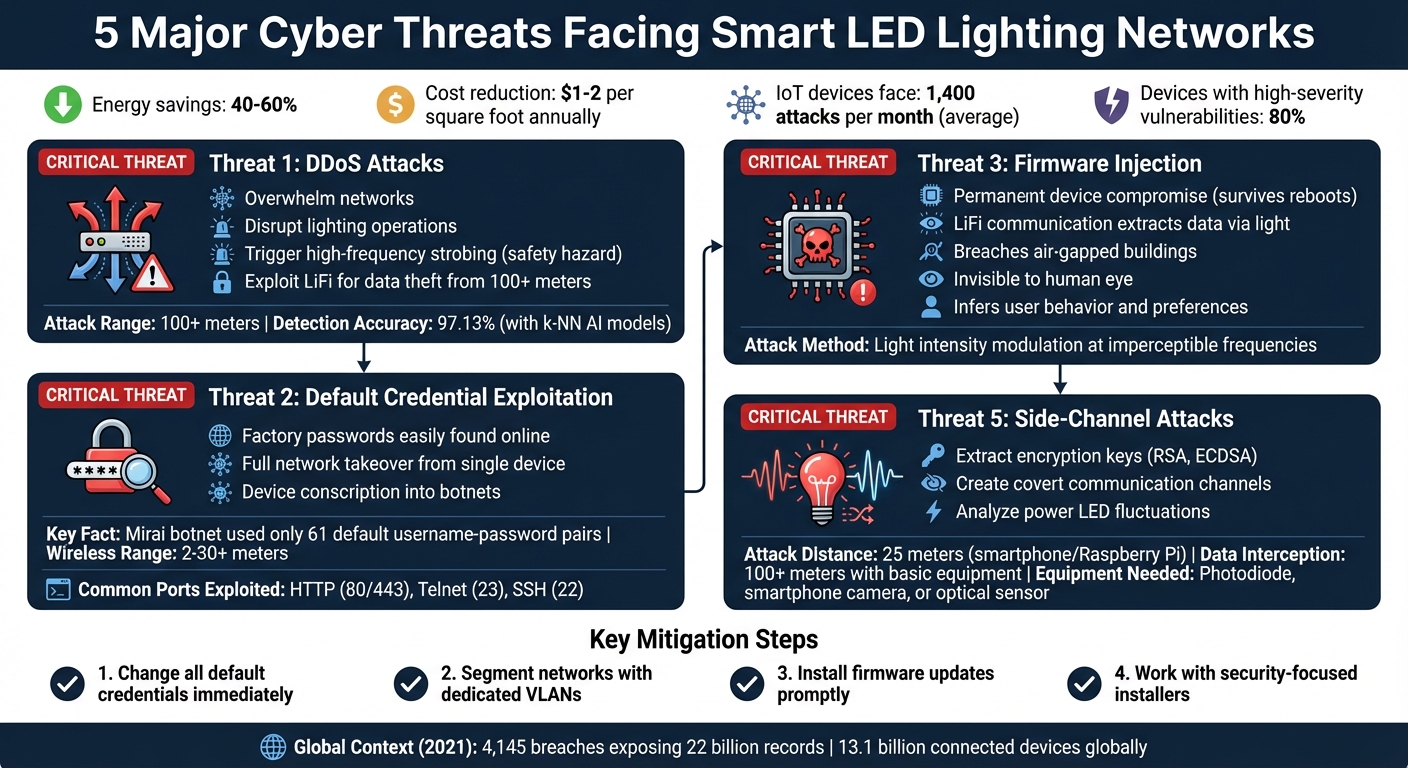
5 Major Cyber Threats to Smart LED Lighting Networks
1. DDoS Attacks
Potential Impact on IoT-Enabled LED Systems
Distributed Denial of Service (DDoS) attacks can wreak havoc on smart LED systems, far beyond simply turning lights on and off. When attackers flood a network with malicious traffic, they can alter device settings in dangerous ways. For instance, they could trigger high-frequency strobing, which poses serious safety concerns. Researchers Eyal Ronen and Adi Shamir highlighted how such attacks could induce seizures in individuals with photosensitive epilepsy by manipulating light frequencies.
"In another attack, we showed that an attacker can strobe the lights at a frequency which may trigger seizures in people suffering from photosensitive epilepsy (in the same way that rapidly flashing video games can cause such seizures)." – Eyal Ronen and Adi Shamir, Researchers
But the risks don’t stop at physical disruptions. Attackers can also use these systems for covert data theft. By exploiting LiFi (light-based communication), they can manipulate LED lights to transmit data from secure or air-gapped buildings, even over distances of more than 100 meters. This vulnerability is especially alarming for public institutions like schools and municipal buildings [1].
Ease of Exploitation by Attackers
The concerning part? These vulnerabilities are surprisingly easy to exploit. Both high-end and budget-friendly smart lighting systems, including popular models like Philips HUE and LimitlessLED, have weaknesses that attackers can take advantage of. What’s more, executing such attacks often requires minimal resources and no physical access to the devices.
"We implemented the attack and were able to read the leaked data from a distance of over 100 meters using only cheap and readily available equipment." – Eyal Ronen and Adi Shamir, Researchers
Mitigation Complexity for End-Users or Organizations
Addressing these security flaws isn’t straightforward, but solutions do exist. Organizations can adopt AI-based detection systems that go beyond traditional signature-based methods to identify subtle changes in network behavior. For example, lightweight models like k-Nearest Neighbors (k-NN) have shown impressive results, detecting DDoS attacks with 97.13% accuracy compared to 81.7% for Artificial Neural Networks [2].
For resource-limited environments, such as smart lighting networks, these lightweight solutions are particularly valuable. Public facilities can also work with specialists like E3 Design-Build Contractor to incorporate cybersecurity measures during installation. Monitoring for unusual patterns in network traffic – such as anomalies in Source/Destination IDs, protocol types, or packet lengths – can help detect and mitigate attacks early [2].
These vulnerabilities highlight the importance of proactive measures and smarter network monitoring to protect IoT-enabled systems from exploitation.
sbb-itb-034f8e1
2. Default Credential Exploitation
Frequency of Occurrence in IoT Networks
Default credentials, such as "admin" or "1234", are a widespread vulnerability in smart lighting networks. These factory-set passwords are often easy to find in product manuals or online databases, making them prime targets for attackers. A stark example is the Mirai botnet, which spread using a fixed list of just 61 default username-password pairs [4]. Popular IoT lighting systems, including Philips Hue, Osram Lightify, and GE Link, operate on the ZigBee Light Link (ZLL) standard, which has its own security weaknesses [3].
Ease of Exploitation by Attackers
Attackers often rely on tools like Shodan or Masscan to locate exposed devices. They exploit extended wireless ranges – spanning anywhere from 2 to over 30 meters – using publicly available databases of factory credentials. Once they find a match, they gain access through management interfaces typically exposed via HTTP (ports 80/443), Telnet (port 23), or SSH (port 22) [4]. Researchers have even demonstrated that these attacks can be launched remotely, such as from a moving vehicle or a nearby public space [3].
"Using our penetration testing framework, we are able to take full control over all three systems [Philips Hue, Osram Lightify, and GE Link]." – Philipp Morgner, Researcher [3]
This ease of exploitation poses a serious risk, granting attackers significant control over entire networks.
Potential Impact on IoT-Enabled LED Systems
When attackers compromise a single device, they can potentially take control of the entire lighting network and even spread to other systems. Beyond lighting, compromised devices can act as entry points to target other devices on the same local network, such as computers or storage units. Additionally, these compromised systems can be conscripted into botnets, enabling DDoS amplification attacks that exploit the device’s outbound bandwidth [4].
Mitigation Complexity for End-Users or Organizations
Addressing these vulnerabilities requires prompt action. Regulations like California’s SB-327 and the UK’s Product Security and Telecommunications Infrastructure Act 2022 now mandate unique preprogrammed passwords or mandatory password changes upon first use [4]. However, many older systems still depend on users manually updating credentials – a step often overlooked.
To mitigate risks, organizations should:
- Change all default administrative credentials immediately upon installation.
- Place smart lighting controllers on a dedicated VLAN or guest network to limit lateral movement.
- Work with professional installers, such as E3 Design-Build Contractor, to ensure default credentials are replaced with strong, unique passwords before project completion.
- Disable Universal Plug and Play (UPnP) on routers to prevent management interfaces from being accessible via the public internet [4].
These steps can significantly reduce the risks associated with default credential exploitation in IoT networks.
Hacker Shows the Most Insane Gadgets in His EDC
3. Firmware Injection and Malware
Firmware injection is another serious threat to IoT-enabled LED systems, following the risks posed by DDoS attacks and default credential exploits.
Potential Impact on IoT-Enabled LED Systems
Firmware injection can transform smart lighting systems into long-term security hazards. Attackers often exploit Over-the-Air (OTA) update mechanisms to replace legitimate firmware with malicious code. This code remains intact even after reboots or network resets [16, 17]. Once compromised, the device may block future legitimate updates, effectively rendering it useless and requiring physical replacement [5].
The repercussions go well beyond disrupting lighting functions. Malicious firmware can program bulbs to strobe at frequencies of 15–25 Hz, which could trigger seizures in individuals with photosensitive epilepsy [12, 16]. Attackers can also manipulate the 802.15.4 radio to jam 2.4 GHz WiFi networks across entire buildings [5]. On a larger scale, synchronizing thousands of infected lamps to switch on and off simultaneously can cause sudden power surges, potentially straining local electrical grids [5].
Ease of Exploitation by Attackers
Between 2016 and 2018, researchers exposed vulnerabilities in smart lighting systems by targeting Philips Hue smart lamps. They exploited a flaw in the ZigBee Light Link protocol’s Touchlink commissioning process, using side-channel attacks like Correlation Power Analysis to extract Philips’ global AES-CCM firmware encryption key. This allowed them to install malicious firmware, nicknamed "IrradiateHue", onto the devices. The attack, demonstrated remotely, forced the lights to blink "S.O.S." in Morse code [16, 17].
"The attack can start by plugging in a single infected bulb anywhere in the city, and then catastrophically spread everywhere within minutes, enabling the attacker to turn all the city lights on or off, permanently brick them, or exploit them in a massive DDOS attack." – Eyal Ronen, Colin O’Flynn, Adi Shamir, and Achi-Or Weingarten [5]
Frequency of Occurrence in IoT Networks
The danger of firmware-based attacks became evident in 2015 when the ZigBee Light Link "Master key", used to encrypt PAN messages, was leaked online and circulated on platforms like Twitter. This compromised the security of all ZLL-certified products [6]. What makes firmware injection particularly alarming is its ability to spread autonomously. Researchers estimated that infecting just 15,000 randomly distributed smart lights could compromise an entire city the size of Paris (around 40.5 square miles) through a "lightbulb worm" [16, 17].
"The worm only spreads through physical proximity and is independent of established networking structures." – Embedded Lab Vienna [6]
Mitigation Complexity for End-Users or Organizations
Defending against firmware injection requires action at both the manufacturer and organizational levels. Manufacturers need to implement asymmetric cryptography with unique encryption keys for each device [6]. Organizations can collaborate with specialized contractors, like E3 Design-Build Contractor, to ensure systems are configured with devices that have robust signature checks capable of resisting side-channel attacks.
However, some vulnerabilities are harder to address. While software bugs can be fixed through OTA updates, hardware flaws that allow side-channel attacks may be unfixable, requiring complete hardware replacement for full security [6]. Organizations must prioritize installing firmware updates promptly, as companies like Signify (Philips Hue) have released patches for known vulnerabilities. Traditional network isolation strategies may not offer protection, as ZigBee-based worms spread via physical proximity rather than IP-based networks [6].
4. Eavesdropping and Data Interception
Eavesdropping and data interception pose a serious risk to smart LED lighting networks, as attackers can exploit the light emitted by these systems to extract sensitive information.
Potential Impact on IoT-Enabled LED Systems
Smart LED lights can be turned into covert communication tools, leaking data from secure environments. By adjusting light intensity at frequencies invisible to the human eye, attackers create a "LiFi communication system" that transmits data through optical signals. This method is so advanced that it can even breach air-gapped buildings – those intentionally disconnected from the internet for security reasons.
The risks don’t stop at data theft. Research has shown that "Light Ears" attacks can analyze light patterns emitted by these systems to deduce private information, such as user behavior and preferences [1][7].
"In the first attack, we use smart lights as a covert LIFI communication system to exfiltrate data from a highly secure (or even fully airgapped) office building." – Eyal Ronen and Adi Shamir [1]
Ease of Exploitation by Attackers
Studies conducted in 2016 and 2020 revealed that attackers using low-cost, commercially available optical equipment could successfully extract data from secure facilities. These techniques include "functionality extension" and "Light Ears" attacks [1][7].
"We design and evaluate novel inference attacks that take advantage of the light emitted by these smart lights to infer sensitive user data and preferences." – Anindya Maiti and Murtuza Jadliwala [7]
These findings stress the importance of implementing strong defenses to protect against such vulnerabilities.
Mitigation Complexity for End-Users or Organizations
Defending against optical eavesdropping requires a combination of digital and physical security strategies. For starters, organizations should encrypt all data and control signals within their smart lighting networks to prevent interception. In high-security settings, facilities should also account for the direction and reach of light, ensuring modulated signals can’t be picked up by external devices through windows or other openings [1].
Regular firmware updates are critical to patch vulnerabilities that allow unauthorized functions. Partnering with specialized contractors, like E3 Design-Build Contractor, can help organizations configure systems to address both network security and the containment of light emissions. However, these measures are complex, as they involve securing not only the digital infrastructure but also the physical characteristics of the light itself [7].
5. Side-Channel Attacks
Side-channel attacks pose a unique risk to smart LED lighting networks by exploiting the physical properties of these devices. Unlike conventional cyberattacks that target software vulnerabilities, these attacks focus on analyzing subtle changes in light intensity or frequency to uncover sensitive data.
Potential Impact on IoT-Enabled LED Systems
The potential damage from side-channel attacks on LED systems goes far beyond basic data breaches. Attackers can manipulate smart LEDs to create covert communication channels. By flickering lights at frequencies undetectable to the human eye, they can transmit sensitive information. In July 2023, researchers led by Ben Nassi at Ben-Gurion University of the Negev showcased a technique called "optical cryptanalysis." They successfully extracted RSA and ECDSA keys from devices running GnuPG and Libgcrypt by measuring power LED fluctuations. Using a simple photodiode, they managed to retrieve internal secret keys from smartphones and Raspberry Pi devices from a distance of 25 meters (about 82 feet) [9].
"We present optical cryptanalysis, a new form of cryptanalytic side-channel attack, in which secret keys are extracted by using a photodiode to measure the light emitted by a device’s power LED and analyzing subtle fluctuations in the light intensity during cryptographic operations." – Ben Nassi et al., Researchers [9]
Ease of Exploitation by Attackers
One of the most concerning aspects of side-channel attacks is how little effort or equipment they require. In March 2016, researchers Eyal Ronen and Adi Shamir demonstrated that high-end smart lighting systems, including the Philips HUE, could be turned into covert LiFi communication tools. They succeeded in exfiltrating data from an office building and intercepting it over 100 meters (about 328 feet) away. Their setup used inexpensive tools and worked even in air-gapped buildings, which are deliberately disconnected from the internet for added security [1]. Simple devices like photodiodes, smartphone cameras, or optical sensors are enough to detect the light fluctuations needed to carry out these attacks [1].
These examples highlight the distinct and alarming risks posed by side-channel attacks compared to more traditional cyber threats.
Mitigation Complexity for End-Users or Organizations
Protecting against side-channel attacks requires a comprehensive approach that incorporates both physical and digital security measures. For instance, organizations can block non-essential status LEDs on sensitive devices by covering them with opaque tape, particularly in environments where security is critical [8]. Additionally, window films or optical filters can prevent attackers from observing LED fluctuations from outside the building [1].
On the software side, it’s important to enforce strict firmware-level permissions to restrict unauthorized access to LED hardware controls. Developers should also rely on updated cryptographic libraries designed to minimize side-channel leakage [10]. For organizations handling sensitive operations, consulting with specialized contractors like E3 Design-Build Contractor can ensure that systems are configured to address both network security and the physical placement of LED devices, reducing the risk of optical monitoring.
Conclusion
Smart LED lighting networks bring the promise of energy savings and automation, but they also introduce critical cybersecurity challenges. As IT and operational technology merge, lighting systems are no longer standalone – they’re now part of expansive networks that require robust security measures.
The risks are significant and growing. In 2021 alone, there were 4,145 breaches exposing 22 billion records. With 13.1 billion devices connected globally [11], the increasing interconnectivity creates a vast attack surface. As Michael C. Skurla of Radix IoT points out, the greatest vulnerabilities often lie in system interconnections rather than the systems themselves. This calls for immediate and coordinated security efforts.
To mitigate these risks, organizations must take proactive steps: eliminate default credentials, segment networks, and prioritize devices that support secure hardware booting and Trusted Platform Module (TPM) technologies. Security is no longer a one-party responsibility – it requires teamwork among manufacturers, installers, IT professionals, and contractors with expertise in both the physical and digital aspects of these systems.
Addressing these challenges effectively requires balancing energy efficiency with cybersecurity. E3 Design-Build Contractor partners with public organizations across Texas to design and implement LED lighting solutions that prioritize both operational performance and security. Their approach ensures lighting systems are isolated from sensitive networks, equipped with secure configurations, and seamlessly integrated with automation systems that meet today’s security standards.
The future of smart lighting depends on embedding security from the outset. With careful planning and the right partnerships, public organizations can enjoy the energy savings of LED technology while minimizing cyber risks.
FAQs
How do I know if our smart lighting is exposed to the public internet?
To figure out if your smart lighting system is accessible from the public internet, check if it can be reached remotely through an IP address or a network connection outside your secure local network. Start by examining your router and firewall settings to spot any open access points. Running vulnerability or port scans can also reveal exposed services. To reduce potential risks, consider using network segmentation and secure remote access options, such as VPNs.
What’s the fastest way to lock down smart LED lighting after installation?
The fastest way to protect your smart LED lighting is by implementing IoT security measures right after installation. Here’s how you can get started:
- Change default passwords: Default credentials are a hacker’s dream. Set strong, unique passwords to secure your system.
- Update firmware: Manufacturers often release updates to patch vulnerabilities. Always ensure your devices run the latest firmware.
- Disable unnecessary remote access: If you don’t need remote control, turn it off to reduce exposure to potential threats.
- Segment the lighting network: Keep your smart lighting on a separate network from sensitive devices like computers or smartphones.
- Configure network access controls: Limit who and what can connect to your lighting system.
Taking these steps right away minimizes risks and helps safeguard your smart lighting from cyberattacks.
Can smart lights really leak data through windows using light?
Smart lights have a surprising vulnerability: they can leak data through windows using optical injection attacks or covert channels. Since LEDs can function as both sensors and transmitters, they can be manipulated to send or extract data via light signals. This issue underscores the importance of implementing strong security protocols in IoT lighting systems to prevent such risks.