
Submetering in Texas municipal buildings offers a clear way to track energy usage, reduce costs, and improve efficiency. By breaking down energy consumption data to specific departments or equipment, cities like Fort Worth and Alamo have identified inefficiencies, recovered lost revenue, and reduced energy bills. For example:
- City of Alamo: Saved $94,000 in lost revenue and reduced lighting energy costs by 74% after upgrading to advanced metering and LED systems.
- Fort Worth: Used GIS technology to map over 3,000 electric meters, improving data accuracy without costly fieldwork.
- Texas State University: Automated energy tracking across 1,044 meters, saving $15,000 from inactive meters and reallocating 40 work hours monthly.
Submetering provides actionable data to address high energy expenses, outdated infrastructure, and limited budgets. These results show how municipalities can save money and streamline energy management with better tracking systems.
Energy Management Challenges in Municipal Buildings
High Energy Costs and Wasted Resources
In Texas, municipalities oversee extensive building portfolios that consume large amounts of energy. With energy expenses accounting for 5%–6% of a city’s budget [3], even minor inefficiencies can lead to considerable financial losses.
One key issue is the lack of separate meters for buildings and non-building assets like streetlights or irrigation systems. This meter-to-asset misalignment prevents cities from accurately allocating energy costs to specific departments or facilities [2]. Without such clarity, facility managers find it challenging to pinpoint which buildings are underperforming in energy use and where improvements are most needed.
Lack of Detailed Energy Usage Data
Most municipal facilities rely on whole-building meters, which only provide total energy consumption figures. This setup makes it nearly impossible to identify the source of energy spikes or implement targeted conservation strategies. For example, without device-level data – such as usage information for individual HVAC systems or chillers – cities cannot verify the savings promised by energy upgrades [3].
The City of Knoxville, Tennessee, faced a similar challenge while managing over 1,000 utility accounts across 150 facilities. Processing paper utility bills manually would have required a full-time employee dedicated solely to data entry [3]. To address this, Knoxville partnered with the Knoxville Utilities Board between 2007 and 2014 to create a consolidated electronic utility bill. This streamlined system cut data management time to just 8–10 hours per month and validated $144,000 in annual savings from an LED traffic signal retrofit. The detailed tracking also helped reduce energy consumption by 16% across the city’s top 10 buildings [3].
These data limitations not only hinder efficiency but also make it harder to manage tight municipal budgets effectively.
Budget and Regulatory Limitations
Adding to the data challenges, municipal managers must work within constrained budgets while dealing with outdated infrastructure. They are tasked with maintaining aging buildings, achieving sustainability targets, and cutting costs – all with limited staff and resources. In-person meter checks, for example, consume time that could be better spent on higher-priority energy management initiatives [2].
Old metering equipment further complicates matters, often producing inaccurate consumption records. This can lead to lost revenue, as cities miss out on funds that could otherwise support efficiency upgrades. Without detailed insights from submetering, facility managers also struggle to justify the budget for energy-saving projects to city officials and stakeholders [1].
These challenges highlight the need for smarter submetering solutions that can deliver clear, actionable savings.
sbb-itb-034f8e1
Why Use Submetering
Submetering Implementation: Case Study Results
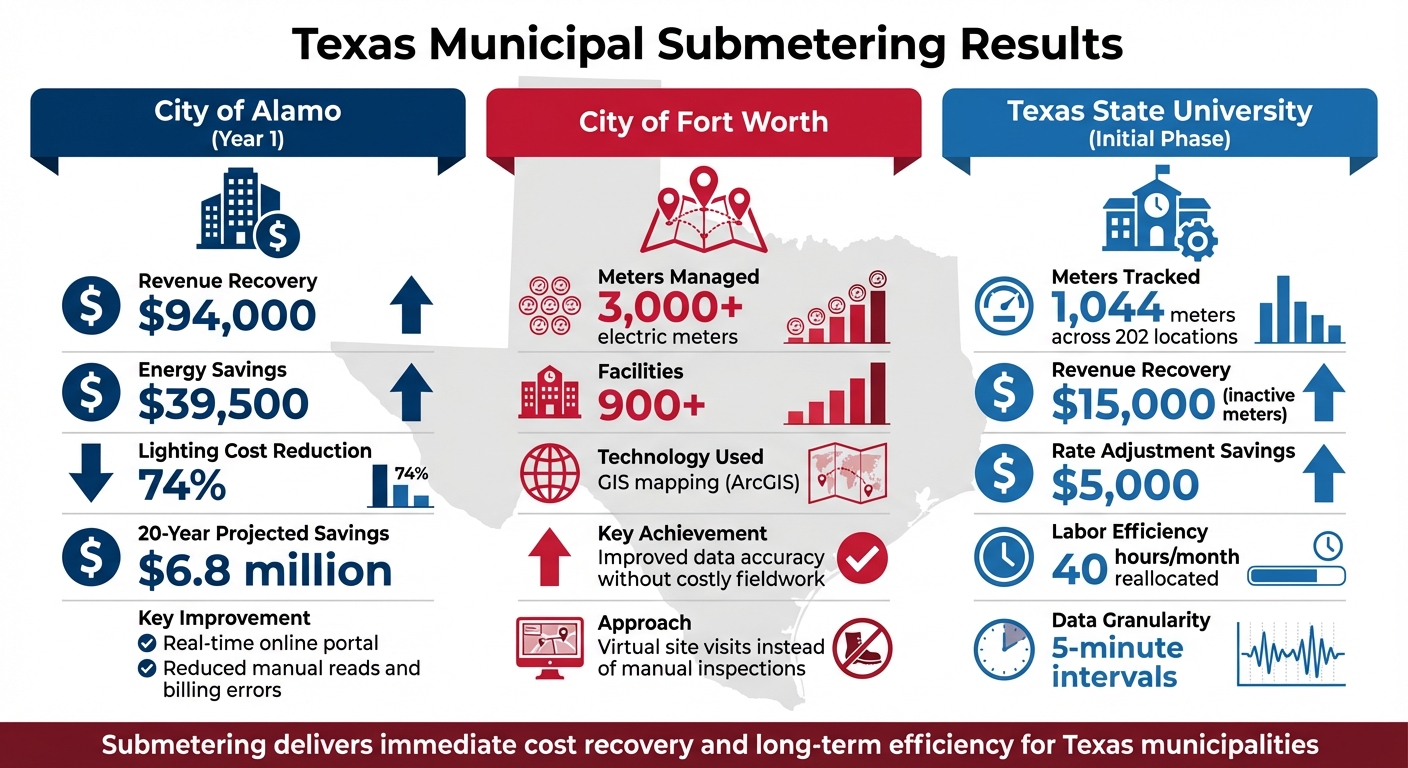
Texas Municipal Submetering Results: Cost Savings and Efficiency Gains
Planning and Installation Process
Back in 2013, the City of Fort Worth, Texas, faced a daunting task: managing over 900 facilities and 3,000 electric meters while trying to determine which meters served buildings versus those powering streetlights and similar non-building assets. Instead of relying on time-consuming manual inspections, the city’s energy services team partnered with FacilityDude to employ ArcGIS software for a virtual site visit approach [2].
The project involved layering data from various sources, including county GIS parcel information, city Risk Management Division reports, and utility account service address data for electricity, natural gas, and water. Using the proximity and visual analysis tools within the GIS platform, technicians were able to accurately link meters to specific structures. This approach not only improved the accuracy of asset and utility records but also eliminated the need for expensive fieldwork [2].
Selecting the right meters that align with accuracy, range, and compatibility requirements was key. Regular calibration and integration with automated systems replaced the need for manual data collection, making real-time consumption analysis possible [1].
Data Analysis After Installation
Once the systems were installed, advanced software analytics began delivering actionable insights. Starting in August 2012, Texas State University implemented EnergyCAP and utiliVisor software to oversee 1,044 meters across 202 locations. This effort, led by Utilities Analyst Brittany McCullar and Manager of Operations Doug Bynum, marked a shift from manually tracking data in spreadsheets to an automated system that captured consumption data every five minutes [5].
This detailed data quickly revealed inefficiencies. During the initial phase, Texas State University identified $15,000 in charges for inactive meters and $5,000 in billing rate errors that had previously gone unnoticed [5]. Doug Bynum highlighted the benefits of the system:
"utiliVisor provides instantaneous utility consumption data which is collected every five minutes… In the future, we will use the consumption imported for sub-meters to invoice internal departments based on actual consumption" [5].
With this granular data, facility managers could spot unusual usage during off-hours, confirm savings from retrofit projects, and focus on high-consumption buildings for efficiency improvements. The emphasis shifted from manual data entry to meaningful data analysis, transforming how energy management was approached.
Cost Savings and Performance Results
The detailed data and streamlined processes led to measurable savings and operational improvements. In early 2021, the City of Alamo, Texas, collaborated with Schneider Electric to replace outdated 1990s mechanical water meters with advanced metering infrastructure (AMI) and upgraded city facilities with LED lighting. By August 2023, the results were impressive: the city recovered $94,000 in lost revenue and saved $39,500 in energy costs within just the first year [4]. City Manager Robert Salinas remarked:
"Our citizens now see more accurate billing and will benefit from long-term savings" [4].
Over the next 20 years, the project is expected to save $6.8 million [4].
For Texas State University, automation brought significant efficiency gains. Brittany McCullar noted:
"enabled EnergyCAP UtilityManagement to export utility bill data in the precise data format required by the University’s AP system. As a result, TxState has permanently reallocated 40 working hours per month to other duties by eliminating double data entry" [5].
| Metric | City of Alamo (Year 1) | Texas State University (Initial Phase) |
|---|---|---|
| Revenue Recovery | $94,000 [4] | $15,000 (inactive meters) [5] |
| Energy/Rate Savings | $39,500 [4] | $5,000 (rate adjustments) [5] |
| Labor Efficiency | Reduced manual reads and billing errors [4] | 40 hours/month reallocated [5] |
| Data Granularity | Real-time online portal [4] | 5-minute intervals [5] |
These findings highlight how submetering can deliver immediate cost recovery while setting the stage for long-term efficiency and savings for municipalities in Texas.
How E3 Design-Build Contractor Supports Municipal Energy Projects

Texas-based E3 Design-Build Contractor is making strides in municipal energy projects by offering integrated energy solutions that boost efficiency and reduce costs.
E3’s Energy-Efficient Services
E3 takes a comprehensive approach to municipal energy systems, going far beyond standard meter installations. Their in-house team of engineers and contractors oversees every step of the process, from initial planning to final installation. This includes implementing high-efficiency HVAC systems, LED lighting retrofits, Building Automation Systems (BAS), and optimizing Energy Management Systems (EMS) [6].
What sets E3 apart is their design-build methodology. The same team that designs the energy solution also handles the installation. As E3 puts it:
"We only build what we design. Our in-house engineers and contractors work hand-in-hand to develop and complete the most efficiently designed and most effectively installed projects" [6].
This seamless integration eliminates potential disconnects between design and construction, resulting in more reliable energy performance.
Custom Solutions for Texas Municipal Buildings
E3 leverages its integrated methods to create tailored energy solutions for municipal buildings. With over 350 Texas clients, the company has a deep understanding of the unique challenges faced by municipalities [6]. They specialize in retrofitting occupied buildings, often working during off-hours to ensure government operations remain unaffected [6].
E3 also helps municipalities secure low-interest funding through Utility Assessment Reports for the SECO LoanSTAR program. This program provides public sector entities with loans as low as 2% for energy efficiency projects [7]. A standout example of their work is the $6,421,852 energy efficiency project with Bryan ISD between June 2020 and 2021. The project included district-wide LED lighting upgrades across 24 facilities, EMS optimization at 19 campuses, and power conditioning improvements at 23 locations [7].
Delivering Cost Reduction and Long-Term Savings
E3’s projects are designed to deliver measurable savings, as demonstrated by the Bryan ISD initiative. This project resulted in $763,908 in annual savings. Dr. Daniel Trevino, Jr., Superintendent of Bryan ISD, remarked:
"We realized our annual savings estimate in just over eight months of tracking" [6].
The improvements in LED lighting, EMS optimization, and power conditioning set the stage for accurate energy tracking through submetering.
E3’s dedication to accountability is evident in their ongoing performance tracking and guaranteed savings verification. By ensuring municipalities not only install advanced systems but also achieve the promised financial and operational benefits, E3 helps public entities maximize their energy investments over the long term.
Conclusion and Key Takeaways
Main Benefits of Submetering
Submetering offers precise energy tracking, eliminates billing errors, and highlights revenue losses caused by outdated equipment. With real-time monitoring portals, staff can quickly identify and address inefficiencies as they arise.
The financial advantages are undeniable. For instance, Alamo’s upgrades recovered lost revenue and significantly reduced energy expenses[4]. In some cases, LED upgrades have cut energy costs by as much as 74% over a project’s lifespan[4]. City Manager Robert Salinas emphasized this progress, stating:
"Our citizens have already seen more accurate billing each month and will experience the benefit of long-term cost savings for our city."[4]
But the benefits go beyond financial savings. Submetering simplifies operations by eliminating the need for manual meter readings, allowing staff to focus on higher-priority responsibilities. For example, Fort Worth’s integration of GIS technology enabled the efficient management of thousands of meters without requiring costly field inspections[2]. These improvements directly address the challenges of high energy costs, limited data, and operational inefficiencies highlighted earlier.
The Future of Energy Efficiency in Texas Municipalities
With these demonstrated cost savings and operational enhancements, Texas municipalities are well-positioned to adopt smarter energy solutions. Mayor Diana Martinez of Alamo underscored this vision:
"The City of Alamo recognizes the local and global call for action in creating a more inclusive, safe, resilient, and sustainable community."[4]
The shift toward comprehensive energy management is gaining momentum. The detailed data provided by submetering is now instrumental in securing federal and state funding for large-scale infrastructure projects. This data-driven approach not only aligns local initiatives with global sustainability goals but also equips municipalities with the tools they need to navigate Texas’s unpredictable ERCOT energy market. As cities face mounting budget constraints and regulatory demands, submetering remains a key strategy for achieving immediate cost savings and long-term operational improvements.
FAQs
How do I know if submetering will pay for itself?
To figure out if submetering is a smart investment, weigh the installation and maintenance costs against the potential savings it could bring. These savings might come from reduced energy use, streamlined operations, or reclaiming lost revenue. Take this example: a city in Texas installed smart meters and LED lighting, saving millions over two decades. Even in the first year, they recovered $94,000. If your expected savings outweigh the costs within a reasonable period, submetering could be a solid choice.
What data is needed to map meters to buildings accurately?
Accurate mapping relies on a combination of critical data and specialized tools. This includes information like meter locations and asset details, paired with software such as ArcGIS. Tools like ArcGIS allow for virtual site visits, making it easier to verify and correctly associate meters with their respective buildings.
Can submetering help us charge departments by actual energy use?
Submetering lets you track energy use for each department separately, making it possible to bill based on actual consumption. This approach not only ensures fair cost distribution but also encourages departments to take responsibility for their energy use, promoting more mindful consumption habits.