
Hospital air control has to work 24/7 because a small pressure or airflow drift can put patients, staff, and procedures at risk.
If I had to sum this up in a few lines, I’d say this: a hospital BAS helps keep air changes per hour (ACH), room pressure, temperature, humidity, filtration, and alarm response within set limits. It does that by linking sensors, VAV boxes, dampers, air handlers, and exhaust systems so rooms like AIIRs, protective environments, and operating rooms stay within code-driven targets such as those in ASHRAE 170-2021 and ASHRAE 241-2023.
Here’s the short version of what matters most:
- ACH tracking: The BAS watches supply and exhaust airflow so rooms stay at the right ventilation rate.
- Pressure control: It keeps isolation rooms negative and protective or surgical spaces positive by balancing air in and air out.
- Humidity and temperature logging: It records trends for audits, fault checks, and service planning.
- Filter monitoring: DP sensors show when filters are loading up before airflow drops too far.
- Outdoor air control: It brings in enough outside air without throwing off humidity or energy use.
- Alarm routing: Pressure loss, low airflow, and fan failure need fast response from the right team.
- Equipment check first: If fans, coils, sensors, or dampers are off, BAS logic alone won’t fix the problem.
A few facts stand out. The article ties hospital controls to minimum ACH, pressure, filtration, and humidity rules in ASHRAE 170-2021. It also points to Equivalent Clean Airflow (ECAi) and Infection Risk Management Mode (IRMM) from ASHRAE 241-2023, which give facilities a way to increase clean-air delivery when infection risk goes up.
In plain English: hospital IAQ control is not just about adding more air. It’s about keeping the right airflow, in the right direction, with the right alarms and records, all the time.
| Focus Area | What the BAS Does | Why It Matters |
|---|---|---|
| Airflow / ACH | Tracks and adjusts supply/exhaust flow | Keeps rooms within ventilation targets |
| Room Pressure | Holds negative or positive pressure | Helps limit cross-contamination |
| Temp / Humidity | Monitors and logs room conditions | Supports comfort, sterility, and audits |
| Filters | Tracks pressure drop across filters | Helps spot loading before airflow suffers |
| Outside Air | Adjusts intake based on conditions | Balances ventilation with humidity control |
| Alarms | Flags faults by priority | Speeds staff response |
If you’re reviewing a hospital BAS, the core question is simple: Can the HVAC system and controls hold pressure, airflow, and humidity targets in actual room conditions, not just on paper?
Core BAS Functions for Hospital IAQ Control
A hospital BAS coordinates air handlers, exhaust fans, terminal units, dampers, and sensors to keep each space within design targets in real time. In plain terms, it keeps airflow, pressure, and air quality inside set limits all day, every day. These are the baseline controls used across the hospital, with the tightest attention on spaces that have strict pressure and ventilation rules.
Airflow Control, ACH Tracking, and HVAC Coordination
The BAS maintains target air changes per hour (ACH) by coordinating supply and exhaust airflow through VAV units, dampers, and room pressure controllers. When room conditions shift, the BAS adjusts airflow instead of forcing fans to run flat out. That means ventilation can track what the space needs at that moment.
Reliable ACH tracking depends on supply fans, exhaust fans, and terminal units working in sync. If supply airflow drops because a filter is clogging or another fault starts to show up, the BAS can flag it before IAQ takes a hit. Calibrated airflow sensing in VAV boxes and air handlers helps improve ACH tracking across operating rooms, patient care areas, and support spaces [3].
Pressure Room Tracking for Isolation, Protective, and Surgical Spaces
Room pressure controls airflow direction and helps limit cross-contamination in spaces where that matters most. The BAS maintains the needed pressure difference by balancing supply and exhaust airflow [4]. In rooms with moderate leakage, a room pressure controller adjusts the extract air damper, while a separate VAV unit manages supply air to meet ACH targets based on temperature or IAQ conditions.
Differential pressure (Δp) sensors track the relationship between a room and the nearby corridor, measured in inches of water gauge (in. w.g.). If pressure drifts out of range, the BAS sends an alarm so staff can step in fast. For low-leakage rooms such as surgical suites, a bypass damper runs in parallel with the extract air damper to allow tighter pressure control. Airtight rooms use cascade control, where the room pressure controller sends a setpoint shift to the VAV unit to offset minimal leakage without creating instability [4]. Modern controllers can also switch pressure modes, so a room can move between positive and negative pressure ratios when clinical needs change [4].
Those same controls matter even more in isolation rooms, protective environments, and operating rooms.
Temperature, Humidity, and IAQ Data Logging
Airflow is only part of the picture. The BAS also tracks temperature and relative humidity all the time, along with room pressure and ventilation data [1]. Trend logs record temperature, humidity, pressure, and airflow for audits and performance checks [1][2]. Those records also support ASHRAE Standard 241-related checks [2]. If humidity jumps or airflow begins to fall, the BAS can trigger a maintenance response before IAQ is affected [1].
The next step is putting these controls to work in high-risk room types and tying them to the alarm logic that supports them.
| Control Component | Primary Function | Typical Signal |
|---|---|---|
| VAV Units | Maintains ACH based on temperature or IAQ | Volumetric flow (CFM) |
| Δp Sensors | Monitors room-to-corridor pressure relationship | Inches of water gauge (in. w.g.) |
| Bypass Dampers | Fine-tunes pressure in low-leakage rooms | Actuator position |
| IAQ Sensors | Detects CO2, VOCs, and humidity | PPM, %, or VOC index |
| BAS Controller | Coordinates supply/exhaust and logs trend data | BACnet or Modbus protocol data |
sbb-itb-034f8e1
How BAS Controls Critical Hospital Spaces
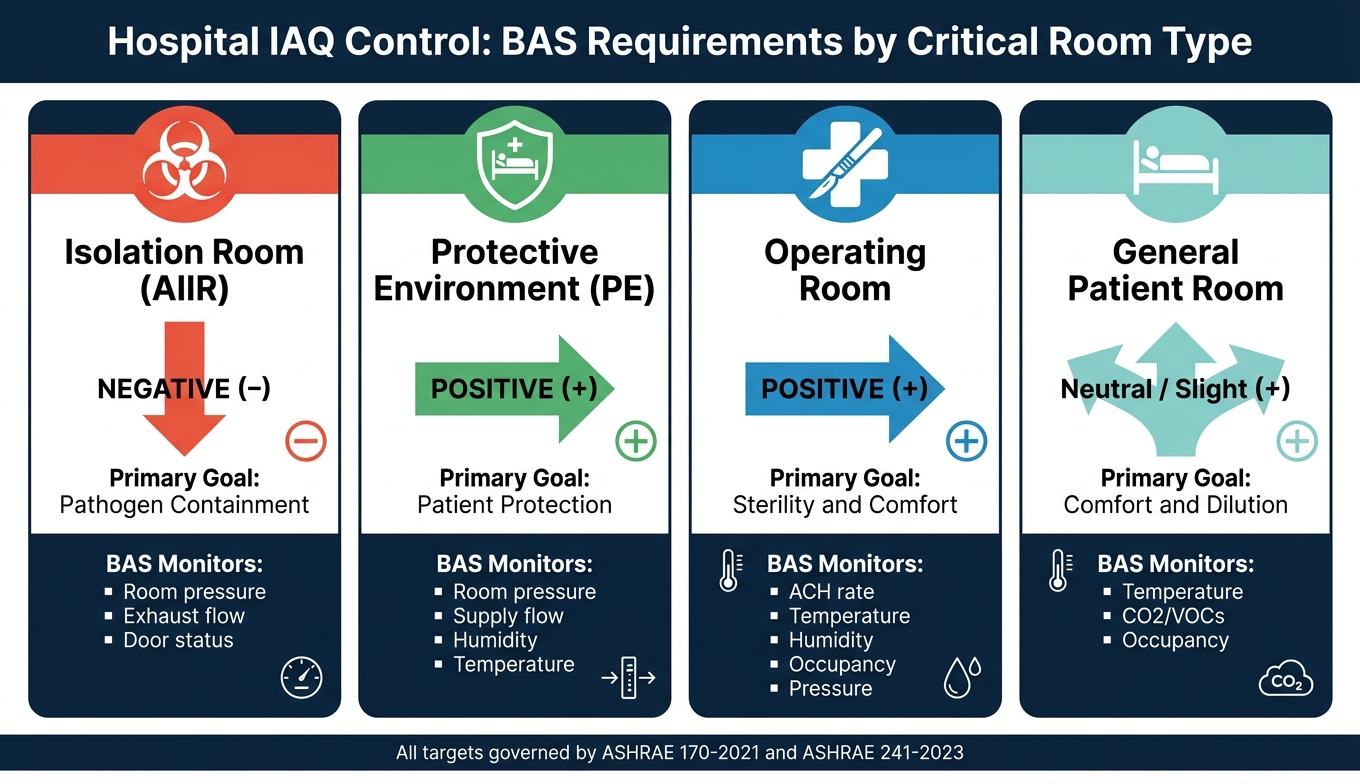
Hospital IAQ Control: BAS Requirements by Critical Room Type
Hospital rooms don’t all carry the same indoor air quality risk. That means the BAS has to control airflow, pressure, temperature, and humidity with much tighter rules in critical areas. In practice, the room type shapes how the BAS handles airflow balance, pressure targets, and how fast the system needs to react.
Airborne Infection Isolation Rooms and Protective Environments
Airborne Infection Isolation Rooms (AIIRs) depend on steady negative pressure so infectious aerosols stay inside the room instead of drifting into nearby areas. The BAS does this by managing the offset between supply and exhaust air, while also watching exhaust flow and room pressure at all times [2].
Protective Environments (PEs) are built for immunocompromised patients, so they need steady positive pressure. In these rooms, the BAS monitors supply flow, room pressure, humidity, and filter status [2]. Some controllers can also switch the pressure mode if the room’s clinical use changes.
Operating Rooms and Procedure Suites
Operating rooms need several conditions to work together at the same time: high ventilation rates, positive pressure, and tight temperature and humidity control. The BAS has to coordinate all of that to support sterility and comfort [1].
When an OR isn’t being used, the system can lower ventilation rates to cut energy use while still keeping the room within target conditions. Once the room goes back into use, the BAS returns it to operating setpoints. Trend data in these spaces also helps drive alarm logic and speeds up maintenance response.
IAQ Control Requirements by Space Type: Comparison Table
The table below shows how BAS priorities shift by room type.
| Space Type | Pressure Relationship | Primary BAS Goal | Typical BAS Monitoring Points |
|---|---|---|---|
| Isolation Room (AIIR) | Negative (−) | Pathogen containment | Room pressure, exhaust flow, door status |
| Protective Environment (PE) | Positive (+) | Patient protection | Room pressure, supply flow, humidity, temperature |
| Operating Room | Positive (+) | Sterility and comfort | ACH rate, temperature, humidity, occupancy, pressure |
| General Patient Room | Neutral / Slight (+) | Comfort and dilution | Temperature, air quality (CO2/VOCs), occupancy |
Pressure control only works when sensors, dampers, and controllers stay in sync. These room-level controls also rely on clean filters, steady outside air, and clear alarm priorities.
Filtration, Outside Air, and Alarm Management
Once pressure control is steady, the BAS still has a lot to juggle. Filters load up, outdoor air changes with conditions, and alarms need to tell the right people at the right time.
Filter Status Monitoring and Maintenance Triggers
Loaded prefilters, final filters, and HEPA filters can choke airflow and throw room pressure off balance. To watch for that, the BAS uses differential-pressure (DP) sensors across each filter stage. These sensors track loading all the time.
As particles build up, the pressure drop across the filter climbs. That gives the BAS a clear signal that the filter is getting dirty, so it can send a service alert before airflow falls below target. Facility teams can see those alerts in dashboards [1].
This matters because dirty filters don’t just sit there quietly. They affect airflow, pressure, and ACH. So as filters load, the BAS adjusts fans, dampers, and alarms to help keep those targets in range.
Filter loading and outdoor-air volume both affect airflow, so the BAS can’t treat them as separate issues. It has to manage both at the same time.
Outside Air Control Without Losing Humidity or Energy Efficiency
The aim is simple: bring in enough clean air without wrecking pressure control or humidity limits.
In humid climates, that balance gets tricky fast. More outdoor air can help with ventilation, but it can also dump extra moisture into the system. To deal with that, the BAS uses occupancy and IAQ data to trim outdoor air while still staying above minimum ventilation targets [1].
A good control sequence also checks outdoor dew point or enthalpy before increasing outdoor air. That way, the system doesn’t pull in air that creates a humidity problem. Filtration and air-disinfection methods can help support clean-air targets without relying only on added outdoor air. ASHRAE 241-2023 supports clean-air targets through Equivalent Clean Airflow (ECAi) [2].
Those airflow shifts need alarm logic that matches the situation. Not every issue calls for the same response, and not every alert should hit the same team.
Alarm Setup, Priorities, and Response Workflows
Pressure, airflow, and fan alarms matter because they show when isolation, protective, or surgical spaces are drifting out of spec. Room-pressure loss, exhaust fan failure, and low airflow should go to engineering right away. Filter-loading warnings should go to maintenance [1][2].
| Parameter Monitored | Typical Limit or Trigger | Affected Spaces | Required Staff Response |
|---|---|---|---|
| Room Pressure | Out of range | Isolation Rooms, ORs, Protective Environments | Immediate inspection of seals, doors, and exhaust fans |
| Filter Differential Pressure | High loading or exceeding manufacturer max | All AHU-served zones | Schedule filter replacement; check for bypass or frame leaks |
| Airflow / ACH | Below minimum setpoint | Operating Rooms, Isolation Rooms | Check fan status, VFD speed, and damper positions |
| Outdoor Air Damper | Fault or position error | Entire building / AHU zone | Manual override and actuator repair/replacement |
| Humidity | High or low humidity | Sterile Processing, ORs | Adjust cooling coil discharge temperature or dehumidification setpoints |
| Exhaust Fan | Failure or low flow | Isolation Rooms, Labs | Dispatch immediate maintenance; switch to backup exhaust; restrict room use |
Thresholds like these can’t just be set once and forgotten. They need to be commissioned, checked in operation, and matched against how rooms are actually performing.
Implementation Priorities and Conclusion
What to Review Before Upgrading a Hospital BAS
Once you’ve set room-level targets for airflow, pressure, filtration, and outside air, the next step is pretty simple: make sure the building can actually hit them.
Before you add new controls, check whether the current plant can maintain the pressure, airflow, and humidity targets outlined above. If the mechanical side can’t keep up, no amount of BAS programming will solve the root problem.
ASHRAE 241-2023 calls for a Building Readiness Plan that defines the operational controls needed to meet target equivalent clean airflow.
Use this checklist to sort out what can be fixed in BAS logic versus what calls for mechanical repair [1][2][6]:
| Review Category | What to Check |
|---|---|
| HVAC Equipment | Coil capacity, fan performance, age, and repair history |
| Sensors | Accuracy, calibration, and coverage |
| Pressurization | Room pressure tests for isolation and protective spaces |
| BAS Logic | Alarm history, trends, and sequences |
| Compliance | ASHRAE 170, 62.1, and 241-2023 alignment |
That distinction matters. A drifting sensor, weak fan, or undersized coil can throw off the whole control strategy. On paper, the sequence may look fine. In the field, though, the system still falls short.
How a Design-Build Partner Can Support Hospital IAQ Goals
After the scope is defined, the upgrade needs to move as one coordinated project instead of a patchwork of separate fixes.
In humid Texas conditions, outdoor-air sequencing and dehumidification need to be reviewed together [5][6]. If one side gets changed without the other, the result can be unstable humidity, comfort issues, and pressure control problems.
E3 Design-Build Contractor can coordinate facility assessment, HVAC upgrades, BAS work, TAB, and closeout in one project scope.
That kind of single-scope delivery helps teams cut down on handoff issues between trades. It also makes it easier to line up controls, airside work, testing, and final verification.
Conclusion: The Role of BAS in Hospital IAQ
A well-tuned BAS helps hospitals maintain pressure, airflow, filtration, and alarm response with less manual intervention. That supports infection risk management, code readiness, and more proactive maintenance across critical spaces.
FAQs
How does a BAS prevent pressure drift in critical hospital rooms?
A building automation system helps stop pressure drift in critical hospital rooms by constantly tracking and correcting supply and exhaust airflow. The goal is to hold a field-adjustable offset between the air coming into the room and the air leaving it.
With closed-loop, pressure-independent controllers, the BAS keeps that offset steady even when room conditions shift. If an airflow device fails or static pressure changes, the system detects the drift and adjusts on its own.
What should be checked before upgrading a hospital BAS for IAQ control?
Before upgrading a hospital building automation system for indoor air quality control, start with a detailed energy audit and a full review of the equipment already in place. That gives you a clear picture of what can stay, what can connect to the new setup, and what should be replaced to improve long-term efficiency.
It also helps to complete a physical inventory and an on-site inspection of key parts, including air handling units, valves, and temperature, pressure, and humidity sensors. At the same time, confirm that the new system supports open-source protocols like BACnet.
How do ASHRAE 170 and ASHRAE 241 affect hospital air control strategies?
ASHRAE 170 lays out the core ventilation rules for hospitals, including room airflow and pressurization, to help protect patients and support compliance.
ASHRAE 241, introduced in 2023, adds equivalent clean airflow (ECA) as a way to measure pathogen-free air. E3 builds these standards into building automation, so HVAC systems keep the required indoor conditions in place.