
If I want a geothermal HVAC system to last, I need a service plan, clean records, and routine checks on the loop, heat pump, pumps, and controls. Poor upkeep can cut system efficiency by 10% to 30%, and sites with written maintenance plans often see 60% to 70% fewer emergency calls.
Here’s the short version:
- I track EWT, LWT, loop pressure, amp draw, and fault history
- I split service by closed-loop vs. open-loop needs
- I assign simple checks to staff and licensed work to vendors
- I use BAS and HVAC monitoring to catch low flow, bad antifreeze, sensor drift, and lockout risks
- I budget routine service apart from major repairs like compressors, pumps, and loop work
A geothermal system doesn’t need mystery. It needs clear tasks, good logs, and action before small issues turn into downtime.
What matters most:
- Monthly: filters, noise checks, condensate area, thermostat settings
- Quarterly: drain flow, duct inspection, loop connection checks
- Seasonal: reversing valve check, antifreeze test, expansion tank check, spring/fall trend review
- Annual: loop pressure, pH, EWT/LWT log, pump amps, coil cleaning, safety switch test
- Every 3 to 5 years: loop flush, inhibitor refresh, blower wheel cleaning
Closed-loop and open-loop systems also need different attention:
| System Type | Main Focus | Common Service Checks |
|---|---|---|
| Closed-loop | Fluid health and loop pressure | pH, antifreeze strength, pressure stability, inhibitor condition |
| Open-loop | Water quality and scaling | Hardness, descaling, well/discharge records, permit files |
I also watch a few hard numbers that help me spot trouble fast:
- Static loop pressure: 30 to 50 PSI
- Pressure loss overnight: no more than 3 PSI
- Suction superheat: 8°F to 12°F
- Air-side delta-T: 15°F to 22°F
- Sensor drift: keep within 2°F
- Loop fluid pH: 7.0 to 9.0
If I keep those readings logged and compare them to startup data, I can spot drift early, plan repairs, and avoid more emergency work. That’s the core of this guide.
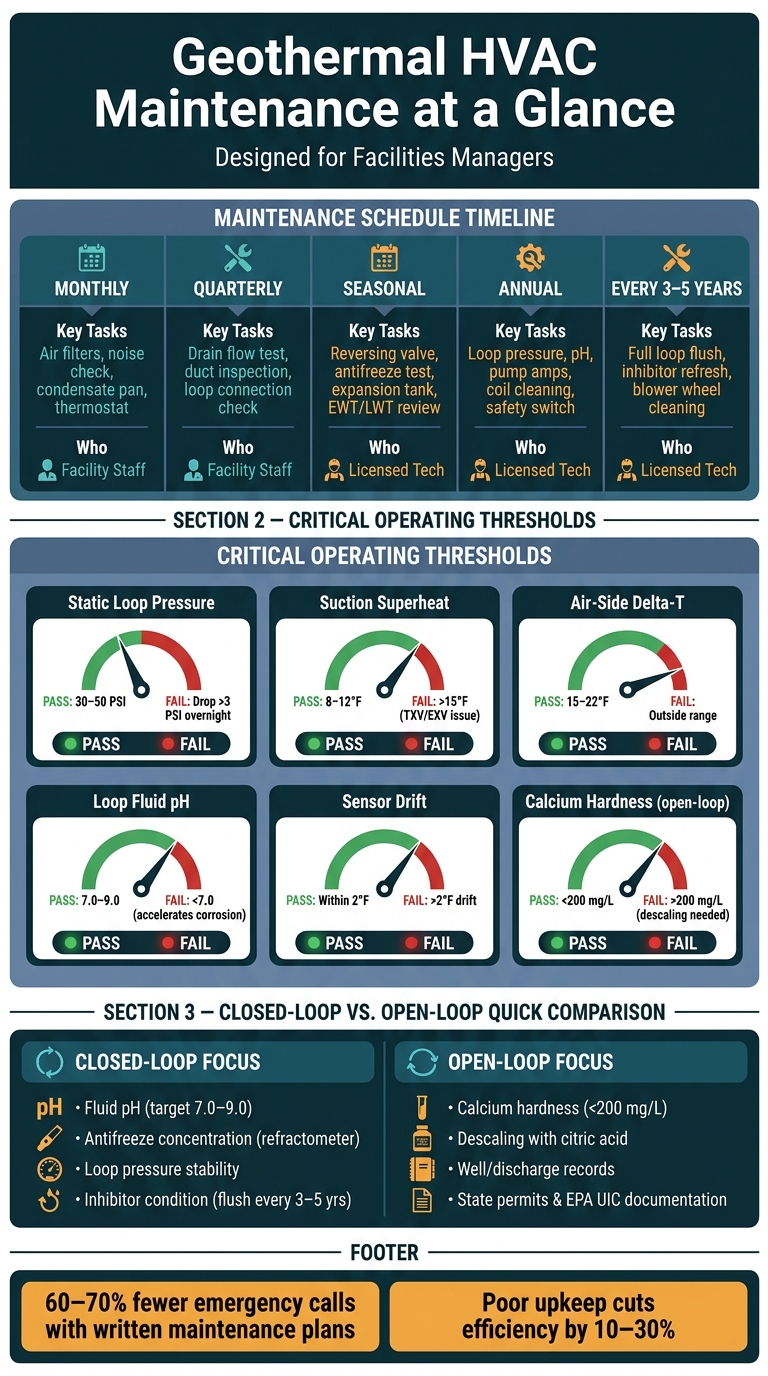
Geothermal HVAC Maintenance Schedule: Tasks, Intervals & Pass/Fail Thresholds
Geothermal Maintenance 101 – Heat of extraction / rejection
sbb-itb-034f8e1
How to Build a Geothermal HVAC Service Plan
A good service plan starts with a plain, complete inventory. First, document every heat pump, loop zone, pump, valve, sensor, thermostat, and BAS point. Then sort those items into three parts: the ground loop, the refrigerant circuit, and the building distribution. That simple structure makes task assignment and handoff faster, and it gives you the starting point for service intervals and ownership.
Document Equipment and Set Service Intervals
For each asset, record its location, system type, and baseline operating data. During commissioning or at the next full inspection, log EWT, LWT, and loop pressure. Those numbers become your baseline for future trend checks. Keep them in the same asset record so they don’t get overlooked later.
Use a clear service cadence. Monthly and quarterly work should cover filter changes, visual inspections, and condensate drain flushing. In spring and fall, run seasonal checks to verify loop pressure, clean the heat exchanger, test antifreeze concentration, check expansion tank pre-charge, and confirm reversing valve operation. For closed-loop systems, schedule periodic fluid flushes, inhibitor refreshes, and pump bearing checks every 3 to 5 years [5][4][3][2].
Assign Staff Roles and Vendor Responsibilities
In-house teams can usually take care of filter changes, visual checks, thermostat verification, and BAS alarm review [5][2]. Vendors should take on work that touches the refrigerant circuit, such as refrigerant diagnostics, loop repressurization, antifreeze adjustments, electrical testing, and heat exchanger descaling. Any refrigerant-circuit work calls for EPA Section 608-certified technicians [1][5].
For multi-campus public facilities, spell out escalation steps in plain terms. A BAS alarm should start with an in-house check. If heating delta-T climbs above 15°F or cooling delta-T climbs above 12°F, hand it off to a vendor [3]. Once roles are clear, BAS trend data can show when the plan needs action instead of guesswork.
Use BAS Monitoring to Catch Problems Early
A building automation system turns geothermal equipment into a steady stream of readable data. Set it up to track EWT, LWT, pump status, runtime trends, and historical logs. Then use that data to decide when a problem calls for hands-on inspection.
Watch for alarm conditions that point to trouble. If heating EWT drops below 30°F, check flow and antifreeze. If EWT goes above 90°F in cooling mode, you may be heading toward a high-pressure lockout [3]. Short-cycling is another warning sign, and it usually shows up as unusually short runtimes. It also helps to separate brief low-temperature events from ones that stick around. If low temperatures persist, that’s often a sign of a flow or antifreeze issue. Historical trend logging also helps track down intermittent faults that are easy to miss in a single site visit [3]. When BAS monitoring is set up in a structured way, it can cut emergency service calls [4]. Those trend lines also help your team start with the parts most likely to need inspection.
Key Components to Inspect for Reliable Performance
Once the plan is set, focus on the three areas that fail most often: the indoor heat pump, the ground loop, and the controls. Building systems integration and BAS trends usually tell you where to start. That matters, because the readings can show which zone is most likely causing the issue before you open anything up.
Indoor Heat Pumps, Airflow, and Refrigerant Components
Start with the basics: the filter and evaporator coil. If airflow is restricted, compressor load goes up and system capacity drops. It’s a simple problem, but it can snowball fast. The condensate pan and drain line also need attention at least once a year to stop algae growth and clogs.
On the refrigerant side, suction superheat is one of the best checks for system charge and expansion valve condition. A normal reading is 8–12°F. If compressor suction is above 15°F, that usually points to a failing TXV or EXV [1].
For the reversing valve, verify that it shifts on a 24V signal. If it sticks, replace it. A valve that moves once and then hangs up again isn’t fixed. Check the solenoid coil resistance too. A normal reading is 5 to 15 Ω. If the circuit is open, the coil has burned out. Then test compressor insulation resistance: above 2 MΩ passes, while below 1 MΩ points to a failed compressor [1].
Ground Loop, Pumps, Valves, and Fluid Condition
If BAS trends suggest a loop problem, check pressure and fluid condition first. Record EWT, LWT, and loop pressure at the start. Those numbers help split loop faults from refrigerant faults. If EWT is in range but the unit still throws faults, the next stop is usually the refrigerant circuit or air side. If EWT is out of range, focus on the loop, pumps, antifreeze, or loop sizing [3].
Loop pressure and fluid condition deserve close attention. With the pump off, static pressure should stay between 30 and 50 PSI. If it drops by more than 3 PSI overnight, that’s a failure. It can mean air is getting into the system, which cuts heat transfer [3].
Check expansion tank pre-charge only when the pump is off and the loop is depressurized. If the tank reads the same as loop pressure with the pump off, the bladder has failed and the tank needs to be replaced [3].
For antifreeze, use a refractometer, not a hydrometer, and make sure it’s calibrated for the fluid in the system. The target freeze point should be at least 10°F below the design minimum EWT for the region. Also pay attention to the fluid itself. Brown color or a sour smell means the inhibitor package is depleted. When that happens, flush and refill the system instead of topping it off [3].
Loop fluid pH should stay between 7.0 and 9.0. If pH drops below 7.0, corrosion speeds up and heat exchanger life can be cut by 5 to 10 years [1]. In open-loop systems, monitor calcium hardness too. Levels above 200 mg/L often mean descaling with citric acid is needed to avoid a 10% to 20% increase in energy costs [3][2].
Distribution, Sensors, and Controls
On the distribution side, inspect duct insulation for gaps or damage, check grilles for blockages, and verify that air-side delta-T across the coil is between 15 and 22°F. For hydronic systems, confirm expansion tank pre-charge at 15 to 20 PSI.
Sensor calibration is the hands-on follow-up to BAS trend review. If sensor drift goes past 2°F, bad readings and nuisance alarms start to show up. Fault code history matters too. Review it during every inspection. If a code clears after reset and stays away for at least 60 minutes, it was likely a transient event. If the same code returns within an hour, you’re probably dealing with an active mechanical or loop failure that needs direct diagnosis.
The table below sums up the main checks and the pass/fail thresholds:
| Component Group | Key Inspection Points | Pass Criteria | Fail Criteria |
|---|---|---|---|
| Heat Pump | Coils, filters, reversing valve | Clean coils; filters replaced; valve shifts on 24V signal | Dirty coils; clogged filters; valve stuck or open-circuit coil |
| Refrigerant Circuit | Suction superheat, compressor insulation resistance | Superheat 8–12°F; resistance > 2 MΩ | Superheat > 15°F (TXV/EXV issue); resistance < 1 MΩ |
| Ground Loop Fluid | pH, antifreeze concentration, color/smell | pH 7.0–9.0; freeze point 10°F below min EWT | pH < 7.0; diluted or high freeze point; brown or sour fluid |
| Loop Pressure | Static pressure (pump off) | 30–50 PSI, stable overnight | Drop > 3 PSI overnight; below 15 PSI minimum working pressure |
| Pumps & Valves | Amp draw, vibration, seals | Amps within nameplate RLA; no visible seal leaks | Zero or very low amps; active seal leaks |
| Distribution & Airflow | Air-side delta-T, condensate pan, grille obstructions | Delta-T 15–22°F; pan clear; grilles unobstructed | Delta-T out of range; algae or clogs in pan; blocked grilles |
| Sensors & Controls | Calibration, fault code history | Sensors within calibration; no recurring fault codes within 1 hour | Sensor drift > 2°F; fault codes returning within 60 minutes |
Maintenance Schedule and Records to Keep
Inspection points are useful, but they don’t do much on their own. You need a fixed schedule. Otherwise, small tasks get pushed back, and system efficiency can slip before anyone notices a clear problem [1].
The schedule below turns those inspection items into repeatable work. The aim is simple: keep the system running well, catch drift early, and make sure the right people handle the right jobs.
Weekly, Monthly, and Quarterly Tasks
Routine checks should go to facility staff. Work involving refrigerant, the ground loop, or water treatment should stay with licensed technicians.
Each month, facility staff should:
- Check air filters
- Listen for abnormal noises
- Check the condensate pan and drain area
- Verify thermostat programming
Each quarter, they should test condensate drain flow, inspect ductwork, and check ground loop connections.
The table below maps tasks to frequency and responsibility:
| Interval | Task | Who |
|---|---|---|
| Monthly | Check air filters, noise review, check condensate pan and drain area, verify thermostat programming | Facility staff |
| Quarterly | Test condensate drain flow, ductwork inspection, loop connection check | Facility staff |
| Annual | Loop pressure, fluid pH, EWT/LWT log, pump amp draw, coil cleaning, safety switch test | Licensed technician |
| Every 3–5 years | Full loop flush, inhibitor refresh, blower wheel cleaning | Licensed technician |
Seasonal checks fill in the gaps that routine visits can miss.
Seasonal Startup and Annual Performance Checks
Before cooling season, verify the reversing valve, clean the condensate drain line, and confirm that spring EWT matches design targets. Before heating season, test antifreeze concentration with a refractometer and check expansion tank pre-charge before the first hard freeze.
It also helps to compare current EWT, LWT, and amp draw against commissioning data and prior-year readings. That’s one of the best ways to spot drift early [3]. In many cases, seasonal drift points to loop problems before the unit throws a fault code [3].
Of course, those numbers only matter if someone logs them year after year.
Logs, Checklists, and Service History
Every visit should end with a completed record. Good documentation speeds up troubleshooting, supports warranty claims, and gives you backup when it’s time to justify a budget [5].
At a minimum, keep these records for each unit:
- Commissioning data: design GPM, original EWT/LWT, initial loop pressure, antifreeze type and concentration
- Fluid health logs: pH readings, refractometer freeze point, inhibitor status, and any flush dates
- Visit-by-visit electrical readings: compressor RLA, capacitor MFD readings, pump amp draw per visit
- Recurring fault codes and alarm timestamps: fault codes (e.g., FP1, HP) and alarm history
- Monthly energy use trends: consumption data tied to seasonal EWT patterns
For open-loop systems, add water quality records, including calcium hardness readings, descaling dates, and copies of any state water-use permits or EPA Underground Injection Control (UIC) documentation [1]. Those files support compliance. They also make vendor quotes and capital requests much easier to defend.
Vendor Support, Budgets, and Next Steps
What to Include in a Geothermal Service Agreement
A service agreement only helps if it spells out scope, responsibility, and response time. And for a geothermal system, that goes well beyond a generic HVAC contract.
The contract should make it clear who owns which tasks on both sides. That includes licensed work like refrigerant handling under EPA Section 608, loop repressurization, antifreeze adjustment, and electrical component testing. Clear task ownership also helps protect warranty coverage [5][2][4].
Each service visit should produce a report that compares current EWT, LWT, delta-T, and amp draw against baseline readings. That way, you’re not just checking boxes. You’re tracking whether the system is drifting over time.
Response times need to be written into the agreement too. If the system throws critical alarms like FP1/FP2 freeze protection lockouts or HP lockouts, those calls should get priority scheduling or priority emergency response [3][2][4].
Once the scope and response window are set, the next move is simple: keep routine service costs separate from long-term repair and replacement reserves.
Budget Factors for Routine Service and Long-Term Repairs
The cleanest way to budget is by task type and then by repair horizon. In plain English, split day-to-day service from the bigger-ticket items that show up later.
Routine costs include annual inspections, filter changes, condensate cleaning, and loop fluid pH testing. Long-term renewal costs usually involve pumps, compressors, controls, and loop repairs that tend to appear after 15–25 years [3][2][4].
Service logs and BAS trend data should guide capital planning. For example, a rising EWT trend over several cooling seasons can point to thermal saturation in the loop field and suggest that remediation may be needed [3][4].
| Cost Category | Key Cost Drivers | Data Sources for Planning |
|---|---|---|
| Routine Service | Filter MERV ratings, annual inspections, condensate cleaning, pH testing | Maintenance logs, manufacturer manuals, ASHRAE Standard 180-2018 [5][3] |
| Minor Repairs | Capacitor/contactor wear, condensate clogs, sensor calibration | Service logs, fault code history [1][3] |
| Long-Term Renewal | Compressor replacement ($3,000–$6,000+), pump motor failure, loop remediation | Equipment age, EWT/LWT trends, Megger test results [3][2][4] |
| Fluid Chemistry | Glycol inhibitor refresh every 3–5 years, antifreeze type, loop volume | Refractometer/pH test logs [3] |
| Emergency Service | Overtime rates, refrigerant leak detection and recovery | Historical emergency call frequency [1] |
Public entities should also check utility rebates or incentive programs that may help offset renewal costs. It’s also smart to negotiate repair pricing at the start. Many vendors offer 10%–15% discounts on repairs and parts for facilities that stay on an active maintenance plan [4].
Conclusion: Core Practices That Keep Geothermal HVAC Running
Once roles, records, and response times are in place, the hard part is sticking with the process. Long system life comes from steady maintenance: document assets from day one, inspect the parts that matter most, follow a seasonal service calendar, and keep records that show the full health story of the system.
BAS monitoring helps fill the space between scheduled visits by catching drift before it turns into a fault. Clear vendor agreements help stop missed tasks. And a budget that separates routine maintenance from long-term renewal can keep deferred work from snowballing into a capital crisis. For public entities such as school districts, municipalities, and healthcare systems, who can use a school facility energy savings estimator to project ROI, these steps also support the investment case for geothermal and other energy-efficient facility upgrades through organizations like E3 Design-Build Contractor.
The system does the work; the facility team keeps it maintained.
FAQs
How often should a facility service a geothermal HVAC system?
Facilities should schedule geothermal HVAC service at least twice a year – ideally in spring and fall – ahead of the busiest cooling and heating months. A yearly inspection handles the main mechanical parts and loop checks, but those seasonal visits can help keep the system running well and extend its service life.
Air filters should be checked every 1 to 3 months. More specialized work – like loop fluid flushing, pump bearing inspections, and heat exchanger servicing – should be scheduled every 3 to 5 years.
What readings matter most when tracking geothermal system health?
Historical data matters more than any one reading. Track entering water temperature (EWT) and leaving water temperature (LWT) over time so you can spot slow thermal shifts before they turn into bigger problems.
It also helps to log loop pressure, flow rates, refrigerant suction and discharge pressures, superheat, energy use, and temperature differentials. When you look at those readings together, they make it much easier to catch faults early and compare system performance against design benchmarks.
What tasks should staff handle vs. a licensed vendor?
Facility staff should take care of the day-to-day basics. That includes monitoring thermostat setpoints, keeping vents clear, checking for water leaks, listening for unusual noises, and inspecting or replacing air filters.
Technical diagnostics and repairs belong with licensed vendors. That covers refrigerant work, loop pressure testing, antifreeze adjustments, electrical inspections, and any work on heat exchangers or circulation pumps.