
One school avoided a $3.5 million+ wired controls job by using BACnet wireless instead.
I see this case as a simple lesson in cost control: when walls, ceilings, and class schedules make new wiring hard to run, wireless controls can cut install work, lower labor, and keep the building open. In this project, staff had been spending 15 to 20 hours a week keeping old HVAC controls working, and Texas heat made failures a direct risk to class time when rooms stayed above 78°F for more than 2 hours.
Here’s the short version:
- Main problem: old HVAC controls kept failing
- Big constraint: concrete walls and finished ceilings made new wiring hard
- Wired option cost: more than $3.5 million, plus about $30,000 a year in service contracts
- Wireless approach: BACnet wireless tied unit ventilators, RTUs, and AHUs into one central interface
- Main install win: no wall cuts, less conduit, less mess, and less class disruption
- Main staff win: remote alarms, schedules, trends, and temperature checks from one place
- Reported labor impact: up to 65% less installation time, about 61% less electrical labor, and around 200 labor hours saved on similar school retrofit work
- Key lesson: plan RF coverage early, keep local control at the unit level, and train in-house staff
If you run a school or other public building, this case shows how wireless BACnet can solve a wiring problem and a budget problem at the same time.
Project Background And Drivers
Campus Profile And Existing Building Conditions
This Texas K–12 campus had older classroom wings and only limited controls infrastructure. Its HVAC setup depended on standalone thermostats, with no central monitoring in place. Those physical limits shaped every control choice from the start.
How Legacy Controls Raised Costs And Complaints
With no central controls, staff had no easy way to monitor equipment, set schedules, or get fault alerts. Standalone room control setups also kept them from adjusting indoor conditions or checking energy use and alarms from one place [1][4].
Principal Keir Rogers said steadier classroom temperatures would improve comfort and learning.
At its core, this was an operations problem. Staff were stuck reacting to issues one room at a time instead of managing the campus as a whole. Given that pressure, a wireless retrofit became the most practical option.
Why BACnet Wireless Was Chosen
The retrofit needed to avoid demolition, exposed conduit, and long classroom disruptions. Running new control cabling through concrete walls would have meant cutting into walls or installing exposed conduit, and neither option fit the schedule or the budget [3].
Wireless BACnet solved that problem. It removed the need for above-ceiling cabling and demolition, which made it the only option that fit the site’s physical limits [3].
sbb-itb-034f8e1
Project Scope And Control Goals
HVAC Equipment And Controls Included In The Upgrade
Once cabling was off the table, the district built the retrofit around the HVAC equipment it could manage wirelessly. The upgrade brought the campus’s main HVAC systems under centralized BACnet wireless control. That covered classroom unit ventilators, rooftop units (RTUs), and air handling units (AHUs). Wireless controllers connected those systems to a Niagara-based interface for central monitoring [3][1][6].
Comfort, Scheduling, And Visibility Targets
The top comfort goal was simple: keep classrooms at steady temperatures. Staff also needed remote access to alarms, trends, and setpoint changes. On top of that, they wanted standard daily and holiday schedules so equipment wouldn’t keep running after hours for no good reason [1].
There was another key requirement too. The controls had to keep local control in place if the network went down [6]. That need shaped both the network design and the device choices.
Budget And Performance Targets
The project also had to protect class time and keep installation labor down. That mattered a lot in an active school setting, where long disruptions can throw off the whole day. Wireless BACnet installs have been shown to save about 200 labor hours on a single elementary school retrofit and reduce installation time by as much as 65% compared with wired options [3][4].
The team also planned to set up a six-month data baseline after commissioning [5]. That would give staff a clear way to track how the system performed once it was up and running.
BACnet Wireless Design And Installation
How BACnet Wireless Architecture Works
To hit the project goals, the district used a wireless BACnet setup that skipped new conduit and kept equipment local. The system still uses BACnet communication, but it removes the hardwired run.
Here’s how it worked: a supervisory controller in the data room connected to a wireless gateway. That gateway then communicated wirelessly with nodes attached to each HVAC unit. For larger campuses, the network can be split into multiple wireless segments to help maintain reliability and cut interference [4].
How Installation Was Done With Minimal Classroom Disruption
Wireless BACnet helped keep the retrofit quiet and low-impact. Since there was no drilling through walls or pulling wire through conduit, the campus avoided construction dust in hallways and classrooms.
Placing nodes at each HVAC unit was fairly straightforward, and commissioning did not require construction work during school hours. That low-disruption install also kept labor costs down and set up the budget gains discussed next.
Coordination, Security, And Delivery Planning
Wireless systems still need RF planning around school Wi-Fi and other building systems [4]. On this campus, early coordination across the mechanical, electrical, and automation scopes helped keep the project on track and prevented trade conflicts during installation.
Introduction to BACnet | What It Is and How It’s Used in Building Automation
Budget Results And Lessons For Other Districts
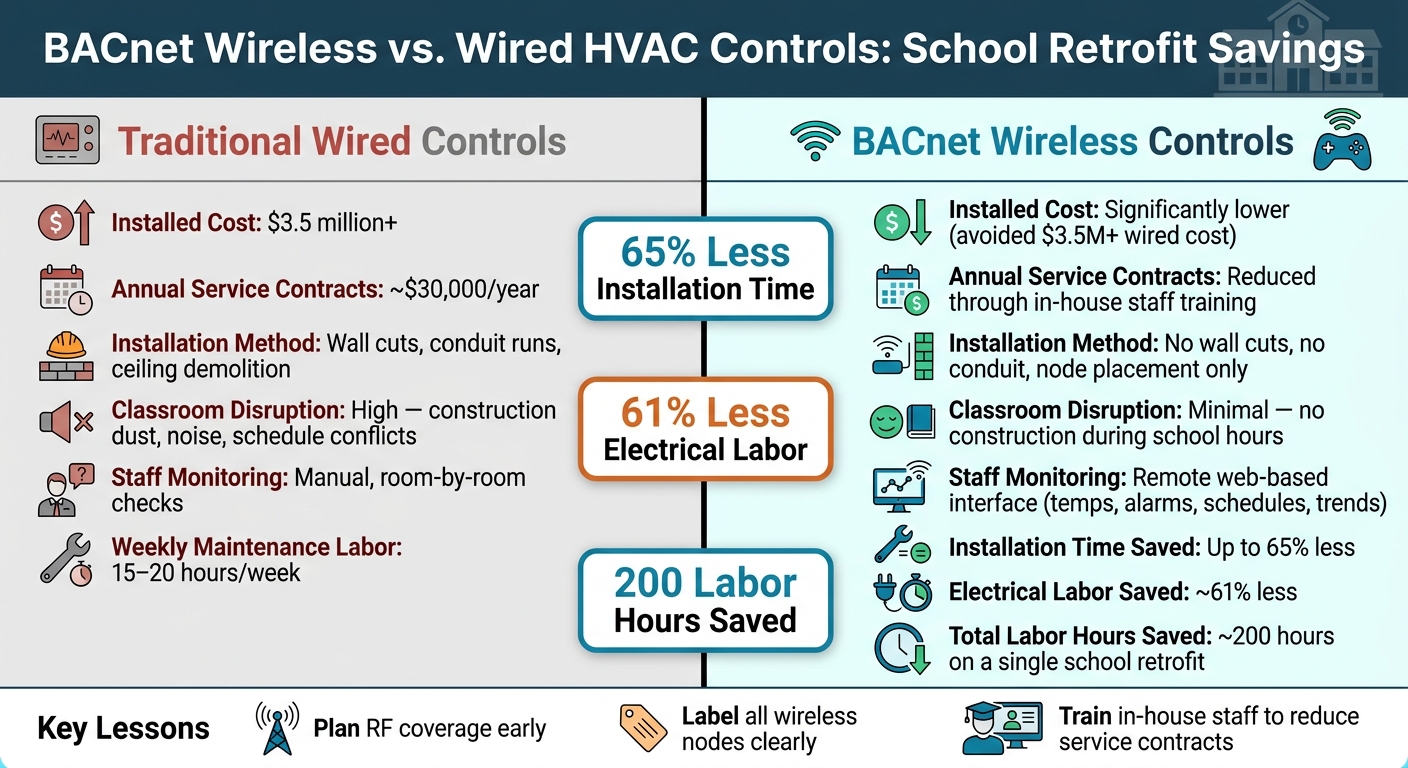
BACnet Wireless vs. Wired HVAC Controls: School Cost & Labor Savings
How BACnet Wireless Helped Keep The Project On Budget
Once the wireless design was set, the savings showed up in the places that usually drive project costs: labor, demolition, and shutdowns.
BACnet wireless cut installed cost by removing the need for conduit, wall penetrations, and ceiling repairs. It also cut installation time by up to 65% and electrical labor by about 61% [4][7]. In school projects, that matters a lot. Less tearing into walls means less mess, fewer disruptions, and fewer hours on site.
Operational Gains After Startup
The savings didn’t stop after installation. The same wireless system also gave staff a much better day-to-day view of what was happening across buildings.
Teams could monitor temperatures, equipment runtime, and alarms from one web-based interface instead of driving to each site. That kind of remote access cuts routine visits and saves staff time. Schedule compliance also got better, which made it easier to spot HVAC units running when buildings weren’t occupied [1].
Conclusion And Lessons Other Districts Can Use
Other districts can take a few plain lessons from this: focus on installed cost, plan RF coverage early, and train in-house staff.
The RF survey should happen early, not after devices are already going in. Nodes should be labeled clearly so staff can find and manage them without guesswork. And in-house teams need training on the new interface. Districts that help their own technicians get comfortable with the system often avoid costly third-party service contracts over time [2].
FAQs
How reliable is BACnet wireless in a school?
In school retrofits, BACnet wireless has proven dependable in the field. One project finished integration even though there were no feasible cabling routes. It also avoided exposed conduit and still delivered solid reliability, with room to scale later.
Another project used a wireless BACnet mesh with 126 nodes across multiple networks and reported a high level of reliability, with no interference from other wireless systems.
What should a district plan before installation?
Before a BACnet wireless installation, school districts need a clear game plan. That starts with assessing each facility’s needs, reviewing the infrastructure already in place, and building a phased rollout plan that keeps disruption to classes as low as possible.
It also helps to coordinate early with school staff and contractors. That way, everyone knows what’s happening, when work will take place, and which areas need extra care. Just as important, districts should pinpoint the spots where wireless can replace difficult or high-cost wiring runs. In older buildings or hard-to-reach spaces, that can save time, labor, and money.
When it’s time to pick a system, an open-protocol system gives districts more room to grow over time and more flexibility with future budgets.
Can HVAC units still run if the network fails?
Yes. Many modern building automation systems include local control. That means controllers can keep HVAC equipment running even if the main network connection goes down.
In setups with distributed intelligence, air handlers and related equipment can keep operating as standalone systems. So even during a communication outage, the system can still help maintain occupant comfort.