
Building automation systems (BAS) are a game changer for cutting maintenance costs. By using sensors, controllers, and software, BAS monitors and adjusts HVAC, lighting, and other building systems in real-time. This reduces emergency repairs, extends equipment life, and lowers labor demands. Facilities save money by spotting issues early, scheduling maintenance based on actual usage, and reducing energy waste.
Key takeaways:
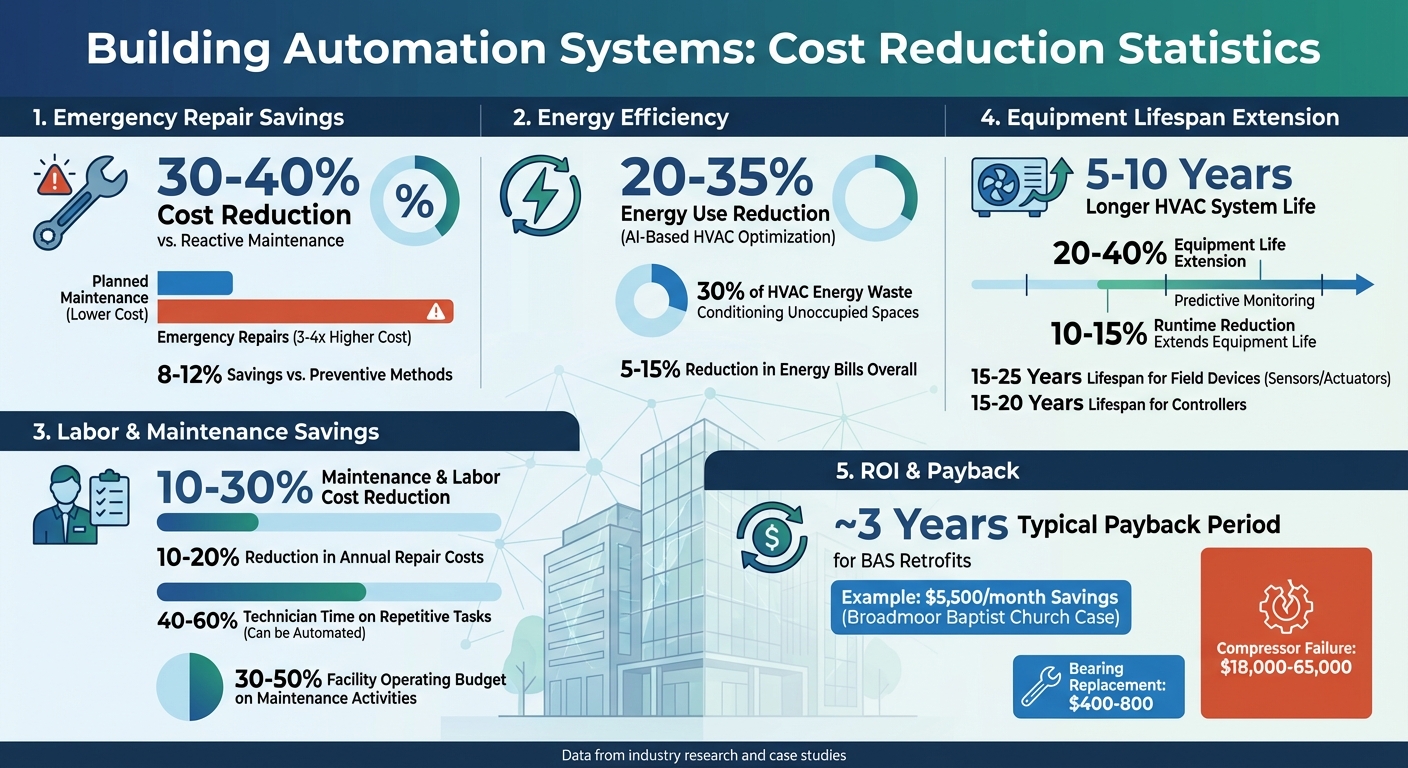
- Emergency repair savings: Predictive maintenance cuts costs by 30–40% compared to reactive methods.
- Energy efficiency: Smarter controls reduce energy use by 20–35%.
- Labor savings: Centralized dashboards streamline tasks, reducing maintenance costs by 10–30%.
- Longer equipment life: Less wear and tear means HVAC systems can last 5–10 years longer.
With automation, facilities can reduce expenses, improve system reliability, and better allocate resources.
Building Automation Cost Savings and ROI Statistics
BAM 092: Preventive Maintenance Strategies For BAS?
sbb-itb-034f8e1
How Predictive Maintenance Cuts Costs
Predictive maintenance slashes operational costs by reducing emergency repairs and fine-tuning upkeep. Building automation systems play a key role here, using real-time data to spot issues before they escalate into costly emergencies. Instead of sticking to rigid schedules or waiting for failures, these systems keep a constant eye on equipment health, alerting staff only when action is necessary. This proactive approach sets the stage for the detailed sensor analysis we’ll explore next.
The financial benefits are impossible to ignore. Emergency repairs can cost three to four times more than planned maintenance [5]. Predictive maintenance programs, on the other hand, deliver savings of 8–12% compared to preventive methods and 30–40% compared to reactive repairs [5]. These savings stem from avoiding overtime costs, rushing to replace parts, and preventing the domino effect of small, undetected issues turning into major problems.
Real-Time System Monitoring and Problem Detection
IoT sensors installed on critical components like compressors, fans, and pumps collect data on vibration, temperature, pressure, airflow, and current draw [5][4]. Analytics software then compares this real-time data with historical patterns, flagging anomalies that might signal a future failure [5].
- Vibration sensors: These can detect worn bearings in motors or pumps weeks before they fail [5][4].
- Pressure sensors: These can catch refrigerant leaks or clogged filters early, preventing strain on the compressor [5].
- Current draw increases: These often indicate blockages or mechanical wear, signaling that a component is overworking [5].
When these deviations are spotted, the system sends automated alerts with diagnostic details, pinpointing the root cause [4]. For instance, catching a $50 clogged filter early can prevent a $5,000 compressor burnout [5]. Predictive monitoring can extend equipment life by 20–40% and save 10–20% on energy costs in smart buildings by addressing inefficiencies quickly [5]. This precise detection ensures maintenance schedules align with actual equipment needs.
Maintenance Based on Actual Equipment Use
Building automation systems also track equipment run-hours and load patterns, allowing maintenance to be scheduled based on actual usage rather than arbitrary time intervals [5][4]. For instance, a rooftop unit cooling a busy cafeteria will naturally need more frequent servicing than one serving a rarely used conference room.
"Instead of indiscriminately scheduling maintenance, predictive systems flag specific components that are starting to underperform or show signs of imminent failure. You intervene only when needed, not before." – ISS Mechanical [4]
This condition-based approach eliminates unnecessary servicing while ensuring no issues are missed between inspections [4]. Facilities adopting predictive maintenance often see a double-digit drop in HVAC operating costs [4]. The budget saved can then be redirected to other priorities, contributing to long-term operational efficiency.
Companies like E3 Design-Build Contractor use these advanced strategies to enhance system performance, extend equipment life, and achieve lasting savings on maintenance and operational expenses.
Extending Equipment Life Through Better Controls
Every hour of operation puts wear and tear on compressors, fans, dampers, and electrical components. Running equipment continuously, even when it’s not needed, accelerates this wear without adding any benefit [6]. Building automation systems solve this issue by aligning equipment operation with actual demand, reducing unnecessary runtime that can shorten the lifespan of HVAC systems.
By cutting equipment runtime by just 10–15% through predictive maintenance, HVAC systems can last 5–10 years longer [6][10]. This approach lowers the need for replacements, reduces capital expenses, and increases asset longevity. Additionally, automation-supported maintenance can lower annual repair costs by 10–20%, thanks to reduced wear and tear [2]. This directly translates to lower ongoing maintenance costs.
Adjusting Systems Based on Building Occupancy
Automation doesn’t just reduce runtime – it also adapts systems to match real-time occupancy. Using tools like motion sensors, CO2 monitors, WiFi data, and badge readers, building automation systems identify which areas are in use [8]. Instead of heating, cooling, or lighting an entire building on a fixed schedule, these systems target specific zones based on actual activity. This eliminates the waste of conditioning unoccupied spaces, which accounts for about 30% of HVAC energy waste in U.S. commercial buildings [8].
Advanced systems go beyond simple on/off controls. They use techniques like thermal mass to stop mechanical cooling 30–90 minutes before a building is vacated, maintaining comfort while saving energy [8]. Dynamic setpoint optimization adjusts supply air and chilled water temperatures in real time, allowing equipment to operate at less stressful, lower capacities [8]. AI-driven platforms take it a step further by predicting thermal loads 2–24 hours in advance, using weather forecasts and historical trends [8].
For example, in March 2024, Broadmoor Baptist Church reported saving $5,500 per month on utilities after integrating facility management software with their building automation system. This upgrade automated lighting and HVAC controls based on their event schedule, replacing a manual process previously handled by staff [1]. Such precise, occupancy-based adjustments reduce unnecessary equipment cycling and mechanical wear.
Automatic Shutdowns When Buildings Are Empty
Smart scheduling complements occupancy-based adjustments by minimizing equipment operation during idle periods. These features automatically shut down or scale back systems during weekends, holidays, and after-hours times when buildings are unoccupied [6][9]. This prevents excessive runtime and avoids frequent on/off cycling, which can lead to premature wear on motors and electrical components [7][6].
The system can also integrate with event schedules, adjusting operations based on actual facility use [1]. For example, schools can ensure HVAC systems aren’t running at full capacity during summer break, while office buildings can give compressors and air handlers genuine downtime instead of running 24/7.
The results are often immediate. AI-based HVAC optimization typically reduces energy use by 20–35% without requiring any equipment upgrades [8]. Fewer operating hours also mean less frequent filter changes, fewer bearing replacements, and longer intervals between major overhauls, all of which lower annual maintenance costs.
E3 Design-Build Contractor applies these automation techniques for public facilities across Texas, helping schools, healthcare systems, and municipalities extend equipment life while cutting energy use and maintenance demands.
Reducing Labor Costs Through Central Control
Before automation, facility staff often spent countless hours moving between mechanical rooms, manually logging gauge readings, and performing repetitive tasks. These maintenance activities can account for 30–50% of a facility’s total operating budget [12]. Yet, much of this work doesn’t require specialized skills. By introducing a centralized building automation platform, these processes are streamlined. Systems like HVAC, lighting, and security are consolidated into a single interface, cutting down on time spent on routine adjustments and enabling more efficient management overall.
Managing All Systems From One Interface
A centralized dashboard gives facility managers instant access to all building systems without the need to physically visit individual control points. Rather than checking separate thermostats, lighting panels, or security systems, managers can view and control key functionalities – like HVAC, electrical, plumbing, and lighting – from one unified interface [11]. This setup reduces redundant efforts and lowers the risk of human error by aligning control strategies across the board.
Cloud-based platforms take this convenience a step further, allowing technicians to monitor and adjust settings remotely from any device with internet access [16,17,19]. For instance, when an alarm goes off, staff can troubleshoot and resolve issues remotely without needing to be on-site [1,23]. This capability is particularly valuable for operations that span multiple locations, saving both time and travel costs.
Additionally, modern systems use open protocols such as BACnet and Modbus, which allow devices from various manufacturers to work together seamlessly [9,17]. With around 77% of global building automation projects specifying BACnet, facilities gain long-term flexibility without being locked into proprietary systems.
Freeing Staff for More Important Work
By centralizing controls and automating routine tasks, valuable technician hours can be redirected toward more critical responsibilities. Research indicates that technicians spend 40–60% of their shifts on repetitive jobs like reading gauges or inspecting filters [12]. Building automation systems handle these tasks by continuously monitoring equipment and recording data, which reduces administrative workloads. Integration with computerized maintenance management systems further enhances workflow efficiency.
When a fault or performance issue arises, the system can automatically generate and assign work orders to the appropriate staff member [1,22]. This not only speeds up response times but also allows maintenance teams to focus on high-priority tasks, such as complex repairs or system optimizations, instead of routine inspections [1,4]. Implementing a building automation system can lead to a 10–30% reduction in maintenance and labor costs [2], giving public facilities the flexibility to optimize staffing or invest in upgrades that improve overall performance and occupant satisfaction.
"Building automation systems give real-time data, which leads to a more results-driven model and a more proactive approach… These systems are critical for centralizing maintenance and better managing service providers – both of which can lead to improvements in expenses and performance."
- Richard Patapoff, Head of Proptech Solutions, Commercial Banking at J.P. Morgan [13]
E3 Design-Build Contractor specializes in implementing centralized building automation systems for school districts, healthcare facilities, and municipalities across Texas. Their solutions help facility teams lower labor costs while enhancing system reliability and response times.
Measuring Financial Returns and Long-Term Savings
To understand the impact of automation, compare your current performance to historical data. A good starting point is to analyze 12–24 months of pre-automation data. Use the ROI formula: (Total Benefits – Total Costs) / Total Costs × 100 [2]. Additionally, calculate the simple payback period by dividing the initial investment by annual savings [2]. These financial metrics provide tangible proof of automation’s value, complementing the operational improvements previously discussed.
Tracking Maintenance Cost Reductions
Building automation generates savings in several key areas. Facilities often experience the following reductions:
- Maintenance and labor costs: 10–30%
- Repair expenses: 10–20%
- Energy bills: 5–15% [2]
These savings result from fewer service tickets, reduced weekend callouts, lower spending on parts, and less time spent on manual monitoring. Modern automation platforms take raw sensor data and transform it into visual dashboards, making it easier to pinpoint exactly where these savings occur.
Switching from fixed maintenance schedules to data-driven strategies further reduces costs by eliminating unnecessary work and minimizing emergency repairs [4][14]. Reactive maintenance, for instance, is typically 3–5 times more expensive than predictive approaches [14]. Facilities that adopt predictive maintenance often see significant reductions in overall HVAC operating costs [4].
Beyond cutting costs, automation also helps extend the lifespan of equipment, delaying expensive replacements.
Delaying Major Equipment Replacements
Automation doesn’t just reduce operating expenses – it also helps extend the life of major assets. By minimizing runtime and catching issues early, automation reduces wear and tear on equipment. Adjusting operations based on actual occupancy can lower runtime by 10–15%, which significantly extends HVAC life by several years [6]. Continuous monitoring and early fault detection allow technicians to fix small issues – like a vibrating fan or slight pressure deviation – before they escalate into costly failures.
The financial impact of preventing premature equipment failure is substantial. For example, replacing a bearing might cost $400–$800, but ignoring the issue could lead to a compressor failure costing anywhere from $18,000 to $65,000 [15]. By optimizing performance and addressing problems early, automation helps defer major capital expenditures and improves budget planning.
Field devices such as sensors and actuators can last 15–25 years, while controllers typically have a lifespan of 15–20 years when maintained through automated monitoring [16]. For example, E3 Design-Build Contractor uses advanced automation strategies to enhance operational efficiency and extend equipment life, ensuring long-term savings and better facility performance.
Conclusion
Building automation systems deliver measurable financial benefits by shifting maintenance from reactive to predictive. This shift minimizes emergency repairs, reduces labor costs, and prevents small problems from becoming major expenses. Many facilities report substantial savings, with most BAS retrofits paying for themselves in roughly three years [2][3].
The advantages don’t stop at immediate cost reductions. By optimizing equipment usage and catching issues early, automation helps extend the lifespan of critical systems. This is especially valuable for public organizations like school districts, healthcare facilities, and municipalities, where tight budgets and deferred maintenance are common challenges. Protecting assets in this way strengthens the case for adopting proactive maintenance strategies.
However, automation isn’t a "set it and forget it" solution. As Jon Logue of RMF Engineering explains:
"Owners who take a ‘set it and forget it’ approach tend to see those savings drop off by year three, just when they should start seeing their return" [3].
Regular retro-commissioning every 3–5 years is crucial to maintaining peak performance. This process addresses sensor issues, updates software, and fine-tunes system settings to ensure everything runs smoothly.
To maximize the value of your automation system, continuous management is key. This includes ongoing staff training, seasonal commissioning, and setting strategic alarms. When properly maintained, building automation systems offer the operational efficiency and financial flexibility needed to support high-performing, cost-effective facilities.
Discover more about integrating building automation solutions with E3 Design-Build Contractor.
FAQs
What building systems should I automate first to cut maintenance costs fastest?
To cut maintenance costs efficiently, focus on automating HVAC systems first. Predictive maintenance tools can track equipment health in real time, helping you avoid costly breakdowns and unnecessary repairs. Pair this with a building automation system (BAS) to manage HVAC, lighting, and other energy systems. This combination not only boosts efficiency but also reduces energy expenses. Prioritizing HVAC automation provides a smart way to save money while streamlining maintenance efforts.
How do I know if my existing HVAC equipment can work with a BAS?
To figure out if your HVAC equipment works with a Building Automation System (BAS), check whether it supports widely used control protocols like BACnet or Modbus. You’ll also need to confirm that your system includes controllers or sensors that are compatible. If it doesn’t, you might need to look into upgrades or retrofits. For guidance on integration or required updates, reaching out to a building automation expert can provide clarity and solutions.
What ongoing tasks are needed to keep BAS savings from dropping after a few years?
To keep your BAS (Building Automation System) savings intact over time, it’s important to focus on a few key practices:
- Regular maintenance: Ensure the system is routinely checked and updated to stay in top condition.
- Consistent energy monitoring: Track energy usage to identify any unusual patterns or inefficiencies early.
- Prompt issue resolution: Address any problems as soon as they arise to avoid larger malfunctions or costly failures.
These steps not only help maintain efficiency but also support the system’s long-term performance.