
If you need LED lights installed fast, a co-op often works best. If you need tighter price checks and a fixed scope, a formal bid is usually the better path.
I’d boil the choice down to four things: time, cost control, project scope, and staff workload. For Texas school districts, contracts at $50,000 or more must use a best-value method under Section 44.031. That means the buying path is not just a timing call. It is also a compliance call.
Here’s the short version:
- Co-op contracts are faster and lighter on admin work.
- Formal bids take longer but give tighter side-by-side price review.
- Co-ops fit standard fixture swaps and summer installs well.
- Formal bids fit larger jobs with controls, wiring, or custom scope.
- If federal funds are involved, I’d check EDGAR and HUB items before award.
- For LED work, change orders are often easier under co-op pricing, while bids hold closer to the original scope.
What matters most is matching the method to the project. A city doing a streetlight swap may want preset labor rates and a short start window. A school district doing a campus-wide upgrade with controls may want public notice, fixed specs, and direct vendor competition.
Quick Comparison
| Criteria | Cooperative Contract | Formal Bid / RFP |
|---|---|---|
| Best for | Standard LED retrofits | Large or more detailed projects |
| Timeline | 2–4 weeks in many cases | 6–12 months in many cases |
| Cost review | Pre-set pricing, but not always the lowest | Side-by-side pricing from competing vendors |
| Staff work | Lower | Higher |
| Change orders | Easier to handle in many cases | More tied to original bid scope |
| Public notice | Usually not needed from the buyer | Required |
| Good fit for | Schools, cities, retrofit work | Schools, colleges, healthcare, capital work |
So before I move on any LED project, I’d ask a simple question: Do I need speed, or do I need tighter bid control? That answer usually points to the right path.
sbb-itb-034f8e1
How Cooperative Contracts Work for LED Upgrades
Cooperative purchasing is a member-driven purchasing model. One lead agency handles a competitive solicitation, awards the contract, and then other public entities can buy from that contract instead of running a separate bid of their own. That can include school districts, cities, colleges, and healthcare systems. In Texas, agencies often use interlocal cooperative contracts [2].
BuyBoard is one of the most common cooperatives for Texas public agencies. For LED projects, the most relevant categories often include "Outdoor Street Lighting" and "Electrical Contractors." If an agency is already a BuyBoard member, it can move straight to vendor review. That changes the pace of the project and gives the agency more room to adjust scope without starting from scratch.
Cost review, timeline, and change-order flexibility
Co-op pricing is usually set up as a percentage discount off the manufacturer’s catalog price for materials, along with capped hourly labor rates for installation and repair [3]. In plain English, that setup can make mid-project changes a lot easier to handle. If a district wants to add fixtures, upgrade controls, or include more sites, it can often do that without kicking off a full re-bid.
The big draw is speed. Co-op projects can often begin within 2–4 weeks, while a standard RFP process may take 6–12 months [4]. For school districts trying to hit a summer install window, that timing matters. The same goes for cities handling multi-site retrofits on a tight schedule.
That said, speed doesn’t mean agencies should stop checking the numbers. Pre-negotiated pricing is not always the lowest available [1], so a best-value determination under Section 44.031 is still part of the job [2]. The contract may already be in place, but vendor documentation and price review still deserve a close look.
Vendor pool, documentation, and best-fit use cases
Co-ops prequalify vendors before contracts are awarded, so agencies aren’t starting at square one on due diligence. Even then, a few checks should happen before a purchase order goes out.
Agencies should confirm:
- Manufacturer authorization letters for each proposed LED product line [3]
- A valid EDGAR Vendor Certification if federal funds are involved [3]
- HUB status
It also helps to bring in an independent professional before talking with a co-op vendor. That step can help define the technical requirements and make sure the project lines up with current building and energy codes [1]. For more complex or multi-site LED upgrades, E3 Design-Build Contractor can define scope and verify that co-op proposals meet technical requirements.
Co-ops tend to fit best when the work is standardized and equipment-heavy. Think of a single-campus LED retrofit during summer break, a multi-site municipal fixture swap, or a product-based upgrade that combines LED lighting with controls. They’re usually a weaker fit for custom construction work or projects where price competition is the top priority. That tradeoff stands out more once you stack co-ops next to formal bidding.
How Formal Bidding Works for LED Projects
When a project needs tighter scope control and head-to-head price competition, formal bidding is often the other main route. In this setup, the agency, or a hired design professional, spells out exact specs for fixtures, controls, and installation standards before bids go out. That way, everyone is pricing the same job.
Under Texas Education Code Section 44.031, school district contracts of $50,000 or more within 12 months must use a best-value method, which includes competitive bidding or competitive sealed proposals [2]. Cities, colleges, and healthcare systems often follow the same path when they want exact specs and a clear paper trail.
Price transparency, specifications, and timeline
Because vendors respond to the same detailed scope, agencies can line up itemized pricing for products and labor side by side. That makes price comparisons much cleaner. And when contractors are hungry for work, formal bidding can lead to strong pricing.
The catch is timing. Texas law requires public notice to run once a week for at least two weeks before the bid deadline [2]. Then comes the review period, which adds more time. So if the project has a fixed installation window, that schedule needs to be built in early. Formal bidding works best when the scope is already locked in before procurement starts.
Competition, compliance records, and change-order controls
The biggest upside of a formal bid is open competition. Qualified vendors respond to the same published criteria, and agencies can look at more than just price. They can also weigh vendor reputation, quality, fit, HUB compliance, and lifecycle cost [2].
There’s also a recordkeeping angle. Under Texas Government Code Chapter 2269, offeror rankings must be made public no later than the seventh day after a contract is awarded [6]. That adds a clear compliance trail.
A fixed scope also helps keep change orders in check. If changes come up later, they’re easier to document because the original bid documents set a clear baseline.
For projects that involve controls, wiring, or other infrastructure work, the bid documents matter just as much as the dollar amount. On complex LED retrofits with electrical or controls work, a design professional can prepare bid-ready specs that match current standards [1].
Co-op vs. Formal Bid: Side-by-Side Comparison for Texas Agencies
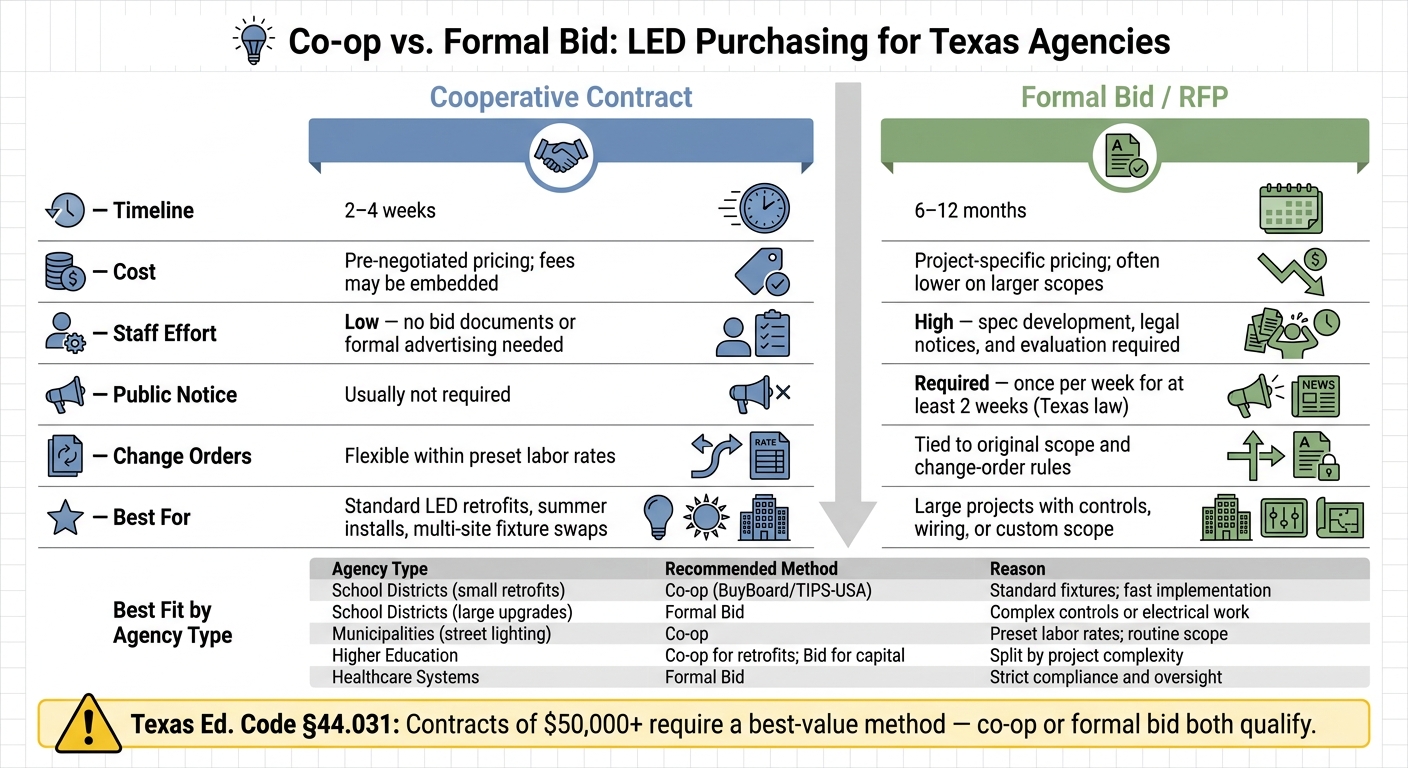
Co-op vs Formal Bid: LED Purchasing Guide for Texas Agencies
Both options are lawful. The better pick comes down to your timeline, project scope, and how much staff time you can put into the process.
If you need to move fast and keep admin work light, a cooperative contract often makes sense. If the project is large, more complex, or highly price-sensitive, a formal bid or RFP may give you tighter control.
Comparison by cost, schedule, compliance, and change orders
| Criteria | Cooperative Contract | Formal Bid / RFP |
|---|---|---|
| Cost | Pre-negotiated pricing; fees may be embedded. | Project-specific pricing; often lower on larger scopes. |
| Procurement Timeline | Fast – days to weeks. | Slower – public notice required. [2] |
| Staff Effort | Low; no bid documents or formal advertising needed. [1] | High; requires spec development, legal notices, and evaluation. [1] |
| Paperwork | Minimal; relies on interlocal agreements and standard forms. [2] | Extensive; full bid packages and public notices required. [2] |
| Change-Order Handling | Flexible within preset labor rates. [3] | Tied to the original scope and change-order rules. [1] |
Here’s the practical difference: a co-op can help you get from approval to kickoff without much delay. A formal bid takes more work up front, but that extra process can pay off when the scope is broad or the dollar amount is high.
The choice usually narrows to four things:
- Cost: Formal bids can produce lower pricing on larger projects, while co-ops trade some price pressure for speed.
- Schedule: Co-ops move in days or weeks. Formal bids take longer because public notice is required. [2]
- Compliance workload: Co-ops cut down on bid prep and advertising. Formal bids demand more internal effort. [1]
- Control over changes: Co-ops can be easier to manage when work shifts within preset labor rates, while formal bids stay closer to the original scope. [1] [3]
Best fit by agency type and project size
| Agency / Project Type | Recommended Method | Why It Fits |
|---|---|---|
| School Districts – small retrofits | Co-op (BuyBoard / TIPS-USA) | Standard fixture swaps; fast implementation. [2] [5] |
| School Districts – large facility upgrades | Formal Bid | Complex controls or electrical work; better price competition. [1] |
| Municipalities – street lighting | Co-op | Street-lighting retrofits; preset labor rates. [3] |
| Higher Education | Co-op for retrofits; Bid for capital projects | Retrofits: co-op. Capital projects: bid. [1] [5] |
| Healthcare Systems | Formal Bid | Strict compliance and oversight. [1] |
Agency type matters too. A school district replacing standard fixtures across a few campuses may do well with BuyBoard or TIPS-USA because the work is routine and speed matters. [2] [5] On the other hand, a large campus upgrade with controls, electrical changes, or a bigger budget often fits a formal bid process better. [1]
The same pattern shows up elsewhere. Municipal street-lighting retrofits often line up well with co-op pricing and preset labor rates. [3] Higher education buyers may split the difference: use a co-op for retrofit work, then use a bid for capital projects. [1] [5] Healthcare systems usually lean toward formal bidding because oversight and compliance demands are tighter. [1]
Conclusion: How Texas Agencies Can Pick the Right Path
The right path comes down to four things: speed, scope, funding rules, and staff capacity. That’s the lens Texas agencies should use to test the next purchase before anything moves forward.
Formal bidding can lower cost on larger projects, but it also brings more time and more process.
Key takeaways for planning the next LED project
Start by confirming whether Section 44.031 applies before choosing a procurement path. Then match the method to the job itself. Simple fixture swaps often fit co-ops well. Projects with controls, electrical work, or broader upgrades usually call for a closer design review.
If federal funds are part of the deal, check EDGAR and HUB requirements before award. That step matters. Missing it can create delays and force changes late in the process.
It also helps to get facilities, procurement, and legal teams on the same page from the start. A little alignment early can save a lot of backtracking later.
Once the path is set, align scope and delivery early. E3 Design-Build Contractor helps Texas public entities plan and deliver LED and other energy-efficient upgrades.
FAQs
How do I choose between a co-op and a formal bid?
Choose a cooperative contract when speed matters and the LED purchase fits the pricing and terms already in place. In Texas, that can meet competitive procurement rules without making you run your own bid.
Use a formal bid when the project is more customized or includes construction or design-build work that the co-op contract doesn’t cover. Your governing body should make a best-value decision and check compliance with your procurement officer or legal advisor.
When does Texas law require formal procurement steps?
In Texas, formal procurement usually kicks in once a contract passes a set dollar amount.
For municipalities, competitive bidding or proposal procedures are required for contracts over $50,000.
For school districts, competitive methods are required for contracts totaling $50,000 or more across a 12-month period.
There are a few exceptions. For example, school buses fall under a lower threshold of $20,000 or more.
State-approved cooperative contracts can meet these purchasing rules in some cases. But architectural and engineering services still need to be procured separately.
What should I verify before awarding an LED contract?
Before awarding an LED contract, make sure the vendor checks every required box. That includes all project rules, all applicable regulations, and manufacturer authorization to sell and service the equipment.
You’ll also want to confirm that the vendor complies with the 2018 International Energy Conservation Code or a later version, UL standards, HUB requirements, and any federal grant standards tied to the project.
Beyond paperwork, look at the vendor’s track record. Review their reputation, service quality, and ability to meet the district’s needs. If the job includes installation or electrical work, verify that the work will be done by – or under the supervision of – a licensed professional.