
If your school HVAC plan does not cover airflow, temperature, humidity, filters, maintenance, and records, it is incomplete. I’d boil this guide down to one point: school leaders need clear targets, a written PM plan, clean records, and firm contractor rules to keep classrooms comfortable, open, and within code.
Here’s the short version:
- Set indoor targets: about 68°F to 79°F, with 30% to 60% relative humidity
- Meet ventilation rules: classrooms often need 10 CFM per person + 0.12 CFM per square foot
- Watch air quality: indoor pollutants can be 2 to 5 times higher than outdoors, and at times much higher
- Use better filtration: aim for MERV 13 when equipment allows; do not go below MERV 8
- Track CO2 in busy spaces: keep it under 1,000 ppm, with under 800 ppm as the better mark
- Follow a school-year PM calendar: fall heating checks, spring cooling checks, summer overhauls
- Split work the right way: simple checks for in-house staff, licensed work for HVAC pros
- Document everything: asset lists, work orders, training logs, TAB reports, BAS records, and turnover files
- Plan money ahead: PM can cut later repair costs, and equipment life often ranges from 10 to 30 years depending on the asset
- Verify performance after work is done: commissioning and trend review help catch issues before they hit instruction
I see this article as a plain guide for district leaders who need to turn HVAC rules into day-to-day action. It ties school standards to maintenance schedules, staffing limits, contractor scopes, budget planning, inspections, training, and recordkeeping – all in one place.
If you run school buildings, this gives you the checklist to keep systems working and to show why the budget is needed.
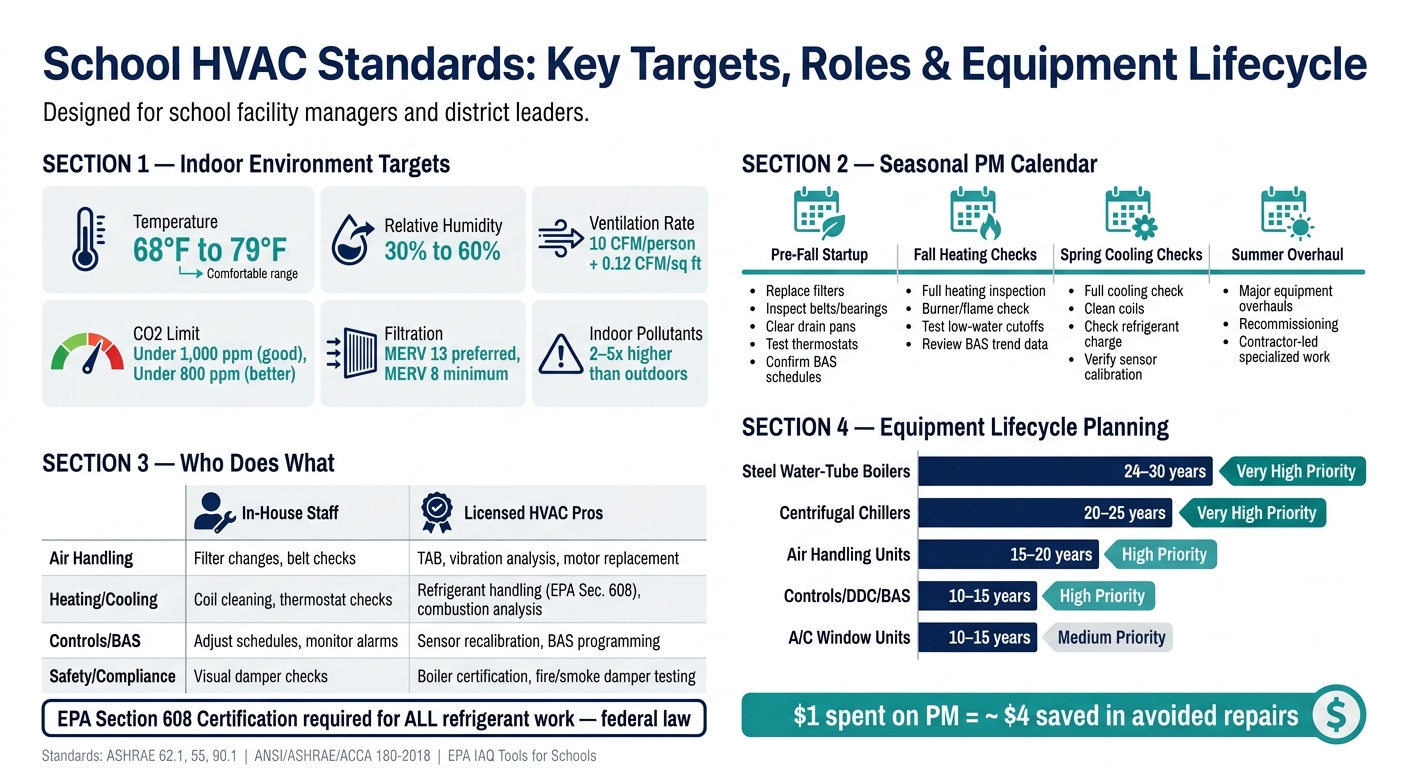
School HVAC Standards: Key Targets, Roles & Equipment Lifecycle at a Glance
HVAC Standards Framework for School Facilities
Core U.S. Standards and Guidance for Schools
School HVAC work starts with a clear ruleset.
ASHRAE Standard 62.1 sets the baseline for outdoor air ventilation in school spaces, including classrooms, gyms, kitchens, and labs. ASHRAE Standard 55 covers thermal comfort for people in occupied spaces. ASHRAE 90.1 and the International Energy Conservation Code (IECC) set the energy-efficiency rules for new construction and major renovations. The EPA’s IAQ Tools for Schools framework gives facilities teams a practical system for managing indoor air quality through inspection and maintenance routines.
Before any renovation or equipment replacement, confirm state and local code requirements. Those rules shape what you can install, how it must perform, and what inspectors will check. In day-to-day operations, these standards become the baseline for maintenance, service contracts, and inspections.
Operating Targets for Temperature, Humidity, Ventilation, and Filtration
Your team needs daily targets it can track and fix when things drift.
For occupied spaces, aim for 68°F to 79°F and 30% to 60% relative humidity [4]. For ventilation, classrooms for students age 9 and older require 10 CFM per person plus 0.12 CFM per square foot of floor area under ASHRAE 62.1 [1][4]. That gives staff a plain benchmark instead of guessing whether a room “feels fine.”
Spaces with changing occupancy, like gyms and cafeterias, can benefit from Demand Controlled Ventilation (DCV) using CO2 sensors. For classrooms, keep CO2 below 1,000 ppm, with below 800 ppm as the better target. For filtration, use MERV 13 where the equipment can support it, and do not go below MERV 8 [1][4].
Put these details in writing in the Owner’s Project Requirements (OPR) document, including:
- Setpoints
- Schedules
- Sensor tolerances
- Alarm limits
Written targets give every inspection a clear starting point.
Common School HVAC System Types and Upgrade Planning
Targets on paper don’t mean much if the equipment can’t hold them.
Central AHUs are usually easier to maintain and control to school targets than unit ventilators or individual heat pumps [1]. They also support higher-efficiency filtration, such as MERV 13+, and do a better job with humidity control. That matters in schools, where one weak link can affect a whole wing of classrooms.
Unit ventilators are often tougher to manage across a district. They’re usually noisier, harder to maintain at scale, and more likely to miss outdoor-air targets because of stuck dampers, blocked intakes, or weak controls. RTUs are common in many school districts and can perform well with steady preventive maintenance. If higher outdoor-air rates would otherwise push up operating cost, evaluate ERV [1].
Those system differences shape the maintenance schedule, service scope, and upgrade plan.
sbb-itb-034f8e1
Preventive Maintenance Standards and Schedules
How to Build a District Preventive Maintenance Program
The next step is turning those standards into a written PM program that people can actually use.
Start with a full equipment inventory. For each asset, log the manufacturer, model, serial number, installation date, and physical location. It also helps to use a numbering system that matches your Building Automation System (BAS), so records stay lined up across both systems. For nurse suites and assembly areas, plan for more frequent checks than you would in standard spaces.
Then set ANSI/ASHRAE/ACCA Standard 180-2018 as the baseline for the program. The 2024 IMC points to Standard 180 where adopted, so districts should keep maintenance records that line up with local code. A CMMS can make this much easier by automating work orders and storing records that are ready for audits. Keep work orders, findings, actions taken, technician name, and credentials for at least three years [6].
PM also helps districts think beyond this month’s repair ticket. It can extend equipment life and support multi-year replacement planning. And the cost case is hard to ignore: every $1 spent on preventive maintenance yields roughly $4 in savings by avoiding later repair or replacement costs [8].
Seasonal Maintenance Schedule Aligned to the School Calendar
Once the program is set, turn it into a school-year maintenance calendar.
Tie the schedule to the school calendar so teams can work when buildings are easier to access and disruption is lower. In hot, dusty climates, increase how often you change filters and clean coils. Dirty condenser coils alone can drive energy use up 10% to 20%.
| Season | Key Tasks |
|---|---|
| Pre-Fall Startup | Replace filters, inspect belts and bearings, clear drain pans and lines, test thermostats and safeties, confirm BAS schedules match the school calendar |
| Fall Heating Checks | Full heating inspection, burner/flame check, test low-water cutoffs, review BAS trend data for sensor drift |
| Spring Cooling Checks | Full cooling system check, clean evaporator and condenser coils, check refrigerant charge, verify sensor calibration, test control sequences |
| Summer Shutdown/Overhaul | Major equipment overhauls, recommissioning, contractor-led specialized work |
What In-House Staff Can Handle vs. Licensed HVAC Professionals
The calendar should also spell out who handles what.
Some work is fine for in-house teams. Some work should go ONLY to licensed HVAC pros. When districts blur that line, they open the door to safety problems and code issues. The fix is simple: write those boundaries straight into district maintenance procedures.
| Task Category | In-House Staff | Licensed HVAC Professionals |
|---|---|---|
| Air Handling | Filter changes, belt tension checks, cleaning drain pans, visual inspections | Test and Balance (TAB), vibration analysis, motor replacement |
| Heating/Cooling | Leak inspections, coil cleaning, thermostat setpoint verification | Refrigerant handling (EPA Section 608), combustion analysis, chiller tube cleaning |
| Controls/BAS | Adjusting schedules, monitoring alarms, basic setpoint changes | Sensor recalibration, BAS programming, sequence-of-operation optimization |
| Safety/Compliance | Visual damper checks, checking for unusual noise or vibration | Boiler certification, fire/smoke damper testing, specialty exhaust testing |
DDC upgrades also need staff training. Without it, overrides and operator mistakes can wipe out the efficiency gains the district paid for.
Any staff member or contractor doing refrigerant work must hold an EPA Section 608 certification. That is a federal requirement, not optional [6]. For boiler work, districts should also check state licensing rules.
These boundaries should shape vendor scopes and performance reviews.
Commercial HVAC/R Systems Tune-Up & Troubleshooting: From PM Lists to Callback Prevention
Vendor Selection, Contracts, and Performance Oversight
Once maintenance duties are clear, the contract needs to pin them down.
What to Include in Service Scopes, RFPs, and Contracts
Start with the OPR and turn the district’s HVAC goals into plain contract language. Spell out required certifications, response times, deliverables, and service windows that fit the school day.
Districts should also standardize key items across all campuses. That includes controls, naming, graphics, valve and actuator brands, and filter targets. If one school calls a point one thing and another school calls it something else, trouble shows up fast.
Turnover documents should be digital and searchable, not buried in binders on a shelf. Require:
- As-built drawings
- Sequences of operation as implemented
- Point lists
- TAB reports
Tie final payment to a complete turnover package. That’s often the only thing that keeps paperwork from drifting for months. For BAS work, bring in IT early so network security, remote access, and network segmentation are set before the job gets messy.
Of course, none of those terms mean much if the district doesn’t check performance after the award.
Performance Metrics, Commissioning, and Service Review Meetings
Keep a live issues log with owners and due dates, then review it in every service meeting. That simple habit helps stop open items from vanishing between site visits. Track unresolved issues and corrective action closeout times so there’s a clear record of what’s still broken, who owns it, and how long it’s been sitting there.
Commissioning is the step that proves whether the work performs the way it should. After major work, require Functional Performance Testing (FPT) in occupied and unoccupied modes, warm-up and cool-down cycles, and sensor calibration. For capital projects, bring in an independent Commissioning Authority (CxA) during planning or early design. In schools, commissioning costs usually run $0.10 to $0.30 per square foot for existing buildings [2], and 0.5% to 2% of total MEP cost for new construction or major renovations [3]. Studies show simple payback periods of 4 to 20 months [2].
"Commissioning is a powerful tool because it can indicate if the designers and contractors have done what they’ve been hired to do." – EPA [2]
Use Monitoring-Based Commissioning (MBCx) to keep an eye on BAS trends and alarms over time. Re-commission every three to five years, and always after major control or equipment changes. It also helps to require follow-up testing during peak heating, peak cooling, and shoulder seasons. A system can look fine in mild weather and still fall apart when conditions swing.
In-House, Service Contract, and Design-Build Roles Compared
A role matrix helps keep work from slipping through the cracks between district staff, service contractors, and design-build teams.
| Responsibility | In-House Staff | Vendor PM Contract | Design-Build Partner |
|---|---|---|---|
| Documentation | Daily logs and filter change records | Service reports and safety certifications | As-builts, O&M manuals, sequences of operation as implemented, point lists, TAB reports, and control database backups |
| Campus Standards | Flags issues and keeps day-to-day practices consistent | Follows district standards for controls, naming, graphics, valve and actuator brands, and filter MERV targets | Standardizes systems and parts across the district; coordinates with maintenance staff during design |
| Capital Project Coordination | Participates in training and reviews sequences and graphics | Provides recorded training and troubleshooting support | Manages energy modeling, system right-sizing, and integration of complex technologies; ensures the finished system is maintainable for school staff |
| Accountability Boundaries | Owns daily operations and escalates issues | Owns contracted service scope and certifications | Owns design intent, commissioning handoff, and turnover package completeness |
Write those roles into the contract, then revisit them on a regular basis. On paper, responsibility can look clear. In the field, it often gets fuzzy unless someone keeps checking.
Budgeting, Inspection Planning, Staff Training, and Documentation
With vendor roles and contracts set, the next job is making sure the program has money behind it, a clear inspection rhythm, and staff who know how to work with the equipment.
Building Annual Budgets and Multiyear Lifecycle Plans
An HVAC budget should have two main buckets: preventive maintenance (PM) and emergency repairs. The PM plan and contract setup you already have can do more than cover day-to-day work. They can also help shape funded replacement planning.
Start by tracking each unit’s age, condition, service history, and expected replacement point. That information turns guesswork into a schedule you can actually use.
The table below gives a starting point for lifecycle planning across common HVAC equipment categories [9]:
| Equipment Category | Expected Service Life (Years) | Maintenance Priority |
|---|---|---|
| Steel water-tube boilers | 24–30 | Very High (High Risk/Cost) |
| Centrifugal chillers | 20–25 | Very High (High Cost) |
| Air handling units | 15–20 | High |
| A/C window units | 10–15 | Medium |
| Controls components (DDC/BAS) | 10–15 | High |
Use PM savings assumptions to set annual reserve funding. Put simply: if PM helps you avoid bigger repair bills and delays, part of that avoided cost should feed the replacement reserve.
Inspection Cadence, Staff Training, and Recordkeeping Standards
Once funding is in place, move the plan into a recurring inspection calendar. Use this cadence: monthly visual inspections, quarterly functional checks, and seasonal startup reviews – heating systems in the fall, cooling systems in the spring [7].
That same calendar should drive training. And training should follow roles, not departments. A school HVAC program touches more people than many districts think, so train custodial staff, nurses, administrators, teachers, and maintenance techs based on what they actually need to spot, report, or handle.
| Personnel | Key Training Topics | Recommended Frequency |
|---|---|---|
| Maintenance Techs | BAS/DDC operation, calibration, functional testing, safety | Annual / Upon system upgrade |
| Custodial Staff | IAQ triggers, green cleaning, filter changes, visual inspections | Annual / New hire onboarding |
| Administrators | Budgeting for lifecycles, IAQ health impacts, ROI of PM | Annual planning cycle |
| School Nurses | Asthma trigger identification, IAQ complaint logging | Annual |
A CMMS can automate work orders and keep service records in one place [5][7]. That matters more than it might seem at first glance. When records are scattered across inboxes, paper binders, and vendor portals, small problems slip through the cracks.
Store training records alongside O&M manuals. That setup helps with audit readiness and gives the program a paper trail when someone asks, “Who was trained, when, and on what?”
Conclusion: Building a Defensible School HVAC Program
With budgets, inspections, and training in place, the program becomes repeatable. A defensible HVAC program depends on a current asset register, realistic PM budgets, regular inspections, trained staff, and clean documentation. Report PM in terms of health, learning, and cost impact [8]. That framing matters because school leaders aren’t just funding equipment. They’re funding uptime, classroom comfort, and fewer disruptions.
When those pieces are in place, districts can defend funding requests, plan replacements years in advance, and respond faster when equipment needs attention.
"Every dollar that is saved from an energy and preventive maintenance standpoint is a dollar that can be spent toward educating our children and keeping them healthy." – Dave Berger, Construction Services Specialist, Des Moines Public Schools [8]
For districts ready to execute energy upgrades, controls work, or replacements, E3 Design-Build Contractor can help turn standards into projects.
FAQs
How do I know if our current HVAC system can support MERV 13 filters?
Review your current mechanical system in-house or ask a qualified HVAC professional to inspect it. Every school’s setup is a little different, so they need to confirm whether your equipment can handle the added pressure drop from MERV 13 filters.
They should also make sure the filter racks and housings are sealed the right way and that the system can still keep enough airflow with higher-efficiency filtration in place.
What records should we keep for HVAC compliance and audits?
Keep a complete inventory of HVAC assets. That means logging nameplate data, installation dates, and each unit’s current condition. If you don’t have that in one place, even simple maintenance can turn into guesswork.
It also helps to keep a written maintenance plan on file. Spell out your performance goals, how often each task needs to happen, and the pass/fail condition indicators for inspections. Clear standards make it easier to spot problems before they turn into bigger repair bills.
Hold on to service and maintenance records, commissioning documents, and verified data for ventilation, airflow testing, and refrigerant amounts. Those records matter more than people think. They show what was done, when it was done, and how the system has changed over time.
A centralized system can make this much easier by tracking work orders and showing performance trends over time. Instead of digging through folders or chasing down old notes, your team can see the full history in one place.
When should a school repair HVAC equipment versus replace it?
Use a facility audit to compare the equipment’s current condition and present value against the cost of replacing it. In many cases, repair makes sense when the system is still within its expected service life and can be brought back into shape with scheduled maintenance.
Replacement usually makes more sense when equipment has gone past its rated service life, often around 5 to 15 years, and starts creating bigger problems. That can look like frequent breakdowns, hard-to-find parts, and higher energy waste.