
Community wind can cut power costs, support backup power plans, and ease pressure on local grids. For Texas schools, cities, hospitals, and campuses, the main idea is simple: put wind generation closer to where power is used, connect at the local distribution level, and plan early for siting, storage, and interconnection.
Here’s the short version:
- Community wind is local wind power tied to nearby public loads, not far-off wholesale markets.
- It often connects to the distribution grid at 12.5 to 41 kV, which can reduce the need for major transmission work.
- Wind has no fuel cost, which helps public entities plan power spending over 20 to 30 years.
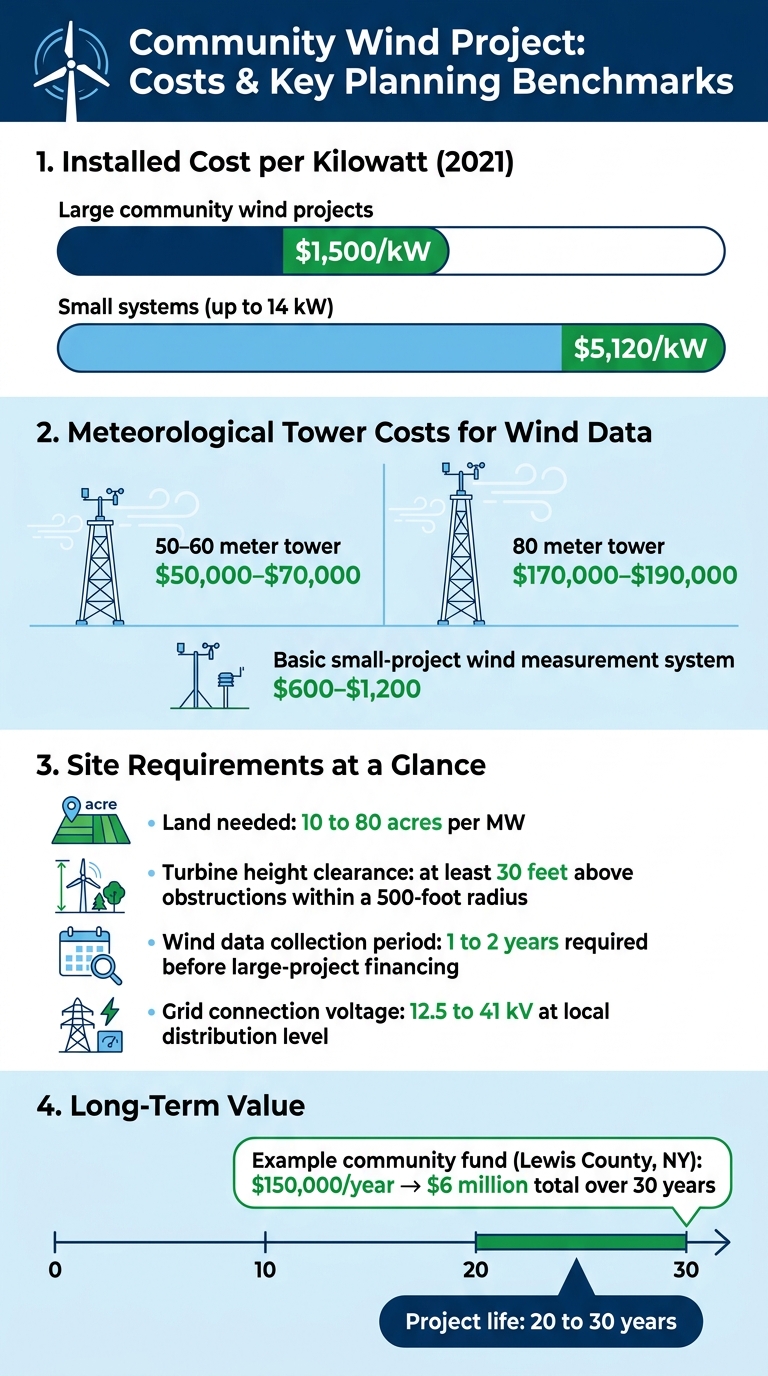
- Costs vary by size: in 2021, large community wind projects averaged about $1,500/kW, while small systems up to 14 kW averaged about $5,120/kW.
- Large projects often need 1 to 2 years of on-site wind data before financing moves forward.
- A 50- to 60-meter met tower can cost $50,000 to $70,000. An 80-meter tower can cost $170,000 to $190,000.
- Turbines usually need 10 to 80 acres per MW and should sit at least 30 feet above obstructions within 500 feet.
- Wind alone does not cover critical loads at all times, so storage, backup generation, or a microgrid may be part of the setup.
What I’d focus on first if I were a public-sector buyer:
- Check your facility’s power use with an energy audit
- Review local wind data and site limits
- Talk to the utility about interconnection early
- Decide whether the project should offset bills, support backup power, or do both
- Size storage and controls around critical loads, not the whole facility
A few public sites tend to fit best:
- Water and wastewater plants with steady, heavy demand
- Schools and colleges looking for long-term price control
- Hospitals and shelters that need backup support
- Municipal and co-op systems that want more local control
Love Wind! The community power source we’ve been missing (the Energy Learning Network)
sbb-itb-034f8e1
Quick Comparison
| Topic | Community Wind | Large Remote Wind |
|---|---|---|
| Location | Near the load | Far from the load |
| Grid connection | Local distribution grid | High-voltage transmission |
| Local control | Higher | Lower |
| Transmission work | Often less | Often more |
| Best use | Public facilities, campuses, co-ops | Bulk power supply |
In plain terms, community wind works best when the site has enough land, solid wind, a clear interconnection path, and a plan for storage or backup. If those pieces line up, it can help public facilities control long-term power costs and keep more energy support close to home.
What Community Wind Projects Are
Community wind projects are locally owned wind turbines that serve nearby electricity use, including schools, hospitals, municipal buildings, businesses, and farms [1][3]. In most cases, ownership sits with local governments, rural electric cooperatives, municipal utilities, or local LLCs [4][1].
What matters most is the local link. These projects are usually built to serve nearby public loads and connect through local distribution lines, not far-off power markets.
Community Wind vs. Large Remote Wind Generation
The day-to-day difference comes down to where the power connects and who has control. Community wind is built close to where the electricity is used and ties into the local distribution grid, usually at 12.5 to 41 kV, instead of high-voltage transmission lines [1]. Because the turbines are nearby, projects can often avoid costly transmission upgrades.
| Feature | Community Wind | Large Remote Wind |
|---|---|---|
| Grid connection | Local distribution grid | High-voltage transmission system |
| Transmission upgrades | Usually not required | Often required |
| Local control | High | Limited |
How Distributed Wind Fits Public Facilities and Campuses
Distributed wind puts turbines at or near the place where the power is used [6]. For public facilities, that setup makes a lot of sense when electricity demand is steady and high.
Water and wastewater treatment plants are a strong match because they run with heavy, constant power demand [6]. In Gloucester, Massachusetts, on-site wind turbines help power city buildings and cut electricity costs for public services [2].
Schools and college campuses can also use on-site wind to offset a large share of electricity use and help steady long-term energy costs [1][3]. Hospitals and healthcare systems are another good fit because they carry critical loads and gain from more stable power prices [1][3].
Siting still matters. Turbines usually need 10 to 80 acres per MW and tend to work best when placed well clear of nearby upwind structures [1].
Those site conditions, along with the load profile, shape how much value a project can provide to the local grid.
How Community Wind Strengthens Local Grids
When community wind ties into the local distribution grid, it can help the grid hold up better and cut some of the risk that comes with transmission congestion. That local tie-in can also make planning easier for public facilities. And for those facilities, that matters most when uptime and critical loads are at stake.
Reliability, Resilience, and Energy Security Benefits
The biggest reliability gain tends to show up during outages. Wind paired with battery storage or other generators can keep critical loads running when the grid goes down [2]. That matters most for schools, hospitals, water treatment plants, and emergency shelters.
Community wind can also reduce reliance on imported fuels and help steady long-term energy costs. For remote or isolated communities, that can make a big difference [1][2].
Those day-to-day gains also affect how a project gets designed, where it gets placed, and what it costs.
Project Advantages and Constraints
| Category | Advantages | Constraints |
|---|---|---|
| Resilience | Supports critical operations when paired with storage; enables microgrid functionality [2] | Variable resource; requires storage or backup generation for 24/7 reliability [2] |
| Local Control | Local officials and residents influence siting, sizing, and aesthetics to fit local priorities [1] | Subject to zoning, ordinances, and permitting that can delay projects [3] |
| Siting | Small physical footprint; land can be shared with agriculture or existing facilities [4] | Requires specific setbacks from roads, structures, and property lines for sound and safety [3] |
Wind output changes over time, so critical loads can’t rely on it alone. If a project needs to support those loads, storage or backup generation should be part of the plan from the beginning.
Those trade-offs feed straight into site selection, interconnection, and project model choices.
Economic Value and Planning Requirements
Community Wind vs. Large Remote Wind: Cost, Control & Grid Connection
After reliability, the next step is simpler: can the project be paid for and built at this site?
Cost, Budget, and Community Benefits for Public Entities
Community wind has no fuel cost and low operating costs. For public entities, that matters because it makes long-term energy budgeting far less shaky. You’re not dealing with fuel price swings year after year.
Installed costs depend a lot on project size. In 2021, large community wind projects averaged about $1,500/kW, while small projects of up to about 14 kW averaged $5,120/kW [1][3]. Public entities may cut net cost through lower electricity purchases, net metering credits, or fixed-rate PPAs over a 20- to 30-year project life.
The upside isn’t limited to lower utility bills. Some projects send money back into the local area in a direct way. In Lewis County, New York, the Number Three Wind Energy Center puts $150,000 each year into a county fund for schools and small businesses, for a total of $6 million over the project’s 30-year life [5].
Site Selection, Interconnection, and Project Model Choices
Financing depends on three things working together: wind data, site layout, and interconnection.
Wind data and site feasibility shape whether a project can get financed at all. Lenders usually want 1 to 2 years of on-site measured wind data before they’ll finance a large project [1]. That data isn’t free to collect. A 50- to 60-meter meteorological tower costs about $50,000 to $70,000, while an 80-meter tower costs about $170,000 to $190,000 [1]. For smaller projects, basic wind measurement systems cost much less, around $600 to $1,200 [3].
Placement matters just as much as raw wind speed. A turbine should sit at least 30 feet above any obstruction within a 500-foot radius to get better wind exposure [3]. And that’s only part of the picture. The site also needs room for setbacks, access roads, and maintenance.
Interconnection needs an early look too. That review can show whether the project can tie in at the distribution level or if it will need a substation [1]. That one detail can shift cost, timing, and even whether the project still makes sense.
The project model also changes the math. It affects ownership, grid use, and where the savings end up.
| Project Model | Ownership | Grid Role | Best-Fit Public Facility |
|---|---|---|---|
| Community-Owned Wind | Local government, schools, co-ops, or local LLCs | Offsets community-wide load or sells excess power to the utility | Municipalities, rural electric cooperatives |
| Utility-Connected Distributed Wind | Public entity or third-party developer | Connected to the distribution grid to offset facility load | Schools, hospitals, campuses, water treatment plants |
| Microgrid-Integrated Wind | Facility owner | Paired with storage or other generation for resilience and backup power | Emergency shelters, critical infrastructure |
Pick the model early, and a lot else starts to fall into place: financing, interconnection, and how the savings return to the facility or the community.
Integration Strategies for Public Facilities and Conclusion
Pairing Wind with Microgrids, Controls, and Efficiency Upgrades
After siting and interconnection, the next step is integration: how wind works with storage, controls, and facility loads. Once the site and project model are set, the next job is making wind fit the facility’s day-to-day operating plan.
A smart setup pairs wind with battery storage, a backup generator, and automated controls. That mix helps keep critical loads online during outages while shedding nonessential loads when power is tight. Isolated-grid systems such as Fox Islands show how onsite wind and storage can keep power on when the main connection is disrupted [2].
Hybrid systems also help balance output over the year. Wind and solar can complement each other seasonally, helping provide a more resilient and consistent electricity supply [2]. Where net metering is available, extra winter wind production can offset summer cooling loads [3].
It also makes sense to cut facility demand before sizing the wind system. For Texas public entities, E3 Design-Build Contractor‘s LED lighting, high-efficiency HVAC, building automation, and infrastructure upgrades can lower the load the wind system needs to serve. Put simply, if the building uses less power, the wind system doesn’t have to do as much heavy lifting.
Key Takeaways for Texas Public-Sector Leaders
Start with an energy audit. Then review wind data, site limits, and utility interconnection before picking a project model. The best results come when wind resource, facility load, and the integration plan work together, with storage or a microgrid added where needed. That gives Texas public entities more reliable, long-term energy cost control while also supporting the local grid they connect to.
FAQs
Is my site windy enough for community wind?
To figure out if your site makes sense for community wind, start by checking the local wind resource.
Gather some early wind data for the site first. That gives you a clearer picture of two things:
- which wind turbine setup fits your location
- whether the project makes sense for your energy needs
Without that first look at the wind resource, you’re basically guessing.
How do storage and microgrids fit with wind?
Pairing wind with battery storage and microgrids can make the local grid more steady and better able to handle disruptions.
Here’s the basic idea: storage charges when wind output is high, then discharges when output drops. That helps smooth generation and cut some of the stop-and-start nature of wind power.
These hybrid systems can also help facilities keep running in islanded mode during larger grid outages. In plain English, that means a site can temporarily operate on its own instead of depending on the broader grid. For critical loads, that can support steadier energy use and more reliable backup power.
What should we review before talking to the utility?
Before you talk to the utility, get clear on the basics of your project. That means your project’s purpose, ownership structure, and technical requirements. It also helps to review local incentive programs, your wind resource, your energy use, and your costs.
A preliminary feasibility study should also look at the numbers. Focus on project economics, your potential return on investment, any permitting or zoning needs, and your plan for grid interconnection.