
Yes – parts of an HVAC system can often stay in place during a geothermal retrofit, but only if testing shows they still fit the new system.
When I look at this topic, the short answer is simple: geothermal does not always mean a full HVAC tear-out. In many buildings, I can keep ductwork, some air handlers, piping, pumps, controls, or backup heat. But I would only keep them after checking airflow, water flow, pressure, leakage, control logic, electrical capacity, and service life.
Here’s the plain-English version:
- Keep ductwork if it is sealed, sized right, and losing less than 5% heat.
- Keep air handlers or coils only if they can meet geothermal airflow and fit new coil needs.
- Keep pumps and loop piping only if pressure and flow tests pass.
- Keep controls only if they can run geothermal sequences and work with the BAS.
- Keep backup heat only if it still covers peak load, emergency use, or code needs.
- Replace equipment that is undersized, leaking, obsolete, near failure, or hard to control.
- Watch red flags: 0.80 to 1.0 in. w.c. static pressure can drop cooling airflow below 280 CFM per ton.
- Test first, decide second. A 100 PSI nitrogen test for 30 minutes is one example used to check loop integrity.
A geothermal retrofit works best when I treat reuse as a part-by-part decision, not an all-or-nothing one. That helps limit downtime, avoid extra work, and keep spending from climbing more than it has to.
| Component | Keep It If… | Replace It If… |
|---|---|---|
| Ductwork | Sealed, sized right, low heat loss | Leaky, undersized, damaged |
| Air handlers | Good condition, enough life left, can support new coils | Poor airflow, coil mismatch, worn parts |
| Pumps/piping | Flow and pressure checks pass | Leaks, poor flow, failed tests |
| Controls | BAS-ready and able to run geothermal logic | Old proprietary setup, limited monitoring |
| Backup heat | Still has a clear use | Adds too much electrical work or has failed |
If I had to sum up the whole article in one line, it would be this: reuse what passes the checks, and replace what will hold the geothermal system back.
Replacing an Existing Geothermal Heat Pump
When existing HVAC equipment can be reused
You can reuse HVAC equipment in a geothermal retrofit only if each part fits the new system’s airflow, water flow, and control needs.
Ductwork, air handlers, and coils that work with geothermal systems
For ductwork, the big issues are condition, size, and leakage. If ducts are damaged, too small, or leaking, they need repair or replacement before the geothermal system goes in. Otherwise, the system won’t deliver the performance it was designed for. Leaky or undersized ducts create losses geothermal equipment cannot overcome[1].
That’s why duct sizing should be checked with a load calculation and an airflow test[1][2]. If the air handler and coils are still in decent shape, and the electrical sizing is correct, those parts can stay in place during a retrofit where the geothermal heat pump replaces the current unit[2].
The same idea applies to hydronic equipment: reuse only the parts the new system can actually support.
Pumps, piping, and controls that support selective reuse
If the ground loop passes flow and integrity checks, it may stay in place while only the indoor heat pump unit is replaced[3][2]. Closed-loop piping segments can also be reused and tied back into new equipment if testing shows they’re still in good shape[3]. Pumps should also be checked to make sure they have enough capacity and match the system.
Controls are where things can get tricky. They decide whether the reused parts will run together as one system.
Controls should be reused only when the existing sequence matches the new geothermal system[3].
Backup heat that still serves a clear purpose
Once the main equipment has been reviewed, backup heat is the last reuse call. Keep it only if it still has a clear job, such as covering peak load, handling emergency operation, or meeting code-required redundancy.
When replacing equipment makes more sense than reusing it
Not every component belongs in a geothermal retrofit. If a piece of equipment can’t meet airflow, water flow, controls, or service-life needs, it’s time to replace it. At a certain point, reuse stops saving money and starts causing problems.
Air-side equipment that cannot meet airflow or coil performance requirements
When static pressure readings fall between 0.80 and 1.0 in. w.c., cooling airflow often drops below 280 CFM per ton [5]. That’s a red flag.
Replace air handlers that can’t accept new coils, are too small for the current load, or don’t have enough space for retrofit work. And if the system still runs on R-22, replace it outright. That equipment is obsolete and expensive to keep alive [3].
Controls and backup systems that add complexity without benefit
Some controls just aren’t built for geothermal. If they can’t manage geothermal sequencing, zoning, or BAS integration, replacement usually makes more sense [6]. In many cases, switching to open-protocol controls is the cleaner path.
Backup heat can run into the same issue. If keeping it means electrical upgrades the building can’t support, replace it [3][6].
Deferred maintenance that justifies broader HVAC replacement
In older public buildings, geothermal work is often the point where deferred HVAC decisions finally catch up. Systems that have gone 10–15 years without significant upgrades are strong candidates for full component replacement instead of partial reuse [6].
If the current system is already close to the end of its service life, pair the geothermal project with full HVAC replacement. That’s usually when mechanical, electrical, and controls checks make the reuse call much clearer.
Those cases should move into the design-check stage before any reuse decision is finalized.
sbb-itb-034f8e1
Design checks owners should require before deciding on reuse
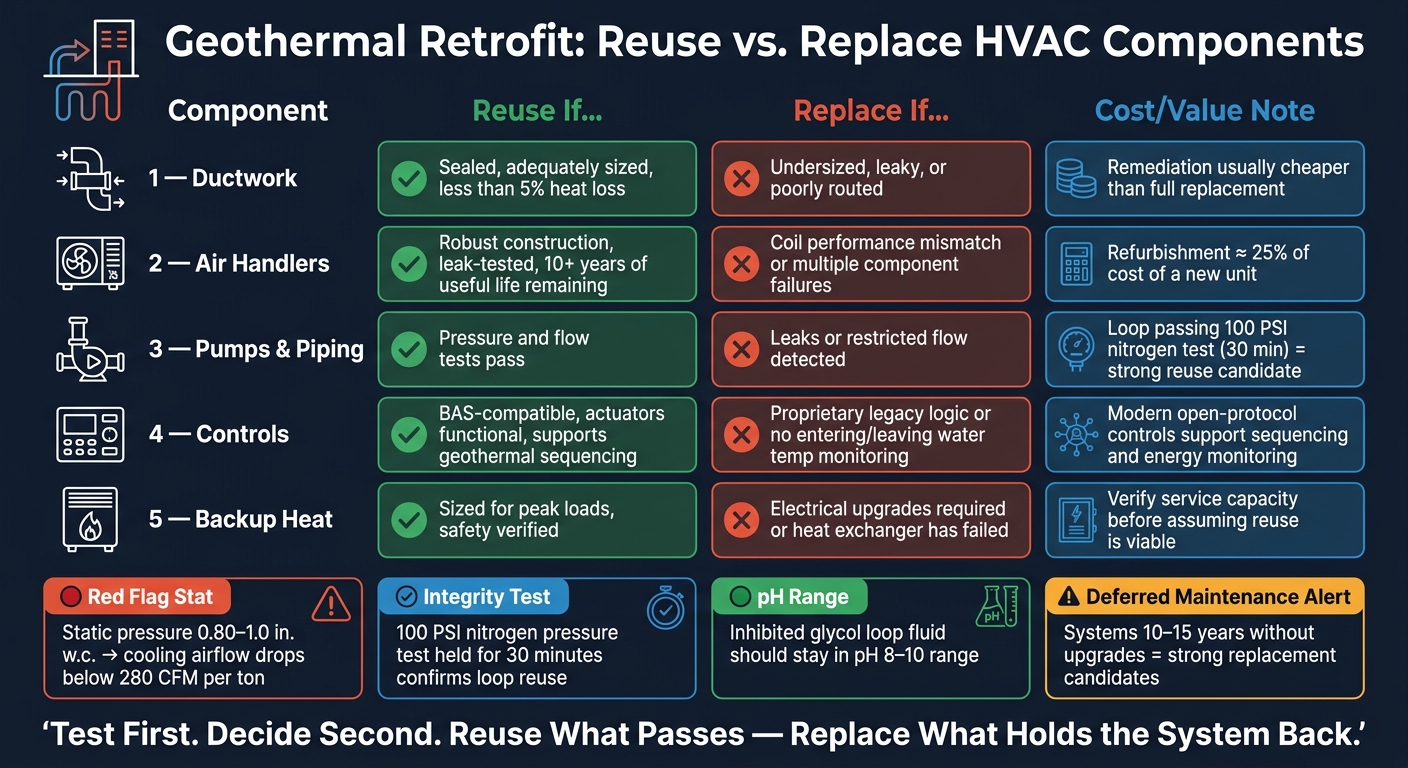
Geothermal Retrofit: Reuse vs. Replace HVAC Components
Owners should ask for engineering checks before locking in any reuse plan. The point is simple: confirm whether each existing part can handle geothermal flow, temperature, and control needs. That’s what turns a rough shortlist into a decision you can defend.
Mechanical and distribution checks
Start with total external static pressure, or TESP. Readings in the 0.80 to 1.0 in. w.c. range often push cooling airflow below 280 CFM per ton [5]. That’s a red flag. Airflow should also be measured by room so you can confirm each space is getting the supply it needs.
Duct leakage needs testing too. Any run with more than 5% heat loss needs added insulation or a move into conditioned space [5]. On air-handling units, fan shafts, bearings, control valves, and damper actuators should be physically inspected and leak-tested [7]. If there’s an existing ground loop, require both pressure and flow testing. A 100 PSI nitrogen pressure test held for 30 minutes confirms loop integrity before reuse [2][4].
These test results should drive the next step. Fix the defects that limit airflow, balance, and system capacity. If a part fails these checks, it should come off the reuse list.
Electrical and controls checks
Electrical review needs to cover panel, breaker, and transformer capacity against added pump loads and backup heat loads. On the controls side, check whether the existing building automation system (BAS) can communicate with the geothermal equipment. If the current setup is proprietary or obsolete, an open-protocol controller or gateway may be needed [6].
Loop fluid should be tested as well. Check pH and inhibitor levels, and keep inhibited glycol in the 8–10 range so corrosion risks show up before new heat exchangers go in [8].
If a component can’t meet the control or power needs, it belongs in the replace category right away.
Reuse vs. replace: a comparison by component
Owners shouldn’t make reuse calls based on age alone. Test data matters more. The table below helps sort out what’s worth keeping and what should be replaced.
| Component | Reuse If… | Replace If… | Cost/Value Note |
|---|---|---|---|
| Ductwork | Sealed, adequately sized, and showing less than 5% heat loss | Undersized, leaky, or poorly routed | Remediation is usually cheaper than full replacement [1] |
| Air Handlers | Robust construction, leak-tested, and with 10+ years of useful life remaining | Coil performance mismatch or multiple component failures | Refurbishment typically costs about 25% of a new unit [7] |
| Pumps/Piping | Pressure and flow tests pass | Leaks or restricted flow | If the loop passes pressure and flow tests, it remains a strong reuse candidate |
| Controls | BAS-compatible, actuators functional, and able to support geothermal sequencing | Proprietary legacy logic or no entering-water and leaving-water temperature monitoring | Modern controls support geothermal sequencing and energy monitoring [6] |
| Backup Heat | Sized for peak loads and safety verified | Electrical upgrades are required or the heat exchanger has failed | Verify service capacity before assuming reuse is viable |
Maintenance history is the last screen. Equipment without steady preventive maintenance is a weak reuse candidate, even if it still runs.
Conclusion: Geothermal retrofits work best when reuse decisions are made selectively
Geothermal retrofits work best when owners reuse only the parts that pass condition, sizing, and compatibility checks. In plain terms, this shouldn’t be an all-or-nothing call. Public owners need to look at each component on its own and decide what stays and what goes.
The main issue isn’t whether a piece of equipment is old. It’s whether that equipment can support the new system in a steady, dependable way.
Cost shouldn’t be the only thing steering the choice. Cutting upfront spend may look good on paper, but keeping equipment only to save money can backfire. Reuse makes sense when it can still deliver dependable service life and when it fits the geothermal design.
Texas public owners can use E3 Design-Build Contractor to review reuse options, controls, and infrastructure upgrades as part of geothermal planning. That review works best when mechanical systems, controls, and infrastructure are assessed together.
FAQs
How do I know which HVAC parts can stay?
It starts with a close look at the system’s structure and how it performs. Ductwork, piping, and air handlers can often remain in place if they’re in good shape, usually less than 15 years old, and haven’t needed many repairs.
Replacement tends to make more sense when equipment is 15–20 years old, fails often, or depends on outdated parts. An energy audit gives you a baseline, so you can compare current performance before making the call.
What tests should I require before approving reuse?
Before approving reuse for a geothermal transition, require a thorough energy and structural audit. The goal is simple: confirm the equipment is reliable and compatible before you move forward.
You should also require functional testing for:
- Airflow
- Temperature differential
- Refrigerant pressure
- A Thermal Response Test (TRT)
- A nitrogen pressure test for the ground loop
On top of that, confirm the existing equipment can support the automation and controls the system will need. If the controls can’t handle the job, the whole setup can turn into a headache fast.
When is full replacement smarter than partial reuse?
Full replacement is often the smarter move when equipment is 15 to 25 years old or getting close to the end of its expected lifespan. It should also move to the top of the list when breakdowns happen often, repair bills keep piling up, or replacement parts are tough to find.
Replacement can also make more sense when the system no longer meets current energy rules, building codes, sustainability targets, or the facility’s zoning and capacity needs.