
HVAC load testing is all about ensuring your heating and cooling systems are sized correctly for your building. When systems are too big or too small, they waste energy, increase costs, and wear out faster. Proper load testing calculates the exact heating and cooling capacity your space needs, preventing these issues and improving performance.
Key Takeaways:
- Oversized systems: Short-cycle, waste energy, fail to dehumidify, and break down sooner.
- Undersized systems: Run constantly, fail to maintain comfort, and wear out quickly.
- Accurate sizing: Saves energy, reduces repair costs, and extends equipment life.
Load testing uses industry standards like ACCA Manual J and ASHRAE guidelines to factor in building design, climate, and usage. This ensures your system operates efficiently while maintaining comfort and humidity control. Skipping this step can lead to costly mistakes, making it vital for long-term reliability and savings.
Understanding HVAC Load Calcs
sbb-itb-034f8e1
Problems Caused by Incorrect Load Calculations
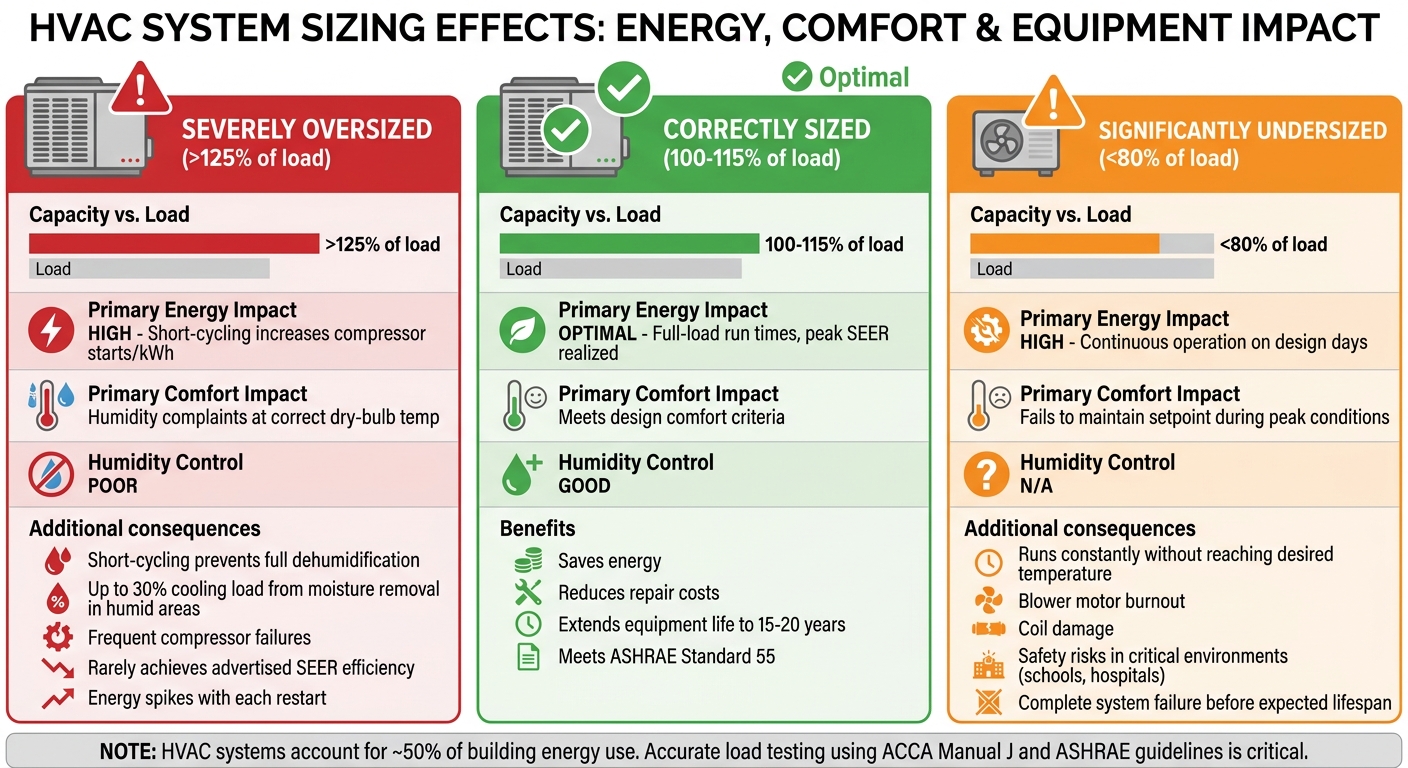
Impact of Incorrect HVAC System Sizing on Energy and Performance
Getting the sizing right for HVAC systems isn’t just about hitting a number – it’s about avoiding a chain reaction of issues that can hurt energy efficiency, equipment lifespan, and even the safety of building occupants. When load calculations are skipped or done poorly, the consequences are hard to ignore.
Oversized Systems and Energy Waste
When HVAC systems are too large for the space, short-cycling becomes a major problem. This happens when the system hits the thermostat’s setpoint too quickly and shuts off before completing a full cycle. The result? The system doesn’t run long enough to properly remove humidity, leaving the air feeling damp and uncomfortable, even if the temperature appears fine.
"Oversized cooling equipment consistently underperforms on humidity control. A unit that short-cycles achieves temperature setpoint but does not maintain the extended run times needed for latent heat removal." – Energy Efficiency Authority [2]
Short-cycling also causes energy spikes every time the system restarts, which can drive up utility bills quickly. On top of that, the repeated starting and stopping puts extra strain on the compressor and blower motor, leading to early breakdowns. In humid areas, where up to 30% of the cooling load comes from moisture removal [4], this lack of dehumidification can lead to mold growth and poor indoor air quality.
Undersized Systems and Poor Performance
On the flip side, undersized systems struggle to keep up. These units often run nonstop, burning through energy while failing to reach the desired temperature. During periods of high demand, the system works overtime, but the results fall short – literally.
"Undersized systems run constantly… Still doesn’t hit the temp you want… Runs up the electric bill… Overloads the blower and coil." – Tony Marino, Trusted Tech, The Furnace Outlet [3]
Systems that deliver less than 80% of the required load are considered severely undersized. On hot days, they operate continuously, putting extreme stress on components like the blower motor and coils. This not only shortens the equipment’s lifespan but also creates safety risks in environments like schools or hospitals, where maintaining safe temperatures during heatwaves is critical [4]. Additionally, these systems often fail to meet ASHRAE Standard 55, which outlines acceptable comfort levels for indoor spaces [5].
Financial and Operational Impact
Incorrectly sized systems are a financial drain. Oversized units face frequent compressor failures caused by short-cycling, with repairs costing thousands of dollars. They rarely achieve their advertised SEER efficiency, making them less cost-effective. Undersized units deal with constant wear and tear, leading to blower motor burnout, coil damage, and complete system failure well before their expected lifespan.
The table below highlights the practical effects of incorrect load calculations:
| Condition | Capacity vs. Load | Primary Energy Impact | Primary Comfort Impact | Humidity Control |
|---|---|---|---|---|
| Severely Oversized | >125% of load | High – short-cycling increases compressor starts/kWh | Humidity complaints at correct dry-bulb temp | Poor |
| Correctly Sized | 100–115% of load | Optimal – full-load run times, peak SEER realized | Meets design comfort criteria | Good |
| Significantly Undersized | <80% of load | High – continuous operation on design days | Fails to maintain setpoint during peak conditions | N/A |
Even systems with the right capacity can face problems if ductwork is mismatched. Poorly designed ducts can increase static pressure, forcing the blower motor to work harder. Many residential systems operate at 0.8" static pressure due to duct restrictions, compared to the 0.5" used in standard SEER2 testing [3]. This mismatch reduces efficiency and raises energy costs. When you add up the higher utility bills, frequent repairs, early replacements, and occupant complaints, it becomes clear that accurate load testing isn’t just a technical detail – it’s a smart financial move.
How HVAC Load Testing Improves System Performance
Accurate HVAC load testing does more than just prevent operational hiccups – it plays a key role in improving system performance. By measuring heat flow (in BTU/h or tons of cooling), engineers can pinpoint the exact capacity needed for the equipment. This process relies on established methods like ACCA Manual J for homes and ASHRAE Standard 183 for commercial spaces, ensuring decisions are based on solid data rather than guesswork [1].
Correct Sizing for Better Performance
The goal of load testing isn’t to pick the biggest system – it’s about selecting equipment that matches the building’s peak load requirements. This involves considering factors like the building’s layout, how it’s used, and its climate zone [2]. Once the load is calculated, Manual S guidelines help ensure the chosen equipment operates within a precise range. This careful matching prevents the problems caused by oversizing (like short-cycling) and undersizing (like constant operation).
"There is no engineering advantage to excess capacity in a correctly designed system." – Texas HVAC Authority [1]
Properly sized systems do more than maintain temperature. They also manage humidity effectively, which is especially important in humid areas where the latent load can account for 30% or more of the total cooling demand [2]. A system that runs long enough to handle both temperature and humidity creates a more comfortable environment and improves indoor air quality. This balanced approach not only optimizes performance but also leads to energy savings.
Lower Energy Consumption
When HVAC systems are sized to match the building’s actual needs, they operate more efficiently, delivering noticeable energy savings. Properly matched systems perform at their rated peak SEER by running at full-load conditions. On the other hand, oversized systems waste energy with frequent starts and stops, while undersized units burn through energy by running non-stop on hot days. Load testing also reflects building upgrades, such as better insulation, which can cut heat gain by over 20% [2]. By using verified data – like blower door test results, window Solar Heat Gain Coefficients, and local climate design temperatures – every bit of capacity is used effectively [1].
Longer Equipment Life
Beyond boosting efficiency, proper sizing helps extend the lifespan of HVAC equipment. Oversized systems often short-cycle, putting extra strain on compressors and accelerating wear. Undersized systems, meanwhile, can overwork motors and coils by running continuously [2]. By avoiding these extremes, a correctly sized system operates in balanced cycles, reducing mechanical stress and delaying the need for expensive replacements. Load testing also ensures the system has the right refrigerant levels and is leak-free, which is critical for long-term reliability [6]. Pairing reduced wear and tear with proper commissioning not only improves current performance but also protects your investment for up to 15–20 years [6].
Best Practices for HVAC Load Testing
Getting HVAC load testing right involves detailed preparation, precise data collection, and collaboration with skilled professionals. This process ensures accurate results and integrates seamlessly into the commissioning workflow.
Key Factors in Load Calculations
Accurate load testing starts with gathering detailed information about the building. The industry standard for these calculations is the Manual J methodology, used by over 80% of contractors to determine heating and cooling needs [8]. This method evaluates various factors that influence energy requirements. For example, building orientation significantly impacts results – east- and west-facing windows can create more than twice the solar heat gain compared to north- or south-facing ones [8]. Additionally, the building envelope plays a major role. Insulation levels, window types, and air leakage all directly affect the accuracy of load testing [7][8].
Internal factors are equally important. The number of occupants and the heat generated by equipment contribute to the internal load, while local climate data helps establish peak temperature demands [8]. Differentiating between sensible heat (air temperature) and latent heat (humidity control) is crucial for achieving comfort. For instance, in a 2,500-square-foot home with four occupants, the total heat demand might reach about 79,100 BTUs [8]. To perform accurate calculations, it’s essential to collect detailed data on square footage, insulation, and window orientation [8].
Once all the data is gathered, professional analysis ensures these variables are applied correctly.
Working with Qualified Professionals
Expertise is essential for precise HVAC load testing and avoiding costly errors. Skilled engineers and contractors can identify improperly sized systems and account for external factors that might be missed by less experienced individuals [7]. Their ability to analyze complex data ensures that system designs meet both operational goals and commissioning standards. Considering that HVAC systems account for roughly 50% of a building’s energy use [7], precision is critical. Regular professional maintenance also helps maintain near-original SEER ratings throughout a system’s lifespan [7].
Professionals often rely on advanced tools like CoolCalc, Wrightsoft, and ServiceTitan to simplify Manual J calculations and minimize human error [8][9]. Some even use LiDAR-powered 3D scanning for highly accurate building models [9].
At E3 Design-Build Contractor, we utilize these cutting-edge tools and techniques to ensure HVAC systems are perfectly sized and optimized for efficiency, improving energy performance and occupant comfort.
Load Testing in the Commissioning Process
Once accurate load calculations are complete, load testing becomes a key part of the commissioning process, ensuring systems perform as intended. This step is critical because 90% of newly installed HVAC systems have deficiencies that impact comfort or waste energy, and nearly half are incorrectly sized at installation [10]. Enhanced commissioning, which begins during the design phase, allows professionals to ensure equipment is appropriately sized before installation [11].
During system startup, it’s recommended to collect performance data after the system has been running for at least 10 minutes. This establishes a baseline for future servicing [10]. Tools like digital manifold gauges, which can measure multiple variables (e.g., microns, temperature, and pressure) simultaneously, improve calibration accuracy [10]. Seasonal retesting – such as checking heating in winter and cooling in summer – further validates system performance [11]. Hiring a commissioning agent has financial benefits too, with a typical payback period of just one to two years [11].
"The key to the commissioning agent is to get all the systems working together… the commissioning agent is the glue of all the systems to make sure everything’s operating correctly and together." – Keri DiLeo, Scalora Consulting Group [11]
Conclusion
HVAC load testing plays a crucial role in ensuring energy efficiency and system reliability. When load calculations are inaccurate, the result is wasted energy, premature equipment failures, and decreased comfort levels.
Improperly sized systems can lead to hefty financial consequences. With HVAC systems accounting for about 50% of a building’s total energy use, errors in sizing – ranging from 40% to 60% – can significantly increase lifetime costs [2][7]. Building codes, such as IECC 2021 Section R403.7, require ACCA Manual J load calculations, highlighting the importance of accurate testing to meet energy benchmarks and achieve long-term efficiency [2]. These operational and financial insights stress why precise load testing is a necessity, not a luxury.
Key Takeaways
- Efficiency Maintenance: Proper load testing ensures HVAC systems maintain around 95% of their original SEER rating throughout their lifespan [7].
- Correct Sizing Matters: Oversized units waste energy, while undersized systems struggle to meet demand, causing comfort issues and inefficiencies.
- Building Envelope Impact: Improvements like better air sealing or upgraded insulation can reduce thermal loads by 20% or more [2]. This not only allows for smaller, more efficient replacement systems but also reduces mechanical strain over time.
For facility managers aiming to boost system performance and cut operating costs, working with experts like E3 Design-Build Contractor can make a significant difference. Their focus on energy-efficient solutions and precise load testing ensures HVAC systems operate reliably while adhering to modern building standards.
FAQs
When should I get an HVAC load test done?
Scheduling an HVAC load test is a smart move if your system isn’t performing as expected. This test helps assess its efficiency, ensures everything is functioning properly, and pinpoints any hidden issues. It’s particularly helpful if you’re planning system upgrades or dealing with uneven performance. Regular testing keeps your system running smoothly and can save you from expensive repairs down the road.
What building details does a load test need to be accurate?
For a precise load test, it’s essential to account for critical building details such as the types of windows, ceiling heights, air infiltration levels, and other factors that influence heat gain and loss. These details play a crucial role in ensuring HVAC systems are properly sized, which helps maximize both performance and energy efficiency.
Will a load test also catch ductwork problems?
Yes, load testing can help pinpoint problems in ductwork, such as leaks or disconnections. These issues often cause energy loss and reduce the efficiency of your HVAC system. That’s why load testing plays a key role in ensuring your system operates at its best.