
Poor LED heat control can cut fixture life fast and turn a small part failure into a repair bill of $1,200+. In public buildings, that matters because lights often run for long hours, and many fixtures sit in hard-to-reach ceilings.
If I had to sum up the article in one line, it would be this: better heat control means fewer failures, lower cooling load, and less lift-based maintenance. The article focuses on five trends that shape that outcome:
- Advanced heat sinks to move heat away from LEDs and drivers
- Airflow-aware fixture layouts to stop heat from getting trapped above ceilings
- Smart controls and dimming to cut runtime and heat build-up
- Remote or centralized driver placement to keep heat-sensitive parts out of hot plenums
- Whole-building fixture layout planning to line up lighting with HVAC and service access
A few numbers stand out:
- About 78.1% of LED fixture input power can turn into heat
- A 10°C rise in junction temperature can cut LED life by up to 50%
- HVAC-linked thermal control can cut cooling energy use by up to 19.2%
- Condition-based maintenance can reduce service visits by 42%
- Better fixture design can push L70 life from 30,000 hours to 100,000 hours
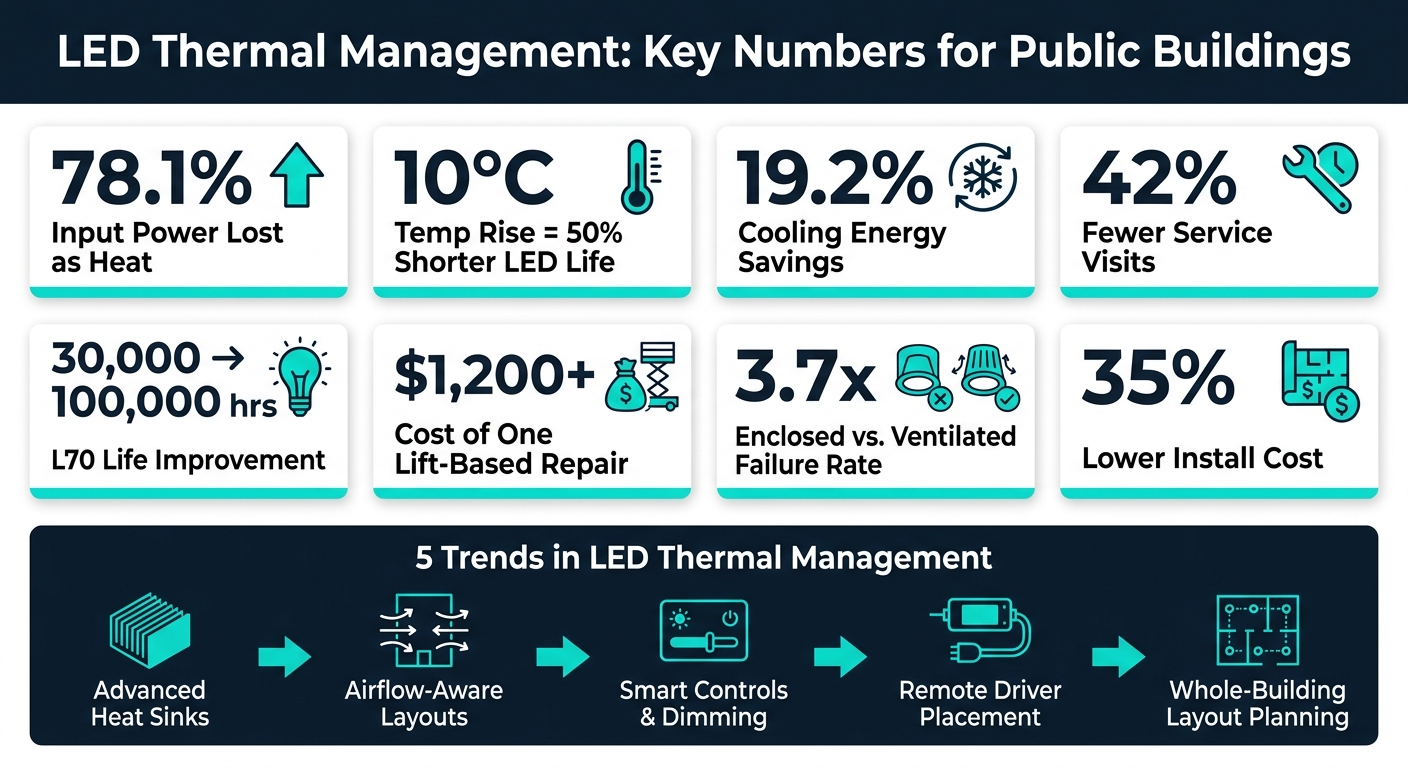
LED Thermal Management: Key Stats & Impact for Public Buildings
Lighting: LED Thermal Management
sbb-itb-034f8e1
Quick Comparison
| Trend | Main goal | Main effect |
|---|---|---|
| Heat sinks | Move heat out of the fixture | Lower LED temperature and longer fixture life |
| Airflow layout | Keep air moving around fixtures | Less trapped heat in ceilings |
| Smart controls | Reduce output and runtime when full light is not needed | Less heat and lower power use |
| Driver placement | Move drivers out of hot ceiling spaces | Longer driver life and easier service |
| Building layout | Plan fixture location with ceiling and HVAC conditions | Lower cooling load and fewer hot spots |
If you manage lighting in a school, hospital, campus, or city building, this article shows where heat starts, what it costs, and what to fix first.
Why Thermal Management Is Now a Facilities Priority
Thermal management has moved to the top of the facilities list for a simple reason: public buildings keep lights on for long stretches, and excess heat turns small lighting issues into expensive maintenance jobs. At that point, thermal control stops being just a lighting spec. It becomes a day-to-day facilities concern.
Heat buildup in ceiling spaces cuts capacitor life and can turn a cheap part failure into a much larger bill [6]. A single failed $15 component can lead to a service call of more than $1,200 once scissor lift rental and specialized labor are added in [6]. In a school hallway, a patient room, or a corridor, that’s not a minor repair. It’s a service and uptime issue.
The failure gap can get wide. Enclosed recessed downlights can fail 3.7 times more often than ventilated ceiling installations, and lumen depreciation speeds up above 95°C [4][8].
There’s also the energy side of the problem. About 78.1% of a typical LED fixture’s input power turns into heat [2], and that heat doesn’t just disappear. It lingers in ceiling spaces and nearby rooms, adding strain where buildings are already trying to control indoor conditions. When lighting heat control is coordinated with HVAC, cooling energy use can drop by up to 19.2% [2]. For schools and municipal facilities keeping a close eye on utility costs, that’s a big deal.
Those maintenance costs and energy losses are what push the five trends that follow.
1. Advanced Heat Sink Designs for Long-Life Fixtures
The heat sink moves heat away from the LED chip and driver so junction temperature stays lower. In schools, hospitals, and city buildings, that extra thermal headroom has a direct effect on uptime and maintenance costs.
Impact on LED Junction Temperature
Newer fixtures are moving beyond standard extruded aluminum and using ADC12 die-cast aluminum, which comes in at about 96 W/m·K, along with cold-forged 1070 aluminum [9]. That shift matters because material choice plays a big part in how fast heat leaves the fixture.
Fin layout matters too. Vertically oriented fins create a chimney effect: hot air rises out of the fixture, and cooler air moves in behind it [3][9]. It’s a simple idea, but it does a lot of work.
On top of that, AI-designed fin geometry has improved cooling efficiency by up to 17.6% while cutting fixture weight by 17.2% [1].
Effect on Lamp and Driver Life
Lower junction temperature helps LEDs last longer and puts less stress on the driver. That means better lumen maintenance over time and fewer early failures in the field.
With better housing design, L70 life – the point where output drops to 70% of initial output – can increase from 30,000 hours to 100,000 hours [9].
Energy and HVAC Implications
Heat from lighting doesn’t just stay in the fixture. It also affects the building.
For every 3.5 watts of lighting heat removed or managed better, about 1 watt of cooling energy is saved [3]. Across a full cooling season in schools and municipal buildings, those savings can stack up fast.
Maintenance Planning Value
Good thermal design also makes service work less of a headache. Modular fixtures let crews swap the LED module, driver, or optics on their own instead of replacing the whole unit. That cuts labor and reduces lift time [5].
There’s also a purchasing angle here. DLC Premium V6.0 fixtures line up thermal specs with rebate criteria [3], which can make fixture selection a bit easier for public-sector buyers.
Even the best heat sink performs better when air around the fixture can move freely, which leads to the next trend.
2. Airflow-Conscious Fixture and Ceiling Layouts
Fixture placement matters just as much as fixture build. Even a well-made heat sink can fall short if it sits in hot, still air. In schools, hospitals, and municipal buildings, ceiling plenums often hold heat and cut fixture life. That means ceiling shape and airflow deserve as much attention as the fixture itself.
Impact on LED Junction Temperature
Recessed fixtures in insulated ceilings are at higher risk. If the space above the ceiling can’t shed heat fast enough, the fixture turns into a heat pocket. Junction temperature can climb past its rated limit, which leads to phosphor degradation and color shift over time [10].
Drivers run into the same problem when they’re mounted right in rising hot-air plumes above boilers, kitchen equipment, or in tall spaces like gymnasiums and atriums [11]. Put simply, hot air goes up, and if the fixture sits in its path, heat builds fast.
Effect on Lamp and Driver Life
In hot ceilings, drivers are often the first part to fail. High heat cuts capacitor life, and that can turn a small repair into a much bigger service job.
A practical fix showing up more often in schools and campuses is to move drivers out of the ceiling altogether. Teams relocate them to cooler, easy-to-reach electrical closets with Class 2 low-voltage DC systems [6]. In gymnasiums and atriums, remote driver placement about 16 to 98 feet from the fixture head keeps the most heat-sensitive parts out of the hottest areas [11].
Energy and HVAC Implications
Heat that gets stuck in the ceiling plenum doesn’t just disappear. It can move back into the occupied space and add to the building’s cooling load. One HVAC-linked method uses LED heat exchange modules (LHEM) to send waste heat outdoors during cooling periods. The difference shows up clearly below.
| Setup | Internal Heat Gain (40W LED) | Internal Heat Gain (80W LED) |
|---|---|---|
| No thermal management | 31.2 W (78.1%) | 62.5 W (78.1%) |
| LHEM + HVAC integration | 1.7 W (4.3%) | 4.1 W (5.1%) |
(Source: MDPI Energies, 2015 [2])
This setup cut cooling energy demand by 19.2% compared with standard LED installations [2].
Maintenance Planning Value
Airflow-aware layouts can cut how often crews need to reach fixtures in tough spots. When drivers are moved to accessible closets, maintenance staff can work on the parts most likely to fail without renting a scissor lift, which usually costs $500 to $1,500 per day [3]. That’s the practical side of layout planning: better placement makes service easier and cheaper.
When layout alone can’t keep heat under control, smart dimming becomes the next tool.
3. Smart Thermal Controls and Adaptive Dimming
Once fixture placement is dialed in, controls become the next tool for cutting heat and runtime. If airflow and layout still leave fixtures running too warm, smart controls can pull output down before heat has time to build up in schools, hospitals, and municipal facilities.
Impact on LED Junction Temperature
More input power creates more heat. Occupancy sensing and daylight harvesting reduce both how long LEDs run and how hard they run. That directly lowers junction temperature by reducing current-driven heat buildup [1][12].
Luminaire-Level Lighting Controls (LLLC) push this a step further. Each fixture acts as its own control point, with embedded sensors that allow fixture-level monitoring and control [12].
Effect on Lamp and Driver Life
One of the most useful tools here is high-end trim. During commissioning, the fixture’s maximum light output is capped to match what the room actually needs. In plain English, you stop the system from over-lighting the space. That lowers thermal stress on drivers and helps extend the life of both the lamp and the driver [12].
LLLC systems have been shown to deliver energy savings above 60% in commercial facilities [12].
Energy and HVAC Implications
Lower lighting load also means less cooling demand. That matters in big public buildings, where lighting and HVAC often pull in the same direction. Networked lighting controls tied to HVAC can reduce cooling load and total electric use in these spaces [13].
Maintenance Planning Value
Smart controls also change the way facilities plan maintenance. Next-generation fixtures can include built-in thermal sensors that feed real-time thermal data across large campuses and hospitals [4]. That gives teams a way to act on condition, not guesswork.
The payoff can be big: condition-based maintenance can reduce service visits by 42% per year [4]. Fewer truck rolls, fewer labor hours, and less equipment use all add up, without waiting for a fixture to fail.
Even with smart controls in place, driver placement still affects how much heat the system has to handle.
4. Driver Cooling and Placement Strategies
Smart dimming can cut runtime, but driver placement still decides how much heat ends up in the ceiling. Put simply, where the driver sits changes how much heat the LED system has to deal with. Drivers mounted inside fixtures or tucked into high ceilings sit in hotter, still air. That heat stacks on top of the heat already produced by the LEDs.
Impact on LED Junction Temperature
Drivers make heat, and LEDs do too. When both sit inside the same housing, the fixture has to handle all of it at once. Moving the driver to a cooler area 16–98 feet away helps shield it from rising hot air and radiant heat near the LED head [11]. It also takes some pressure off the fixture’s main heat sink and helps keep LED junction temperature under control [7].
Effect on Lamp and Driver Life
Heat usually hits the driver first. In many cases, electrolytic capacitors are the first parts to fail, which makes the driver the weak point in the system [6][7]. One way around that is centralized DC power distribution. With this setup, drivers move to ground-level electrical closets or rooms instead of staying above the fixture. That keeps them in conditioned air, extends service life, and allows hot-swappable power modules to be replaced at floor level [6].
Energy and HVAC Implications
LED drivers are efficient, but they still waste some power as heat. In a 1,500-driver system running at 95% efficiency, about 75,000 W of waste heat still gets dumped into the building’s cooling load. That equals more than 255,000 BTUs per hour [14]. Remote or centralized driver placement helps keep more of that heat out of conditioned space.
Maintenance Planning Value
Remote placement changes driver failure from a lift job into ground-level service. That can cut downtime and reduce lift use. In schools, hospitals, and municipal buildings, this matters a lot. Maintenance teams can service the part most likely to fail without booking a lift or pulling a crew away from other work.
Centralized Class 2 low-voltage DC setups can also lower first-time installation costs by up to 35% and trim annual operating costs by about 20% [14].
Taken together, placement, temperature, and access make the tradeoff easy to see.
| Placement Strategy | Driver Temperature | Maintenance Access | HVAC Impact |
|---|---|---|---|
| Internal (Inside Fixture) | Highest | Requires lifts | Adds heat to conditioned space |
| Remote (Cool Zone) | Lower | Moderate | Reduces fixture thermal load |
| Centralized (Electrical Room) | Lowest | Easiest; ground level | Heat can be exhausted outdoors |
That building-level tradeoff becomes even clearer when fixture layout is planned across the whole facility.
5. Thermal-Aware Fixture Layouts for Whole-Building Performance
Even well-built fixtures can fall short when the ceiling plan holds heat in all the wrong places. Heat sink design, airflow, controls, and driver placement only do their job if the layout supports them. At the building level, placement decisions can turn fixture-level gains into lower energy use, longer service life, and less maintenance trouble.
Thermal-aware layout starts early in design. Fixture location, insulation, ceiling plenums, airflow paths, and nearby heat sources all affect junction temperature, lamp life, and the building’s cooling load. A photometric plan – a 3D lighting map of the installation – helps flag hot spots and dark spots before anything gets installed.
Impact on LED Junction Temperature
Fixtures can run hotter than expected for simple layout reasons. Recessed units placed too close to insulation, sealed housings with poor airflow, and the wrong fin orientation can all trap heat. Junction temperature has a direct effect on light output and service life, and tight ceiling spaces can push fixture temperatures up fast even when the room itself feels fine.
Effect on Lamp and Driver Life
Cooler fixtures help preserve rated life and reduce stress on drivers. Keeping drivers and other weak points out of overheated ceiling cavities supports that lifespan and also makes future replacement work less of a hassle.
That same trapped heat doesn’t just affect the fixture. It also adds to the cooling burden across the building.
Energy and HVAC Implications
Lighting accounts for 15% to 20% of total building electricity use [1], and about 78.1% to 80% of the power supplied to LED lighting becomes heat instead of light [2][1]. A thermal-aware layout can cut cooling load by keeping that waste heat out of conditioned space. As a rule of thumb, removing 3.5 watts of lighting heat saves about 1 watt of cooling cost.
Maintenance Planning Value
A layout built around thermal performance makes maintenance easier to plan over time. Cooler fixtures usually mean fewer lift jobs and fewer emergency replacements. For school districts, hospitals, and municipal buildings, that kind of upfront planning builds on the gains from heat sink design, airflow, controls, and driver placement.
Use these checks before purchase and installation.
| Layout Risk Factor | Thermal Impact | Recommended Fix |
|---|---|---|
| Recessed in insulated ceilings | Rapid heat buildup, fixture temperature rise | Maintain manufacturer-specified airflow clearance |
| Sealed housing | Trapped heat, shortened driver life | Use fixtures rated for enclosed operation |
| Wrong fin orientation | Up to 50% less natural cooling | Specify vertical fin alignment during layout review |
| No plenum exhaust strategy | Waste heat added to cooling load | Integrate heat sinks with plenum exhaust airflow |
These checks belong in the upgrade plan, not after the lights are installed.
Thermal Performance Comparison Tables
These tables compare the main thermal trade-offs across cost, heat control, and service access in public buildings. Use them to match the thermal approach to ceiling conditions, maintenance needs, and budget.
Heat Sink Type Comparison
| Feature | Standard Aluminum | Heat Pipes | Vapor Chambers |
|---|---|---|---|
| First Cost | Lowest | Moderate | Highest |
| Thermal Performance | Standard | High (passive two-phase) | Excellent (uniform heat spreading) |
| Weight | Heavy/Bulky | Lighter than solid aluminum | Lightest/Slim profile |
| Maintenance Value | High – simple, no failure points | Moderate – reliable | Moderate – reliable |
| Best Fit | Schools, municipal offices | High-bay gyms, high-wattage fixtures | Hospitals, tight ceiling plenums |
If the project is driven by budget, standard aluminum is usually the go-to pick. Heat pipes and vapor chambers make more sense when fixtures run hotter or when ceiling space is tight.
Driver Type Comparison
| Factor | Static (Internal) Driver | Adaptive or centralized DC |
|---|---|---|
| First Cost | Baseline | 15–25% higher [5] |
| Thermal Impact | Constant heat output; heat-sensitive capacitors degrade faster in hot plenums | Dims to protect components; heat-sensitive parts moved to cooler locations |
| Failure Risk | High – heat-sensitive capacitors are the primary weak link [6] | Low – active cooling or remote placement reduces exposure [6] |
| Maintenance access | Requires scissor lift rental ($500–$1,500/day) for ceiling access [3] | Ground-level "hot-swap" in under 60 seconds; no lift needed [6] |
| Best Fit for Public Buildings | Standard low-ceiling offices | High-ceiling gyms, STEM labs, hospital corridors [6] |
In high-ceiling spaces, access cost can beat part cost in a hurry. That’s why driver choice often comes down to one simple trade-off: heat exposure above the ceiling versus easy service from the floor.
Layout Strategy Comparison
| Layout Strategy | Conventional layout | Optimized High-Efficacy / Control Layout |
|---|---|---|
| First Cost | Lower (fewer fixtures, less technology) | Higher (more sensors, smarter components) |
| HVAC Impact | High internal heat gain – about 78% to 80% of input power becomes heat [2] | 19.2% reduction in cooling energy demand with integrated thermal management [2] |
| Plenum Impact | High – requires conduit and metal junction boxes for high-voltage AC wiring [6] | Low – Class 2 low-voltage DC eliminates conduit; about 60% reduction in cabling costs [6] |
| Maintenance access | Frequent lift use; drivers are vulnerable to high plenum heat [6] | Modular driver swaps in about 5 minutes; 100,000+ hour fixture life [5] |
| Lifecycle Cost | Higher total cost of ownership (TCO) due to full fixture replacements | 20%–35% lower TCO over a 20-year building lifecycle [5] |
| Schools / Healthcare Fit | Standard | High |
The pattern is pretty clear. Modular replacement can cut lifecycle cost across large campuses and health systems, especially where maintenance crews deal with tall ceilings and long service routes. These comparisons help narrow upgrade options by building type, ceiling height, and how easy it is to reach the equipment.
Applying These Trends to Public Building Upgrades
These five trends work best when they’re treated as one connected system, not a set of separate decisions. In public buildings, heat sinks, airflow, controls, driver placement, and fixture spacing all need to fit the HVAC system and the conditions above the ceiling. From there, the job becomes matching those choices to the ceiling space you already have, the control setup in place, and how crews will get access for service.
The clearest connection is between lighting and cooling. Since most LED input power ends up as heat, fixture selection should be coordinated with HVAC so that waste heat is managed where it adds the least load.
In day-to-day project work, that kind of coordination is easiest when lighting, HVAC, and automation are scoped together. E3 Design-Build Contractor coordinates LED lighting, HVAC, building automation, and infrastructure upgrades for public facilities, which helps line up fixture selection, plenum conditions, and driver placement during design.
After the system is designed, maintenance access becomes the final test. Moving failure-prone LED drivers out of hot ceiling spaces and into centralized electrical closets or ground-level access points cuts thermal stress and makes service simpler, without the need for lift-based maintenance.
Conclusion
LED thermal management is a facilities issue, not just an engineering detail. When heat isn’t controlled, driver life gets cut short, light output drops, and the building’s cooling load goes up.
Across public buildings, the pattern is pretty simple: less heat leads to longer service life, less maintenance, and lower cooling demand. Those gains stack up. Heat sinks reduce fixture temperature, airflow-aware layouts help prevent heat from getting trapped, smart controls reduce runtime, driver placement helps with cooling and access, and thermal-aware layouts support better whole-building performance.
For schools, campuses, hospitals, and city buildings, that translates into fewer lift calls, fewer failures, and budgets that are easier to plan around.
For facility teams, thermal performance should be part of how fixtures are bought and maintained, not treated as a box-checking spec. The payoff is better reliability, fewer disruptions, and lower lifecycle cost.
FAQs
Which thermal upgrade should I prioritize first?
Start with smart controls. Networked lighting controls connected to occupancy sensors and HVAC often deliver the biggest energy savings because they cut heat output based on how the space is being used in real time.
After that, put attention on high-quality passive heat sinks. Cold-forged aluminum with vertical fins is a strong choice, since heat is one of the main reasons LEDs fail. For Texas public facilities, E3 Design-Build Contractor puts extra weight on this because it helps equipment last longer and run with better efficiency.
How do I know if heat is shortening fixture life?
Excess heat often shows up as performance problems first, not total failure right away.
Common warning signs include random shutdowns or on-off cycling, intermittent flickering, and early lumen depreciation.
You might also notice a pattern: fixtures in hotter areas keep failing, while the same fixtures in cooler spots still work fine. Infrared thermography can help spot hot areas caused by poor thermal contact. And in many cases, heat-sensitive drivers fail before the LED chip does.
Are remote drivers worth the upfront cost?
Yes. Remote drivers can be worth the investment because they help protect one of the fixture’s most heat-sensitive parts from early failure.
When you place drivers in cooler, easier-to-reach spots, you can cut down on flickering, shutdowns, and repeat maintenance. That also helps the lighting system last longer and can lower the total cost of ownership.
Related Blog Posts
- LED Chip Advancements: What Facility Managers Need to Know
- How LED Sensors Improve Energy Efficiency
- Checklist for LED Lighting System Maintenance
- Predictive Maintenance for IoT LED Lighting