
If I had to boil it down to one answer, it’s this: schools usually lean toward campus batteries or solar-plus-storage, cities often need islandable microgrids, and hospitals usually need microgrids with generator and HVAC coordination.
Here’s the short version:
- Campus batteries are the simplest starting point for short backup and bill control.
- Solar-plus-storage adds daytime recharging, which helps during outages that last more than a few hours.
- Islandable microgrids are the best match when power loss is not an option.
- Thermal storage or CHP can take strain off HVAC-heavy sites.
- EV charging works best as a load the system can turn down, not as backup on its own.
Most public-site systems are built to cover 4 to 8 hours of critical load support. Some run longer when paired with on-site generation. In the article, I compare each path by resilience value, bill impact, load fit, and setup difficulty – with examples like a school district with 1 MW of solar PV and 1.1 MWh of storage, and public-site projects showing 5% to 10% energy-cost cuts and up to 14% peak-demand reduction.
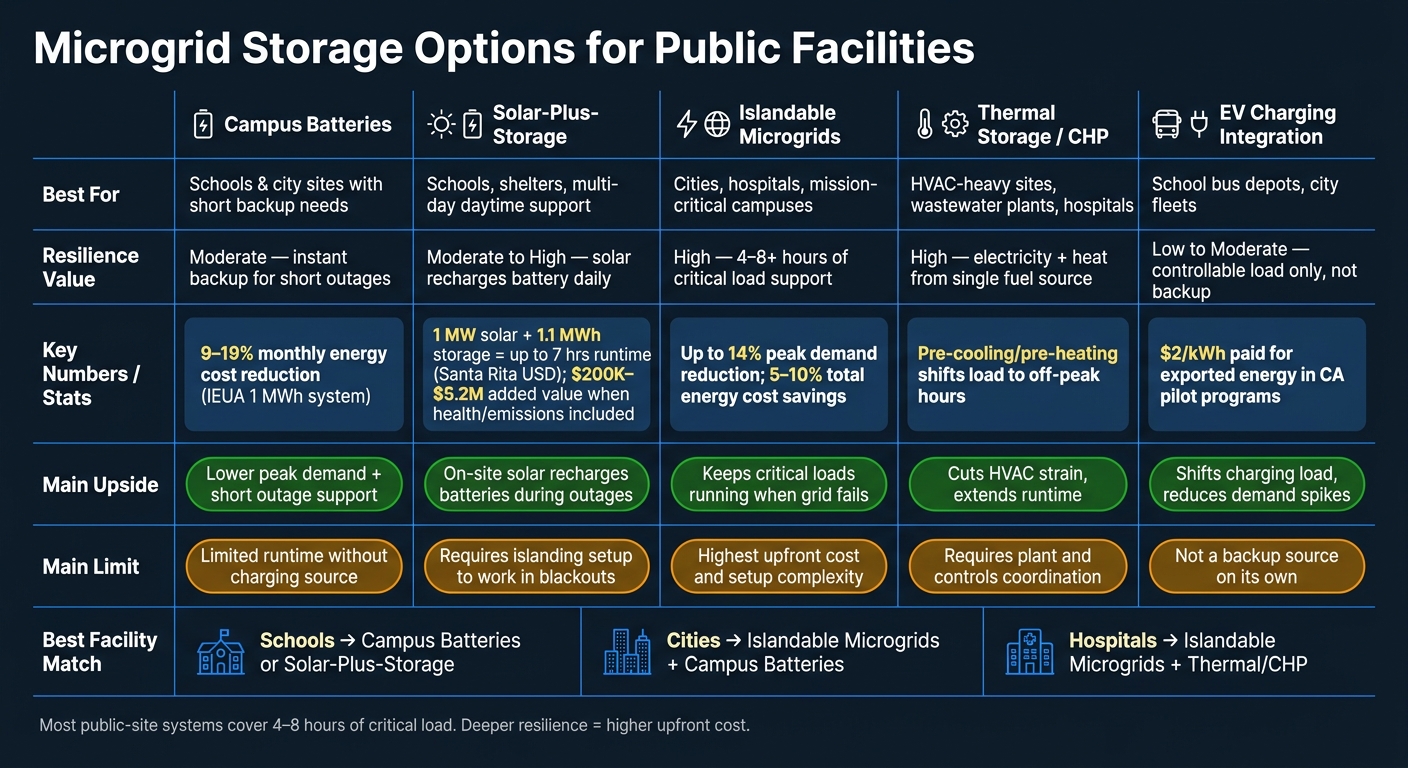
Microgrid Storage Options for Schools, Cities & Hospitals: Quick Comparison Guide
Transitioning from Diesel Backup Generators to PV-Plus-Storage Microgrids in CA Public Buildings
sbb-itb-034f8e1
Quick Comparison
| Option | Best for | Main upside | Main limit |
|---|---|---|---|
| Campus batteries | Schools, city sites with short backup needs | Lower peak demand and short outage support | Limited runtime without charging source |
| Solar-plus-storage | Schools, shelters, multi-day daytime support | Solar can recharge batteries during outages | Needs islanding setup to work in blackouts |
| Islandable microgrids | Cities, hospitals, mission-critical campuses | Can keep critical loads running when the grid fails | Higher cost and more setup work |
| Thermal storage / CHP | HVAC-heavy sites, wastewater plants, hospitals | Cuts HVAC strain and can extend runtime | More plant and controls coordination |
| EV charging integration | School bus depots, city fleets | Can shift charging and reduce demand spikes | Not a backup source by itself |
If you’re choosing a storage path, the three things that matter most are how long you need backup, how much critical load you must keep on, and how much you can spend.
1. Campus Batteries
The simplest storage option is a stand-alone campus battery.
A campus battery system stores electricity from the grid or from on-site generation, then sends it back out during peak-rate hours or when the grid goes down.
Resilience Value
Campus batteries provide instant backup for critical loads. They can also carry a facility through short outages without adding more generation.
Cost and Bill Impact
Batteries can lower utility bills through peak shaving and time-of-use shifting. IEUA‘s 1 MWh battery, paired with solar and biogas, cut monthly energy costs by 9% to 19% in the first seven months without upfront capital [2].
That kind of setup makes a lot of sense for city facilities like wastewater treatment plants. If power drops at those sites, the risk isn’t just inconvenience. It can affect public health and interrupt core services.
Critical-Load Fit and Integration Complexity
Start by sizing the battery around the facility’s critical loads. Then add more capacity only if the budget allows and the runtime need is there.
For schools, cities, and hospitals, the main issue is simple: which loads can’t go down, even for a moment? Schools often use batteries for short backup. Cities use them to support core infrastructure. Hospitals rely on them to keep essential loads running without interruption.
A battery microgrid links on-site generation, critical loads, and controls [1]. For public agencies with tight capital budgets, Energy-as-a-Service models can remove the upfront cost barrier while still delivering savings and resilience gains [2].
When solar is part of the system, the battery can recharge on-site and extend daytime resilience.
2. Solar-Plus-Storage Systems
Solar-plus-storage combines on-site solar with batteries. The setup stores power made during the day and uses it later for evening peaks or outages. Compared with battery-only storage, solar gives the system its own daytime recharge source, which can keep power available longer when the grid is down.
Resilience Value
The big issue is simple: is the solar system only there to cut utility bills, or can it also keep critical loads running during an outage?
A standard grid-tied system can lower energy costs, but it won’t help much in a blackout unless it’s built to island. Once islanding is in place, the picture changes. Solar can recharge the battery each day, which stretches runtime and makes the system far more useful for sites that need power over several days.
Santa Rita Union School District is a good example. The district installed about 1 MW of solar PV and 1.1 MWh of storage across its schools. Each site can run for up to seven hours and recharge daily from solar as a Powered Emergency Response Center. [7][10][11]
Cost and Bill Impact
For public facilities, solar-plus-storage can cut bills in two main ways:
- It offsets daytime electricity bought from the grid.
- It shifts solar energy into higher-cost hours.
That helps on the cost side. On the backup side, the numbers can also work. A resilience-focused study of a medium-sized hospital found that an optimized microgrid with solar PV, battery storage, and diesel backup delivered 9–14.2% net present cost savings compared with grid-only operation. [8]
Another point from modeling across 14 U.S. cities stands out. When the math only includes utility bill savings and resilience, systems usually end up sized on the smaller side. But when health and emissions benefits are included, such as avoided emissions, solar-plus-storage can add $200,000 to $5.2 million in value. That can make larger systems pencil out. [9]
For public agencies serving vulnerable populations, that lens can matter a lot.
Critical-Load Fit
The fit depends on the facility.
- Schools usually need enough backup to serve as shelters.
- Cities need support for disaster-response loads.
- Hospitals need nonstop power for critical systems, with existing generators still in the mix.
Integration Complexity
Integration can be where things get tricky.
Schools are often the easiest place to start. Many begin with a fairly standard setup and add islanding controls later. Even then, the work isn’t plug-and-play. Critical loads have to be separated onto dedicated panels, and the system has to coordinate with existing emergency generators.
Hospitals are the hardest fit. Solar-plus-storage has to work with life-safety systems, automatic transfer switches, and strict healthcare code rules. That means careful load segregation and redundancy engineering. [3][4]
Cities sit somewhere in the middle, but they bring their own headaches. A city project may involve several buildings, multiple utility connections, and control-system links spread across sites. [5][6]
E3 Design-Build Contractor can help coordinate the electrical, automation, and infrastructure work these projects require.
When solar-plus-storage needs to support multiple buildings, generators, or longer outage duration, it starts to function as part of a full islandable microgrid.
3. Islandable Microgrids
Islandable microgrids can disconnect from the utility grid during an outage and keep critical loads running with on-site power. That makes them a clear step up from a single-battery setup, especially when one asset isn’t enough to support multiple buildings or a mix of critical loads.
Resilience Value
How long a microgrid can run comes down to three things: load size, storage capacity, and on-site generation.
For public facilities, this isn’t abstract. Schools need power for classrooms and kitchens. Cities need it for pumps and treatment systems. Hospitals need it for life-safety systems and surgical loads.
For cities, the main use case is mission-critical infrastructure like wastewater treatment plants, water pumping stations, and similar facilities where backup options may be limited and public health depends on continuous service. As the Inland Empire Utilities Agency (IEUA) said about its own system:
"As an agency providing an essential service to the public, these benefits [power reliability and stabilized costs] prove invaluable." [2]
Cost and Bill Impact
Islandable microgrids can also lower peak demand and day-to-day operating costs by coordinating multiple on-site assets instead of letting each one run on its own.
Microgrid battery storage can cut a public agency’s peak demand from the electric grid by as much as 14%. Total energy costs can also drop 5% to 10% when storage is paired with an existing renewable portfolio. [2]
That whole-site coordination is the key point here. Storage, generation, and controls work together across a public campus as one system.
Integration Complexity
This is where the hard part starts. The IEUA project involved coordinating electrical interconnections between solar, biogas engines, and a 12 kV grid connection, all while working around major underground utilities at an active facility. [2]
| Facility Type | Critical Load Priority | Integration Complexity |
|---|---|---|
| Schools | Lighting, HVAC, refrigeration | Moderate |
| Cities (WWTPs/Utilities) | Continuous waste processing, public health systems | High; multi-source coordination required |
| Hospitals | Life-support, ER, surgical suites | High; requires seamless islanding |
If an agency wants to avoid upfront capital costs, Microgrid as a Service (MaaS) can be another path. In that setup, a third party builds and maintains the system, and the facility pays for the electricity it uses – often at rates below the utility. [1]
When HVAC loads are the main driver, thermal storage can help cut peak demand and extend resilience.
4. Thermal Energy Storage Links
When batteries alone can’t carry the whole job, thermal assets can take pressure off HVAC systems and help a microgrid run longer. Instead of storing electricity, thermal energy storage shifts when heating and cooling use power.
One of the main thermal links in microgrids is Combined Heat and Power (CHP), also called cogeneration. CHP makes electricity and usable heat from a single fuel source. For public facilities with big HVAC needs or process-heat demand, that two-for-one output can trim grid dependence and lower operating costs.
When thermal assets are paired with an islandable microgrid, plus fuel planning and load prioritization, they can help keep critical services running for long stretches. [1]
Cost and Bill Impact
Thermal storage lowers peak demand by pre-cooling or pre-heating ahead of high-cost hours. Forecasting software can then plan charge and discharge timing across storage assets using historical facility data. [2] In practice, schools use it to cut HVAC peaks, cities use it to manage large buildings, and hospitals use it to keep cooling steadier in critical areas.
Critical-Load Fit and Integration Complexity
Wastewater treatment plants are a strong match for CHP-based thermal links because they often produce methane on-site. That methane can fuel both electricity and heat production. [1] They’re one clear example of a thermal-linked microgrid at work, not the whole category.
Integration usually centers on coordinating HVAC plants, process-heat systems, and facility controls. If a site has older plant equipment, it may need HVAC or controls upgrades before the system can be tied together. [2]
The best thermal setup depends on the facility’s main load – HVAC, process heat, or a mix of both.
| Facility Type | Best Thermal Use Case | Primary Benefit | Integration Complexity |
|---|---|---|---|
| Schools | Site-specific thermal storage | Load shifting | Varies |
| Cities (WWTPs) | CHP with on-site methane | Heat and power from on-site fuel | High |
| Hospitals | Site-specific thermal storage | Critical-load resilience | Varies |
5. EV Charging Integration
EV charging is a flexible load, not a backup power asset by itself. In a microgrid, it only helps when the control system can dial charging down fast and protect battery capacity for critical loads. That’s the core issue: EV charging competes with on-site batteries for available capacity and control priority.
Resilience Value
Schools have the clearest use case, mostly because of electric bus fleets. School buses usually park overnight on set schedules, which makes them easier to charge during off-peak hours or shift into solar-heavy midday periods. Some pilot programs have also let school buses send power back during emergencies. In one California program, operators were paid $2/kWh for exported energy or verified load reduction during grid stress events. [19]
Cities also have solid potential, especially at fleet depots and public charging hubs. Vehicles in these places often charge on repeatable schedules, which makes curtailment much easier when the microgrid needs to give priority to critical loads during an outage. [13][14][15]
Hospitals are the weakest match. EV charging has to sit below life-safety systems, clinical equipment, and HVAC in the pecking order, so it has less resilience value there. [16][17]
Cost and Bill Impact
If EV charging is unmanaged, demand charges can climb fast, especially when several vehicles plug in at the same time. Managed charging helps by spreading sessions out and lining them up with solar production. That can lower peak demand and trim demand-charge costs.
For schools, the clearest savings often come from overnight bus charging paired with time-of-use scheduling. For cities, the math gets better when a large share of fleet vehicles charges at one depot and demand-charge controls are in place. [13][14]
Critical-Load Fit and Integration Complexity
The hard part isn’t usually the chargers. It’s the controls.
Smart chargers need to connect with the microgrid controller, building systems, and utility interconnection rules so charging can shut down on its own during outages. [12] Once bidirectional charging enters the picture – V2G or V2B – things get more complicated. You now need utility approval, vehicles that support it, and added interconnection steps. A simple starting point is managed one-way charging. Bidirectional charging makes more sense only when vehicle dwell time, hardware, and utility approval line up. [17][18]
The best fit changes a lot by facility type because parking behavior and load priority are so different.
| Facility Type | Strongest Use Case | Resilience Value | Integration Complexity |
|---|---|---|---|
| Schools | Electric bus depot charging | Moderate to high | Moderate; higher if V2G is added |
| Cities | Municipal fleet depots and public charging hubs | Moderate to high | Moderate; scale can be large |
| Hospitals | Staff, shuttle, and noncritical parking | Low to moderate | High because of reliability and load-priority constraints |
So EV charging works best as a controllable load inside the microgrid, not as a replacement for storage.
Pros, Cons, and Tradeoffs by Approach
No single storage option works for every public facility. In most cases, the tradeoff comes down to upfront cost, outage coverage, and how hard the system is to tie together. The table below puts those tradeoffs in one place.
| Approach | Resilience Value | Cost & Bill Impact | Critical-Load Fit | Integration Complexity | Key Notes by Facility |
|---|---|---|---|---|---|
| Campus Batteries | Moderate | Strong peak-shaving savings; third-party ownership can reduce upfront cost [1][2] | Best when the facility can shift energy use around peak periods | Moderate; software must coordinate multiple sources in real time [2] | Best for cost control |
| Solar-Plus-Storage Systems | Moderate to high; depends on battery sizing [1] | Peak shaving saves on high utility rates [1] | Good for 4–8 hours of critical load support [1] | Moderate; increases when coordinating with existing generation [2] | Best for sites that need daytime recharge during outages |
| Islandable Microgrids | High; supports 4–8 hours or longer [1] | Highest upfront cost; third-party ownership can reduce the capital burden [1] | Best for facilities that cannot tolerate outages [1] | High; requires tying together generation, storage, load controls, and utility interconnection [1] | Best for mission-critical public infrastructure |
| Thermal Links (CHP) | High; provides electricity and heat [1] | Uses on-site gas such as methane to lower costs [1] | Best for sites with heavy heating or cooling demand [1] | High; requires careful heat/power synchronization [1] | Best where heat loads are significant |
The big tradeoff is simple: the deeper the resilience, the higher the upfront cost tends to be. That gets even trickier when fire and life-safety rules enter the picture, especially in hospitals and older municipal facilities with dense underground utilities.
Generator coordination can also get messy. If a facility already has solar, biogas, wind, or fuel cells on-site, adding battery storage means the control system has to balance all of those sources in real time. Think of it like an air-traffic controller for power: each source has to come in at the right moment, in the right amount, without stepping on the others. It can be done, but it takes software that can read utility rates and coordinate multiple power sources in real time. [2]
With those tradeoffs in view, the next step is matching each approach to schools, cities, and hospitals.
Which Storage Approach Fits Schools, Cities, and Hospitals
These tradeoffs play out a little differently depending on the facility.
Schools usually need the lowest-cost route to lower utility bills and cover short outages. That makes campus batteries or solar-plus-storage the best fit. MaaS can also help cut upfront capital needs.
Municipal campuses need the whole site to keep running. So the best fit is usually campus batteries inside islandable microgrids. EV charging can still play a role, but it should be treated as a controllable load, not a backup power source.
Hospitals need continuous power for critical systems. That means islandable microgrids are the starting point. Thermal storage or CHP makes sense when HVAC loads are high enough to justify the added system complexity.
Here’s the fastest way to line up each facility type with the right storage approach.
| Facility Type | Best Fit | Main Value | Main Constraint |
|---|---|---|---|
| K-12 Schools | Solar-plus-storage, campus batteries | Bill savings and shelter support | Upfront capital budget (CAPEX) |
| Municipal Campuses | Islandable microgrids, campus batteries, EV fleet integration | Operational continuity for mission-critical infrastructure | Limited redundancy in existing electrical infrastructure |
| Hospitals | Islandable microgrids, thermal storage, generator coordination | Continuous HVAC support and 24/7 life-critical load protection | High reliability requirements and complex system integration |
A Texas-based design-build contractor like E3 Design-Build Contractor can help match the system to the site’s load, budget, and resilience needs.
FAQs
How do I choose the right backup runtime?
Choose backup runtime based on two things: your facility’s critical loads and the kinds of outages you usually deal with.
For many institutional facilities, 4 hours is a common benchmark. Critical infrastructure, like wastewater treatment plants, often aims for 4 to 8 hours to keep key operations running.
In harsher settings, system modeling can size storage for 48-hour autonomous operation.
The goal is to find the sweet spot between steady performance during grid failures and cost-effective peak shaving.
What loads should stay on during an outage?
During an outage, a microgrid should keep critical loads running so key operations don’t stop. What counts as a critical load depends on the facility, but it often includes mission-essential systems like hospital life-safety systems, data and communications equipment, and core wastewater treatment functions.
Once the microgrid separates from the main grid, it relies on on-site storage, renewables, or backup generation to keep those vital systems powered.
When is an islandable microgrid worth the cost?
An islandable microgrid makes sense when a facility can’t afford power interruptions.
It’s often worth the cost for mission-critical operations that need resilient, uninterrupted power, especially in places where grid outages or weak utility service could disrupt day-to-day work.
That matters a lot for schools and healthcare systems with poor reliability or limited grid connections. In those cases, an islandable microgrid doesn’t just keep the lights on. It helps keep core services running when the main grid goes down.
It can also make the system more cost-effective by:
- supporting peak shaving
- adding onsite renewables
- cutting the need for redundant backup generation