
If I need the short answer: rule-based control is easier to put in place, while supervised learning can cut more energy use when the data, staff time, and BAS setup are ready.
When balancing comfort and energy in public buildings across Texas, the choice usually comes down to five things:
- Setup effort
- Data quality and history
- How much tuning staff can handle
- How well the system deals with weather and occupancy changes
- Portfolio size
Here’s the core takeaway in plain English:
- Rule-based control uses fixed schedules and setpoints. It is simpler to start, but staff often have to keep editing it by hand.
- Supervised learning uses past BAS, weather, and occupancy data to predict load and adjust setpoints. It needs more setup and review, but studies in the article show about 10%–30% energy savings in some cases.
- For small portfolios, tighter schedules and better BAS sequences are often enough.
- For medium to large portfolios, supervised learning starts to make more sense, especially where teams are buried in overrides, complaints, and schedule changes.
- Before moving to supervised learning, I’d first clean up BAS data and tighten rule sequences. The article notes that better rule-based control alone can still deliver 17%–31% HVAC energy savings versus older static setups.
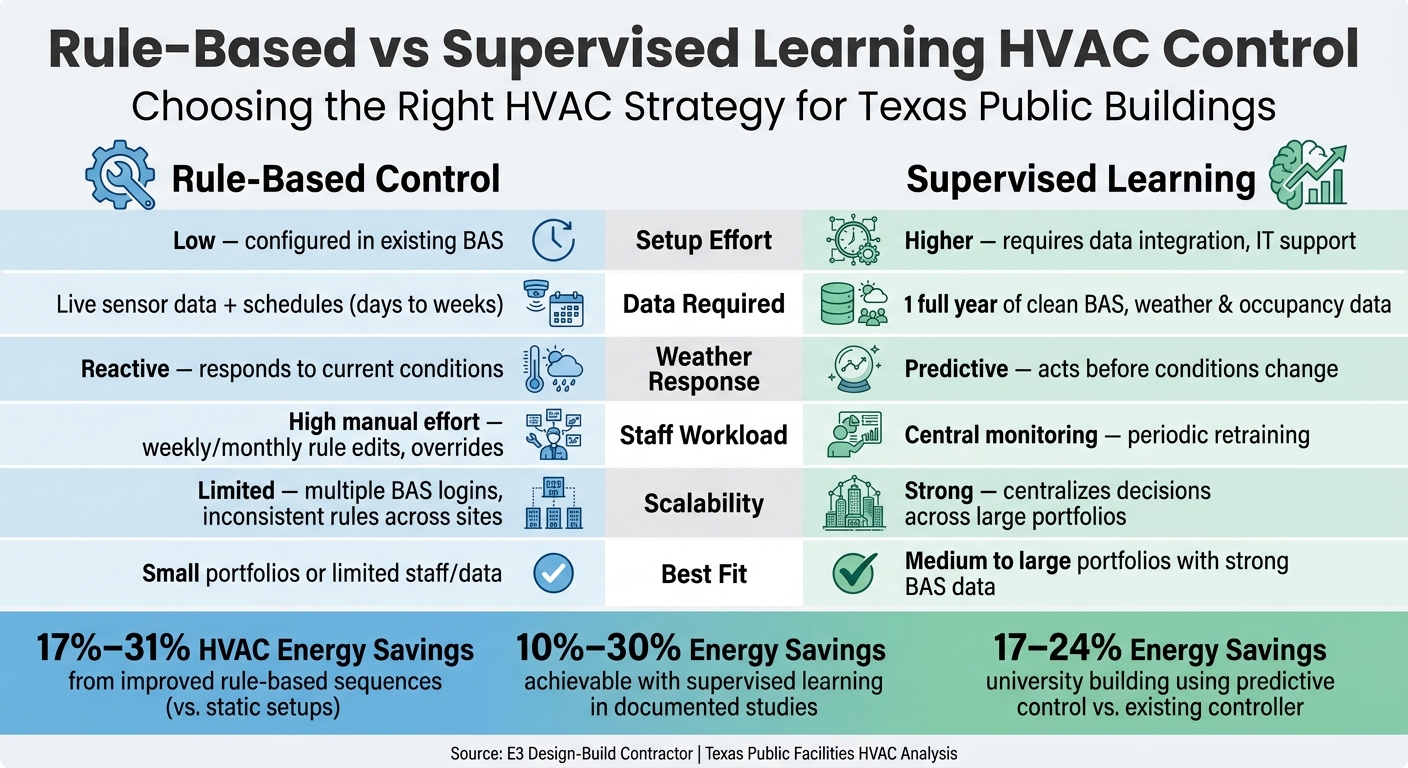
Rule-Based vs Supervised Learning HVAC Control: Texas Public Buildings Comparison
SBA 479: Role of AI and Machine Learning in HVAC Energy Optimization
sbb-itb-034f8e1
Quick Comparison
| Factor | Rule-Based Control | Supervised Learning |
|---|---|---|
| Setup | Lower effort | Higher effort |
| Data needed | Live sensor data and schedules | Clean historical BAS, weather, and occupancy data |
| Staff work | More manual edits over time | More model review and retraining |
| Weather response | Reactive | Predictive |
| Occupancy changes | Manual overrides or schedule edits | Uses forecast and occupancy signals |
| Best fit | Small sites or limited staff/data | Larger portfolios with strong BAS data |
My read: if your BAS trend logs are weak or your team is already stretched, supervised learning will likely disappoint. If you run many buildings and want fewer manual changes, it can be worth a close look.
That’s the full article in one view before the deeper detail begins.
Rule-Based HVAC Control: Easier to Set Up, More Manual Work Over Time
Rule-based control fits neatly into most BAS setups because it doesn’t need model training or large historical datasets. A controls technician maps the needed points – zone temperature sensors, humidity sensors, CO₂ sensors, occupancy signals, damper positions, valve positions, and equipment status – then builds the schedules and if-then logic right inside the BAS.
Setup Steps and Data Requirements
Setup usually begins with time-of-day and day-of-week schedules that match how the building runs. Classrooms may follow one schedule, gyms another, and administrative offices a third. After that, technicians define the control thresholds: cooling setpoints often land in the 72–75°F range for occupied spaces, humidity limits usually sit around 40%–60% relative humidity, CO₂ trip points for demand-controlled ventilation often fall near 800–1,000 ppm, and setback temperatures are set for occupied and unoccupied periods. Live sensor inputs drive the logic as conditions change. Unlike supervised learning, the system does not need years of labeled historical data before it can go live. It needs accurate sensor readings and a clear sequence of operation.[2][3][4][5]
That simplicity matters, especially when a BAS is already installed and the facilities team knows how to work with it.
Tuning Effort and How It Handles Weather or Occupancy Shifts
The strain shows up when building conditions shift. A school district moves to an early-release schedule. A clinic adds Saturday hours. A municipal building hosts a weekend sports tournament. Every change sends someone back into the BAS to update schedules by hand – building by building, zone by zone.
In extreme Texas heat, that job gets harder. Without predictive logic, systems lean on fixed runtimes or manually changed summer schedules to pre-cool spaces. That sounds fine on paper, but buildings don’t heat up at the same pace every day. On a brutal afternoon, equipment may start too early or keep running too long because the rules can’t judge how fast the space will warm up. The result can be demand spikes, higher utility bills, and more comfort complaints.[6][7][9][10]
Staff Time Across Multi-Building Public Portfolios
For teams managing a dozen or more campuses, this manual work adds up fast. Technicians may spend hours each week handling overrides, dealing with hot and cold calls, and rewriting schedules at the start of each academic term or event season.[8][10][11] And if an override has no time limit, a zone can stay in occupied mode longer than planned, which means equipment keeps running in an empty building until someone spots it.
That creates a familiar cycle: staff react to complaints instead of steering the system with intent, and planned maintenance or optimization work gets pushed aside. E3 Design-Build Contractor says clients often reach out after dealing with chronic staff overload tied to manual rule-based control. One practical fix is to centralize scheduling through building systems integration, so a single change can roll out across many buildings at once while still keeping a rule-based setup.[8][10][11]
Supervised Learning HVAC Control: More Data Needed, Better Predictive Control
Rule-based control responds to what’s happening right now. Supervised learning tries to see what’s coming next. That tradeoff matters: you can get better control decisions, but only if the data behind the model is in good shape first.
Setup Process and Historical Data Requirements
Supervised learning depends on BAS trend logs, weather data, and occupancy or schedule records. Those inputs need to be cleaned up and time-aligned before training starts. Unlike rule-based control, this approach doesn’t work well with schedules alone. If the data base is weak, the model picks up noise instead of actual building behavior.[13][14]
Most reliable models need about a year of history that covers cooling, heating, and shoulder months. That gives the system enough variety to make solid predictions.[14][19] And if you’re dealing with a mixed public portfolio, one model usually won’t fit every site. Different building types have different load patterns and operating schedules, so each building needs its own history.
Bad data can throw the whole thing off. Missing sensor values, faulty meters, mismatched timestamps, and sensor drift can all hurt model performance. This isn’t side work. It’s a core part of setup, and public owners should plan for staff time or contractor help to handle it.[13][17] Those same issues can also make later retraining less dependable.
Model Tuning, Retraining, and Ongoing Oversight
Supervised learning models need regular monitoring and periodic retraining when something meaningful changes, like schedule shifts, a chiller replacement, or a new setpoint plan. In public portfolios, that’s a big deal because equipment and operations change over time. If the model keeps running on old assumptions, prediction accuracy slips and the control gains get smaller.[15][16] Once the model is dialed in, the upside comes from forecasting instead of reacting.
In day-to-day use, retraining is often triggered by warning signs such as more comfort complaints or bigger gaps between predicted and actual temperatures. In healthcare settings, shifts in service lines or patient volumes can also call for a model update. A quarterly or annual review cycle is a good place to start, with extra retraining after major operating changes.[15][16][21]
How It Responds to Forecasts, Occupancy, and Comfort Targets
This predictive ability lets the system move before temperatures and demand jump. That matters a lot in Texas, where heat spikes and occupancy swings are common. Instead of waiting for a zone to get warm and then scrambling to respond, the system can use forecasted outdoor temperatures and expected occupancy to pre-cool spaces during lower-cost hours before demand peaks.[12][1][18] On a hot afternoon with more people in the building, it can begin cooling earlier and ramp up more smoothly, which helps avoid the demand spike that comes from playing catch-up.
This is where supervised learning starts to earn its keep. A university educational building using predictive control achieved 17–24% energy savings compared with its existing controller.[20] Across 87 educational properties, AI-powered HVAC delivered a 3.12% reduction in district heating and an 8.93% reduction in electricity use between 2019 and 2023.[22] For operators, that can mean fewer comfort complaints, steadier indoor conditions, and lower utility bills when weather or occupancy changes fast.
Supervised Learning vs Rule-Based HVAC Control: Side-by-Side Comparison for Texas Public Facilities
The tables below boil the tradeoffs down to what teams usually care about most: setup, data, tuning, weather response, staffing, and fit across a building portfolio.
Comparison Table: Setup, Data, and Tuning Effort
| Factor | Rule-Based Control | Supervised Learning |
|---|---|---|
| Setup and BAS integration | Low – configured in the existing BAS | Higher – requires data integration and secure connectivity and IT support |
| Sensor dependence | Minimal – zone temperature sensors, schedules, and a few central plant points | High – zone temperatures, humidity, CO₂, valve positions, fan speeds, and energy data |
| Historical data needed | Days to weeks | At least one full cooling season, ideally a full year |
| Training labels needed | None | Yes – comfort, occupancy, and equipment-state labels |
| Tuning frequency | Manual and ongoing – weekly or monthly adjustments, with extra work at season changes | Periodic retraining every few weeks or months, or after major operating changes |
| Retraining requirement | None – rules stay fixed until a human edits them | Required when performance drops or operating conditions change enough to affect results |
For a Texas school district running a legacy BAS across many campuses, rule-based control is usually the faster rollout at each site. Supervised learning asks for more up-front integration work, but once the sites are connected, it can bring the same optimization approach across the whole portfolio.
Comparison Table: Weather Response, Occupancy Changes, and Staff Workload
| Factor | Rule-Based Control | Supervised Learning |
|---|---|---|
| Weather response | Reactive – responds to current outdoor temperatures and simple thresholds | Predictive – uses weather forecasts and learned building response to act before conditions change |
| Occupancy handling | Fixed schedules; special events need manual overrides | Dynamic – uses CO₂, access control, or booking data to adjust delivery in real time |
| Staffing and oversight | Facility technicians adjust rules, respond to alarms, and handle complaints locally; no data science expertise required | Central teams monitor dashboards and manage major changes; requires comfort with analytics and IT coordination |
| Scalability | Hits limits quickly – many BAS logins, inconsistent rules, and uneven performance across sites | Scales well – centralizes decisions and reduces local tinkering across large portfolios |
That staffing difference tends to show up fast when one team is covering several campuses at once. In that setup, rule-based control can turn into a lot of small manual tasks, while supervised learning shifts more of the work to central monitoring and system management.
Which Approach Fits Small, Medium, and Large Portfolios
Portfolio size usually decides the fit.
For a small portfolio – like a handful of municipal buildings or a small school district – rule-based control with tighter schedules and standard setpoints is usually enough. The overhead of running a supervised learning platform would likely outweigh the savings.
For medium portfolios – such as a school district with 10 to 30 campuses – rule-based control starts to bend under the load. Staff bounce between BAS logins, rules drift from one site to another, and manual tuning ramps up every fall. That’s the point where supervised learning starts to make sense, especially on the most energy-intensive campuses, while smaller support buildings stay on improved rule-based control.
Large portfolios – major healthcare systems, higher education campuses, or large districts – are where supervised learning makes the strongest case. At that scale, the number of schedules and overrides gets hard to manage, and the energy savings can justify the added cost. A practical path is to first stabilize current BAS rules, then add monitoring and fault detection to build a data base, and after that pilot supervised learning on a few high-impact buildings before rolling it out more broadly. To identify these high-impact opportunities, facilities can use a public facility energy audit analyzer to estimate potential waste and savings.
Conclusion: Picking the Right Control Strategy for Your Building Portfolio
After looking at setup, data, tuning, and staffing, the choice gets simpler: it comes down to readiness and scale. Rule-based control is faster to put in place and easier for in-house teams to manage day to day. Supervised learning can adjust better over time, but it depends on clean BAS data, IT support, and steady oversight. For Texas public facilities, the deciding factors are usually BAS readiness, staff capacity, and portfolio size.
Portfolio size and staff bandwidth tend to drive the call. A small municipal portfolio can often perform well with tighter schedules and better setpoints. But a large school district or healthcare network running many buildings will usually hit a limit with manual rules. That’s the point where supervised learning starts to make sense.
Before you move to supervised learning, tighten the control sequences already in place. Better rule-based sequences – including methods aligned with ASHRAE Guideline 36 – can still deliver 17% to 31% HVAC energy savings compared with older static rules, which makes that a smart first move before stepping into a more advanced control approach.[23][24]
Key Takeaways for Facility Leaders
The main decision rests on five factors:
- Available BAS data
- Staff capacity
- Portfolio size
- Comfort goals
- The need to cut operating costs without disrupting classrooms, clinics, or public services
If your BAS doesn’t have steady trend logging, or your team is already stretched thin, supervised learning will likely fall short until that base is fixed.
E3 Design-Build Contractor helps Texas public facilities assess BAS readiness and plan HVAC control upgrades.
FAQs
How do I know if my BAS data is ready for supervised learning?
Check that your BAS supports open protocols like BACnet, Modbus, or LonWorks. It should also include at least two years of historical data.
Then make sure the setup is clean and usable. That means:
- correct meter mapping
- steady point and system naming
- enough context, such as day types and occupancy patterns, to tell the difference between normal performance and actual anomalies
If that context is missing, even good data can send you in the wrong direction.
When should a public facility move beyond rule-based control?
A public facility should move past rule-based control when day-to-day needs no longer fit the original programming, or when manual tweaks and patchwork fixes keep causing waste, performance drift, and higher energy bills.
A shift to a Building Automation System (BAS) makes sense when the facility needs centralized, data-driven control for things like complex occupancy patterns, demand-controlled ventilation, or multi-zone spaces.
Can improved rule-based control deliver enough savings on its own?
Yes. Better rule-based control alone can cut costs in a big way.
High-performance control sequences can reduce annual HVAC energy use by about 30%. Setpoint optimization can trim another 8%. That’s a meaningful drop, especially for buildings where HVAC is one of the biggest line items on the utility bill.
A lot of that comes down to cutting waste that happens every day in the background. Tactics like occupancy-based control and automated setbacks help systems run only when needed, instead of heating or cooling empty spaces.
But there’s a catch: those savings don’t always stick on their own. To keep them in place, teams need ongoing commissioning. Without it, performance can drift over time because of manual overrides, sensor wear, or bad calibration.