
If you don’t rate facility condition in a consistent way, capital planning turns into guesswork.
I’d sum this process up like this: set one scoring system, inspect every site, calculate backlog and FCI, rank risk, and turn the results into a multi-year project plan. The article shows how public owners can use the same steps across a full building portfolio to decide when to repair, renew, reuse, or dispose of assets.
Here’s the short version:
- I start by setting scope, standards, and rating rules
- I gather drawings, work order history, utility data, and past reports
- I inspect systems and log age, defects, code issues, and remaining useful life
- I score each asset and calculate deferred maintenance and Facility Condition Index (FCI)
- I rank needs by safety, function, cost, and obsolescence
- I turn those findings into a fiscal-year capital plan
A few points matter most:
- FCI = deferred maintenance / current replacement value
- Lower FCI means the facility is in better shape
- Priority should follow a simple order: safety first, function second, aesthetics third
- The output is not just a report. It’s a project list tied to timing, risk, and cost
In plain terms, I’d treat the FCA as a repeatable way to move from field notes to budget decisions, with the same scoring logic used across schools, campuses, and public buildings.
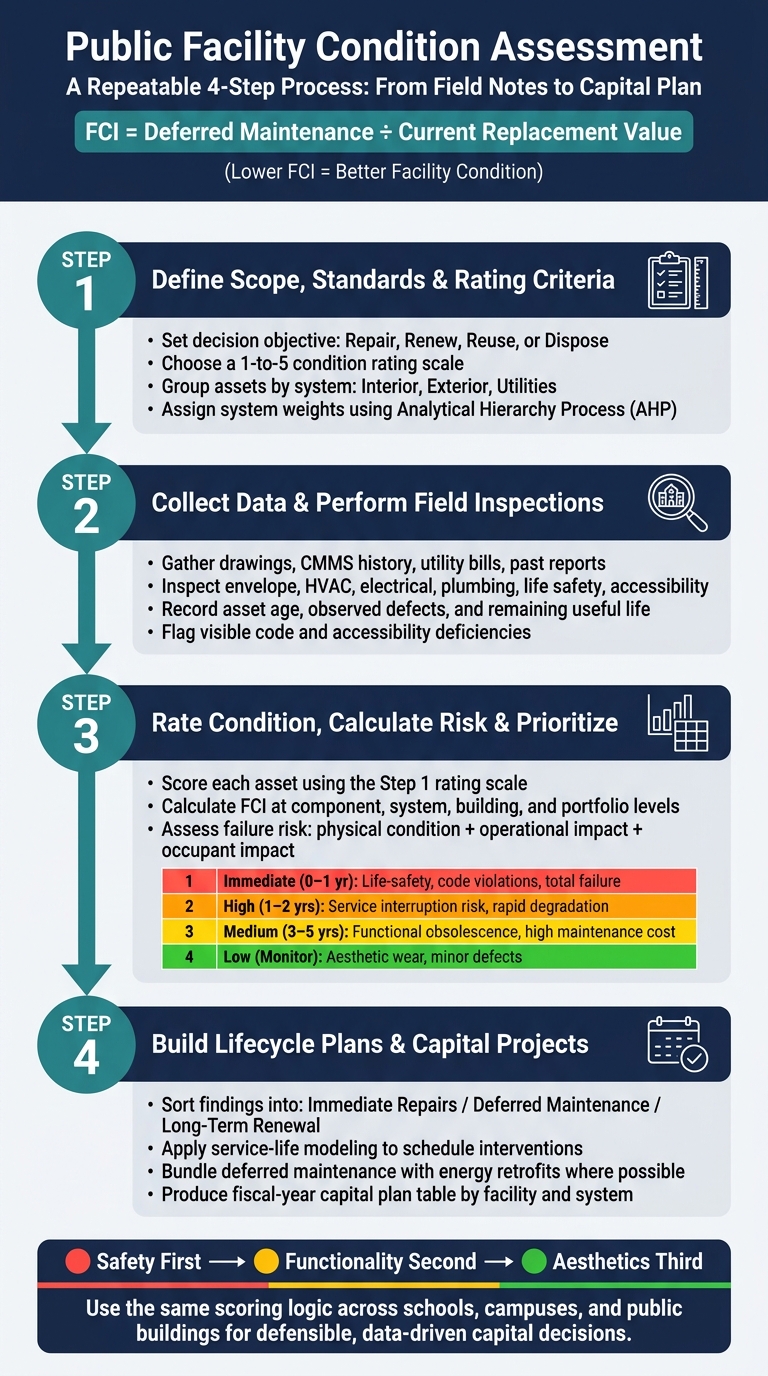
Facility Condition Assessment: 4-Step Methodology for Public Buildings
Mastering Facility Condition Assessments: Maximizing Your Asset Management
sbb-itb-034f8e1
1. Define Scope, Standards, and Rating Criteria
Start by setting the scope, scoring rules, and decision criteria for the assessment. This gives you a shared yardstick, so later condition scores and risk rankings line up across the full portfolio.
Set the Portfolio Scope and Assessment Objectives
First, define the service-life decision the assessment needs to support: repair, renew, reuse, or dispose. The goal should also account for physical, functional, and economic obsolescence, along with legal and code compliance, while keeping safety, functionality, and aesthetics in view [1][2].
Choose an Asset Structure and Condition Scale
A consistent asset structure helps keep scores aligned across the portfolio. Group assets by system – interior, exterior, and utilities – and use one condition scale across all sites [2].
A 1-to-5 scale works well, as long as each score has a clear definition. Some methods also pair diagnostic scores with six obsolescence factors and use weighted approaches such as the Fuzzy-Delphi Method and the Analytical Hierarchy Process. That helps teams score in a consistent way and reflect the relative importance of each system [1][2].
Plan the Team, Schedule, and Data Tools
Bring in facility managers, maintenance leaders, and subject-matter experts such as consultants, academics, and contractors. It also helps to include facility users, since they often spot safety or functional issues that don’t show up in a checklist alone [2].
Use BIM, sensor data, and scoring software to support consistent ratings [2]. Expert judgment and weighted criteria also help keep critical systems at the top of the list [1][2].
With the scope and scoring rules in place, the team can move into record collection and field inspections.
2. Collect Facility Data and Perform Field Inspections
With the scope and rating criteria in place, the next step is simple: gather the records, then check what’s happening on-site.
Compile Drawings, Maintenance History, and Utility Records
Before fieldwork starts, pull together the records that show how the facility has performed over time. That includes drawings, CMMS or work order history, utility bills, warranty files, and past assessments. These records help the team confirm what they see in the field, trace deterioration, and spot hidden defects.[1]
Inspect Building Systems and Record Observed Deficiencies
Field inspections help confirm the records and document observed deficiencies. In occupied public facilities, non-invasive methods let assessors review the building envelope, HVAC, electrical, plumbing, life safety, accessibility, and site infrastructure without disrupting daily use.
The result is a single field record that can be scored and compared across sites. Put plainly, the job here is to turn raw observations into inputs for risk and capital planning.
Record Asset Age, Remaining Life, and Visible Code Deficiencies
For each asset, record the installation or renovation date, observed defects, and estimated remaining useful life. Also note any visible life-safety or accessibility issues so they can shape later prioritization.
Age, observed condition, and remaining useful life support later scoring and renewal timing. Age, observed condition, and code deficiencies also help determine which assets move first into renewal, repair, or compliance work.
These records and observations feed the condition scores, failure-risk ranking, and priority matrix in the next step.
3. Rate Condition, Calculate Risk, and Prioritize Needs
Use the field records from Step 2 to turn site notes into scores, backlog estimates, and a ranked list of needs.
Score Assets and Calculate the Facility Condition Index
Each asset inspected in the field should receive a condition rating based on the scale set in Step 1. Those ratings feed two outputs: the deferred maintenance backlog and the Facility Condition Index (FCI).
FCI compares total deferred maintenance with the current replacement value of the facility.[2] That gives teams a simple way to see how far a building has drifted from its intended state. Results should roll up from the component level to the system, building, and portfolio levels so comparisons and budget decisions stay consistent.
To make scoring more consistent across different asset types, agencies can use the Analytical Hierarchy Process (AHP) to assign weights to building systems based on how much they matter to facility operations.[1] In plain terms, AHP helps a team avoid treating every system as if it carries the same importance. A failing finish is one thing. A failing power system is a different story.
Combine Condition, Obsolescence, and Criticality to Assess Failure Risk
A condition score by itself doesn’t say when an asset will fail or how much damage that failure could cause. A practical risk model looks at physical condition, operational impact, occupant impact, and maintenance cost.[2]
When an asset scores poorly across several of those factors, it moves up the risk list. In public facilities, the assets with the most risk are often switchgear, chillers, water pumps, and fire suppression parts. These systems tend to matter every day, and when they go down, the ripple effect can be costly and disruptive.
Teams should also flag functional obsolescence and compliance obsolescence. Both can push risk higher even when the physical condition still looks acceptable.[1] That’s a common trap: a system may seem fine on the surface, but if it no longer meets current use needs or code requirements, the risk picture changes fast.
Build a Clear Priority Matrix
Once condition scores and risk rankings are in place, findings can be sorted into four action windows using a simple priority framework.[2]
| Priority Level | Criteria/Impact | Recommended Timing | Example Assets |
|---|---|---|---|
| Immediate | Life-safety risk, code violation, or total system failure | 0–1 Year | Main switchgear, fire suppression, structural columns |
| High | High risk of service interruption or rapid asset degradation | 1–2 Years | Central chillers, roof covers, domestic water pumps |
| Medium | Functional obsolescence or high maintenance cost | 3–5 Years | HVAC terminal units, interior doors, floor finishes |
| Low | Aesthetic degradation or minor wear | Monitor | Interior paint, wall coverings, landscaping |
The three-level priority hierarchy – Safety first, Functionality second, Aesthetics third – helps keep the matrix defensible.[2] It also gives teams a clear way to explain why one project moves ahead of another, especially when funding is tight. Use this matrix to shape the multi-year capital plan in Step 4.
4. Turn Assessment Findings into Lifecycle Plans and Capital Projects
Turn the Step 3 priority matrix into a funded project sequence. Start by sorting findings from condition scores, FCI, and priority levels into three buckets: immediate repairs, deferred maintenance, and long-term capital renewal. That gives leaders a clear view of what needs attention now, what can be scheduled later, and what belongs in future capital planning. Then rank each project by urgency and criticality using the scoring criteria set earlier.
After that, tighten the timing with remaining useful life and field observations. Service-life modeling helps you schedule repairs, renewals, and replacements based on the age, repair history, and observed condition gathered in Step 2. If refurbishment or reuse can extend service value at a lower cost than full replacement, include that option in the plan.
When HVAC, envelope, or lighting work is already on the calendar, bundle deferred maintenance with energy retrofits. It’s a practical move. You’re already opening up the system, so it makes sense to tie efficiency work to the same renewal plan.
Leadership usually wants two views at once: a portfolio-level summary and a fiscal-year project list. A simple table works well here. Show the system, current condition, predicted remaining useful life, recommended intervention year, estimated cost, and recommended action. Then add a capital plan summary by facility and fiscal year so decision-makers can compare scenarios side by side.
| System | Current Condition | Remaining Useful Life | Intervention Year | Estimated Cost | Recommended Action |
|---|---|---|---|---|---|
| [Asset/System] | [Good/Fair/Poor] | [Years] | [FY] | [$] | [Repair, renewal, or replacement] |
| [Asset/System] | [Good/Fair/Poor] | [Years] | [FY] | [$] | [Repair, renewal, or replacement] |
| [Asset/System] | [Good/Fair/Poor] | [Years] | [FY] | [$] | [Repair, renewal, or replacement] |
This format makes deferred work easy to spot and shows the risk tied to each delay.
Conclusion: A Repeatable Methodology for Better Public Facility Decisions
Taken together, these steps turn field notes into a capital plan teams can stand behind. A condition assessment should be repeatable, and it should get better each time you run it. It connects day-to-day operations with maintenance, so when conditions slip, service delivery usually feels it fast. Standardized data leads to decisions people can defend, and that kind of consistency is what separates a plan people use from a report that ends up collecting dust on a shelf.
The same planning framework also helps with efficiency upgrades. If renewal work includes retrofitting vs. replacing HVAC, lighting, and envelope systems, teams can cut operating costs at the same time.
The goal is a steady process that protects occupants, controls costs, and gives decision-makers data they can rely on.
FAQs
How often should a facility condition assessment be updated?
Facility condition assessments should be updated continuously so the data stays accurate and current.
As a general rule, formal energy and performance audits are often done every 1 to 3 years. Broader facility health reviews tend to be updated every 3 to 5 years.
Whatever schedule you use, current data matters. It helps teams plan capital spending and supports better-informed public policy decisions.
What FCI range signals repair vs. replacement?
The available sources do not give a set Facility Condition Index (FCI) range for choosing between repair and replacement.
Instead, they point to a more practical approach: use formal plans based on useful life, manufacturer guidance, and expert inspections, not a fixed FCI cutoff.
That matters because an FCI score can help show a building’s condition, but it doesn’t tell the whole story on its own. A piece of equipment might look fine by one number and still be near the end of its service life. Or the opposite can happen. That’s why these sources lean on scheduled planning and on-the-ground review instead of a single percentage.
Who should be involved in the assessment process?
Facility managers should lead the process. They usually have the clearest view of building operations and can keep the work on track.
Maintenance and custodial teams should be part of it too. They bring day-to-day knowledge, know the equipment history, and often spot patterns that others miss.
For more complex systems, bring in outside specialists when needed. That can include auditors, mechanical engineers, or water management consultants. Safety staff should also be involved when the work touches confined spaces or energized electrical systems.
Building occupants can help as well. They may not work on the systems directly, but they can flag recurring issues that point to bigger problems.