
If you buy the wrong restroom fixture in Texas, your project can fail review, miss inspection, and cost more to fix later.
I’d boil the article down to this: for Texas public restrooms, I need to check four things before purchase – state flow/flush limits, local code changes, TCEQ model listing, and site pressure. The article also makes one point clear: low-flow fixtures can cut building water use by 20% to 30%, but only if the installed products match code and the system pressure is under control.
Here’s the short version:
- State rules set the base limits for toilets, urinals, faucets, and showerheads.
- Local cities can set tighter rules than the state minimum.
- TCEQ listing matters: a fixture can look right on paper and still fail approval if the model is not listed.
- Pressure matters: if static pressure is over 80 psi, a PRV is required.
- Inspection happens more than once: rough-in first, final inspection later.
- Retrofits should start with older, high-use buildings, especially pre-1994 sites.
- WaterSense products are often the safest starting point for public projects.
A few numbers stand out right away:
- Toilets: Texas limit 1.6 GPF
- Urinals: Texas limit 0.5 GPF
- Lav faucets: Texas limit 2.2 GPM
- Showerheads: Texas limit 2.5 GPM at 80 psi
| Fixture | Texas limit | Common lower-use target |
|---|---|---|
| Toilet | 1.6 GPF | 1.28 GPF |
| Urinal | 0.5 GPF | 0.125 GPF |
| Lavatory faucet | 2.2 GPM | 0.35–1.5 GPM |
| Showerhead | 2.5 GPM | 2.0 GPM |
What I take from the article is simple: check local rules first, confirm state limits next, verify the exact model on the TCEQ list, and make sure pressure is corrected before install. That gives me a clean path from spec to inspection to closeout.
Texas Statewide Fixture Standards and Compliance Basics
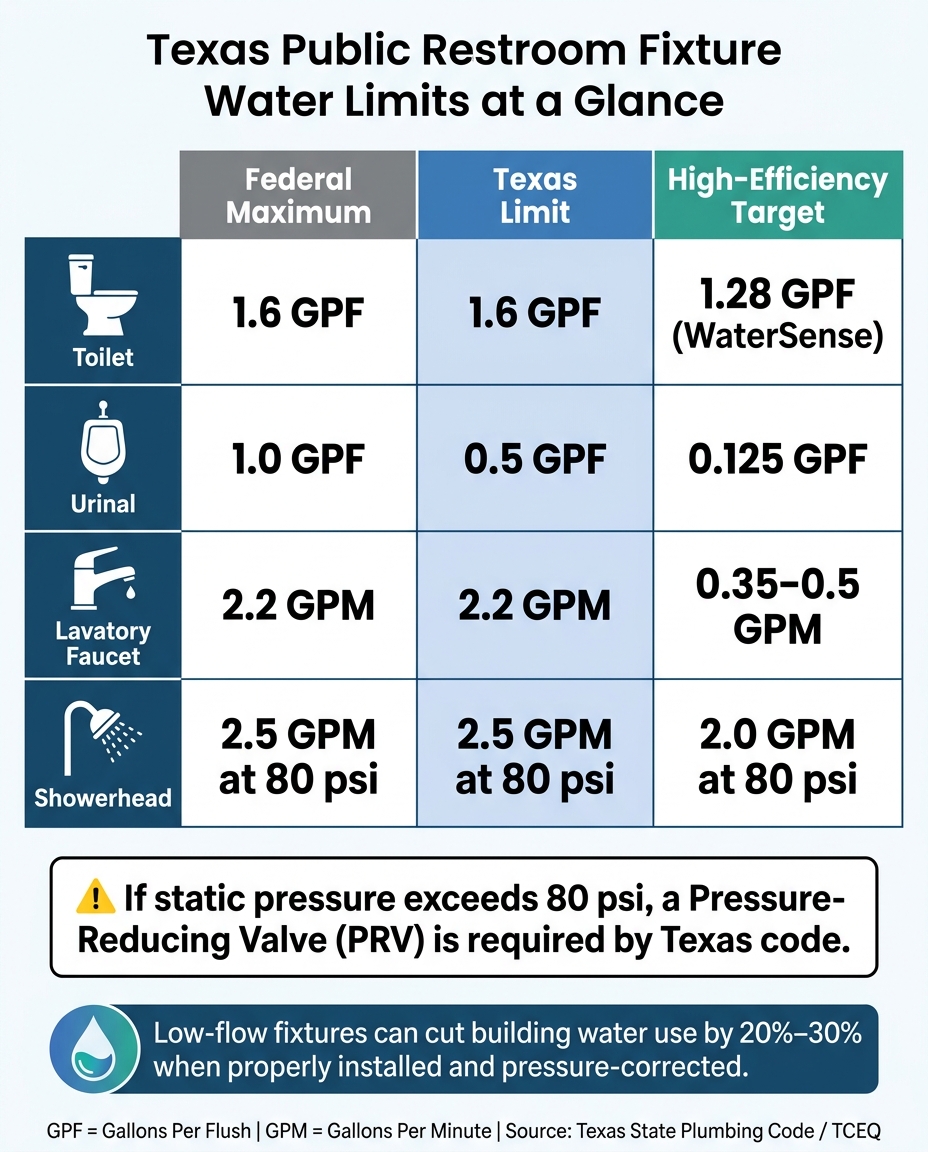
Texas Public Restroom Fixture Limits vs. High-Efficiency Targets
Texas sets the minimum fixture limits that public facilities need to meet before inspection. The Texas State Plumbing Code is the statewide standard used for approval and inspection.
Maximum flow and flush limits for common restroom fixtures
The table below shows Texas limits alongside common high-efficiency targets. Texas is stricter than the federal baseline in some areas, especially urinals.
| Fixture Type | Federal Maximum | Texas Limit | High-Efficiency (Typical) |
|---|---|---|---|
| Toilets | 1.6 GPF | 1.6 GPF | 1.28 GPF (WaterSense) [2] |
| Urinals | 1.0 GPF | 0.5 GPF | 0.125 GPF [2] |
| Lavatory Faucets | 2.2 GPM | 2.2 GPM | 0.35–0.5 GPM [4] |
| Showerheads | 2.5 GPM at 80 psi | 2.5 GPM at 80 psi | 2.0 GPM at 80 psi [2] |
These limits affect both procurement and submittals.
If service pressure goes above 80 psi, a PRV is required so installed flow stays within the rated limit [2][3].
TCEQ fixture listing, testing, and specification checks
Manufacturers send ANSI-accredited test results to TCEQ for listing. Before procurement, check the exact model number against the TCEQ list. That step matters. A fixture can match the written spec and still fail approval if it isn’t on the TCEQ list.
Project specifications should spell out the required GPF or GPM limits and cite the Texas rule that applies. Don’t rely only on brand names or broad product descriptions. For commercial projects, submittals need cut sheets that show:
- Model numbers
- Flow and flush rates
- WaterSense proof, where applicable [4]
Where compliance is checked during design and construction
Compliance is checked at the specification, submittal, installation, and inspection stages.
Texas uses a two-step inspection process: a rough-in inspection before walls or slabs are closed, and a final inspection after fixtures are installed and the system is pressurized and tested [3]. If the installed fixtures don’t match the approved compliant models, the inspection fails. That can lead to rework, resubmittals, added cost, and delays in getting an occupancy permit [3].
For projects seeking LEED, WELL, or Fitwel certification, the paperwork also gets checked during final commissioning and closeout [4].
Keep a project binder with cut sheets, WaterSense proof, commissioning records, and inspection logs. Local code amendments and public-sector guidance can push these minimums even tighter.
sbb-itb-034f8e1
Local Texas Codes and Public-Sector Water-Efficiency Guidance
How city amendments can be stricter than state minimums
State code sets the floor. Local jurisdictions can go beyond it.
That’s why the local AHJ is usually the first approval check before you choose fixtures. A product may meet state code and still miss a city’s local amendment.
Cities such as Houston, Plano, Frisco, and McKinney often require WaterSense-labeled fixtures or apply other local amendments tied to local water-supply conditions [2][3]. In North Texas, some jurisdictions also tighten pipe material and venting rules because of expansive clay soils [3].
Here are some common local overlay targets used in public restroom planning:
| Fixture Type | Example Local Target |
|---|---|
| Toilets | 1.28 GPF (WaterSense) [2] |
| Lavatory Faucets | 1.5 GPM (aerator retrofit) [2] |
| Showerheads | 2.0 GPM (WaterSense) [2] |
Local targets above reflect common WaterSense-aligned efficiency goals applied in Texas jurisdictions [2][3].
Before specifying any fixture for a public project, contact the local AHJ or building department directly. If the facility sits within a Municipal Utility District (MUD), check whether the MUD has separate conservation tariffs that add another layer of requirements. After you confirm local rules, SECO and TCEQ guidance can help set the project’s efficiency target.
SECO and TCEQ guidance for public restrooms
SECO and TCEQ guidance leans toward higher-efficiency fixtures, especially in schools, campuses, and healthcare buildings. For public-sector planning before design submittals, use 1.28 GPF toilets and 0.5 GPF urinals, with sensor-actuated or self-closing faucets preferred in high-traffic restrooms [2]. For faucet upgrades, start with 1.5 GPM aerator retrofits [2].
TCEQ requires Texas municipalities to keep drought contingency plans under 30 TAC §288.20, and staged response protocols can affect fixture use and pressure regulation during supply shortages [1]. Check the current drought stage before finalizing fixture schedules or pressure settings. Those targets should shape the retrofit and new-build steps that come next.
Planning Restroom Retrofits and New Builds in Texas
Once the fixture limits are set, the next move is simple: shift from code review to project planning.
Step-by-step approach for new construction
Use the approved limits to build the fixture schedule. Then check pressure and product compatibility before submittal. Start with the Texas plumbing code, and lock in any local amendments before you finalize the schedule.
Two early checks matter most.
- Check service pressure. Review service pressure as early as you can. If the pressure is too high, a PRV and permit are required.
- Verify flush valve and bowl compatibility. Pair the right flush components with the right bowls so you don’t run into service issues later.
Those same pressure and compatibility checks also apply when you’re replacing fixtures in occupied buildings. The setting may be different, but the risk is the same.
How to prioritize restroom retrofit projects
The fastest way to build a retrofit priority list is to inventory every fixture by model and rated flow. Start with pre-1994 facilities, where many toilets still exceed current flow limits [2]. After that, review urinals and faucets.
Put the highest priority on buildings where the compliance gap is biggest and occupancy is highest. That gives you the best place to start if you’re trying to make the most of time and budget.
In drought-prone regions such as the Edwards Plateau, Trans-Pecos, and Rolling Plains, drought plans can tighten operating limits, so those sites often move to the top of the list [1]. Sites with pressure problems should move up too.
After the inventory is done, group fixtures by scope. That way, plumbing, access, and control upgrades can be bundled together instead of handled as scattered one-off jobs.
Coordinating fixture upgrades with broader facility improvements
Fixture work rarely stands alone. It often touches piping, backflow, and accessibility work, so coordinate those scopes early to avoid rework and keep everything aligned.
Bundle accessibility upgrades with fixture replacements when you can. It cuts duplicate labor and keeps crews from opening the same area twice. If the facility is also due for sensor-actuated faucets, make the power choice during design: hardwired sensors or lithium batteries. Hardwiring during construction eliminates recurring battery replacement labor [5].
Document the final fixture list, pressure settings, and submittal approvals for closeout.
Conclusion: What Texas Facility Leaders Should Check Before Buying Fixtures
Buying fixtures is the last compliance gate before procurement. This is the point where a small miss on paper can turn into a jobsite headache later. So before you sign off on a purchase, lock in compliance first.
Compliance and planning checklist
Before finalizing any fixture selection, work through these steps in order:
- Check the local AHJ before issuing a purchase order. Cities like Houston, Austin, McKinney, and Frisco often enforce standards stricter than state minimums [2][3]. Local rules beat state minimums, so this comes first.
- After local approval, confirm the statewide minimums. Check the statewide code limits, then apply any stricter local WaterSense targets.
- Verify every model number on the TCEQ list before specification. This is especially important for properties in Municipal Utility Districts (MUDs), where overlapping local rules may apply [2][1].
- Use WaterSense-labeled fixtures by default. WaterSense is a smart default for Texas public restrooms because it can make approvals smoother and support better water use.
- Coordinate inspections early. Build rough-in and final inspection into the project schedule from day one so you don’t find non-compliant work after the walls are closed.
One thing runs through every step here: pressure. If static pressure at the site exceeds 80 psi, code requires a pressure-reducing valve (PRV) [2][3]. If pressure isn’t controlled, conservation-grade fixtures may not perform at their rated flow rates.
If a fixture clears this checklist, it’s ready for procurement. At that point, you want fixtures that are TCEQ-listed, locally approved, pressure-corrected, and matched to the project scope.
FAQs
How do I verify a fixture is TCEQ-listed?
Check the State of Texas Water Commission List of Approved Plumbing Fixtures to make sure the fixture is cleared for use. You should also confirm rules with your local Authority Having Jurisdiction, since city and county plumbing codes can differ from one place to the next.
If you’re planning upgrades, E3 Design-Build Contractor can help match fixture choices to state rules, efficiency targets, and day-to-day building needs. And when it’s time to install, make sure the work is done by, or under the supervision of, a Texas-licensed plumbing professional.
When does a Texas restroom project need a PRV?
In Texas, a PRV is usually needed when the water supply pressure goes past the limit set by the local plumbing code or the authority having jurisdiction. In many cases, that limit is 80 psi.
Local rules can follow the IPC or UPC, sometimes with local changes mixed in. So before you start the job, check with your local AHJ or a licensed plumber to confirm the pressure limit and whether your project needs a permit.
Which buildings should I retrofit first?
Start with a water audit to spot the buildings that use the most water and offer the best chance to cut waste. Put high-traffic facilities at the top of the list. In commercial office buildings, restrooms can make up about 35–45% of total water use, so that’s usually where the biggest wins are.
From there, target older, high-flow toilets that use more than 1.28 gallons per flush and replace older urinals with EPA WaterSense-labeled models. Also move fast on leaks. They may seem minor, but they can waste about 6% of total water use.