
If an HVAC unit is old, keeps failing, and costs close to 50% of replacement price to fix, I’d usually plan to replace it instead of sinking more money into repairs.
In public buildings, this choice often comes down to a short list of checks:
- Age and condition: Units near or past service life – like a 30-year-old rooftop unit – need a close review.
- Repair history: Repeated breakdowns in the last 24 months are a bad sign.
- Cost: If one major repair is near half the cost of a new unit, replacement often wins.
- Energy use: Higher utility bills with similar building use can point to falling efficiency.
- Refrigerant: Older R-22 systems can become more expensive to keep running.
- Comfort and air issues: Hot and cold spots, weak airflow, high CO₂, or humidity above 60% can show that the system no longer fits the space.
- Safety: A cracked heat exchanger is a replacement issue, not a patch issue.
- Controls: Older equipment that can’t work with BAS or zone scheduling can hold a building back.
- Timing: Schools, hospitals, colleges, and city buildings often need to line up work with breaks, budgets, and approval cycles.
I’d treat the decision this way: if repairs keep stacking up, comfort complaints don’t stop, and the unit has controls and energy monitoring fit or phased-down refrigerant, replacement usually gives the lower 3-to-5-year cost picture.
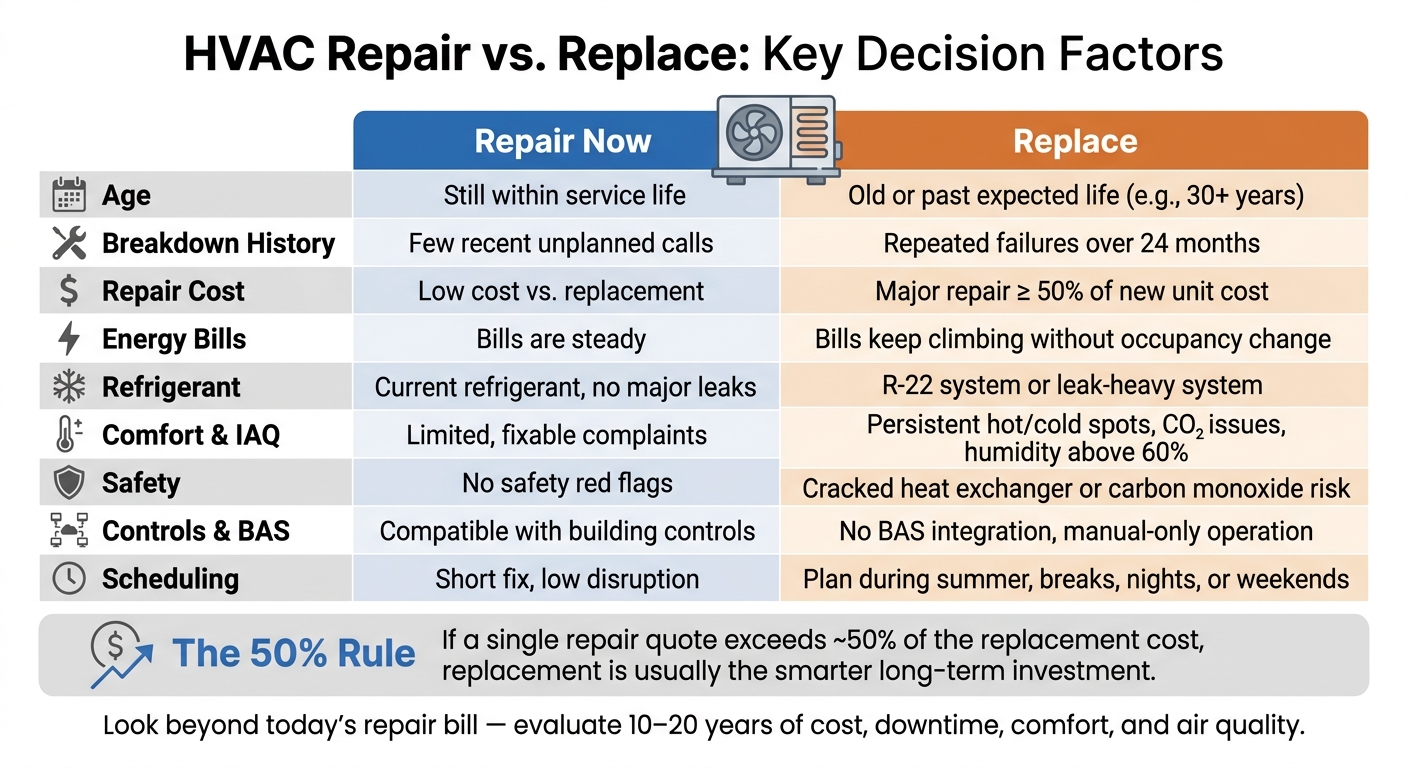
HVAC Repair vs. Replace Decision Guide: Key Factors at a Glance
Repair Your AC or Replace It? How To Decide
sbb-itb-034f8e1
Quick Comparison
| Check | Repair now may still fit | Planned replacement often fits |
|---|---|---|
| Age | Unit is still within service life | Unit is old or past expected life |
| Breakdowns | Few recent unplanned calls | Repeated failures over 24 months |
| Repair bill | Low cost compared with replacement | Major repair near 50%+ of new cost |
| Energy use | Bills are steady | Bills keep climbing without a clear use change |
| Refrigerant | Current refrigerant, no major leak issue | R-22 or leak-heavy system |
| Comfort / IAQ | Complaints are limited and fixable | Hot/cold spots, airflow, CO₂, or humidity issues keep coming back |
| Safety | No safety red flags | Cracked heat exchanger or similar hazard |
| Controls | Unit still works with building controls | Poor BAS fit, limited zoning, manual-only control |
| Scheduling | Short fix with low disruption | Better to plan work during summer, breaks, nights, or weekends |
Put simply: I wouldn’t judge this by today’s repair bill alone. I’d look at the next 10 to 20 years of cost, downtime, comfort, and air performance before making the call.
Equipment age, condition, and failure history
Age is a warning sign, not a final answer. But when a piece of equipment moves past its expected service life, the repair-or-replace call starts to look very different.
Age thresholds that trigger a replacement review
A 30-year-old rooftop unit should trigger a replacement review. By that point, repair bills and performance issues tend to climb [3].
How maintenance history affects the repair-or-replace call
Past repairs tell you a lot. Recurring compressor failures, leaks, and damper problems usually point to a unit in decline. And if it has needed repeated unplanned repairs over the last 24 months, replacement starts to make more sense [3].
At South High Community School in Worcester, 30-year-old rooftop units were replaced after repeated leaks, compressor failures, and damper issues; the project also improved comfort and IAQ [3].
That kind of pattern shows up often in older public buildings. When both age and failure history are pointing in the same direction, the next thing to look at is repair cost and operating cost.
A facility checklist for repair, borderline, or replace decisions
Use this checklist:
| Factor | Decision signal |
|---|---|
| Equipment age | Has it exceeded its expected service life for its type? |
| Repair history | Repeated unplanned repairs in the last 24 months? [3] |
| Major mechanical failures | Recurring compressor failures, persistent water leaks, or damper control problems? |
| Comfort and IAQ | Is the unit struggling to maintain heating, cooling, fresh air, or humidity requirements? |
When several of these signals show up at once, replacement usually has the stronger case than another repair.
If age, failures, and comfort complaints keep piling up, the decision tends to move from repair toward replacement.
Repair cost limits, energy efficiency, and refrigerant phaseouts
2 cost rules commonly used in HVAC decisions
Once age and failure history start pointing to trouble, cost usually decides the next move. Two common rules can help facility managers make that call with less guesswork.
Use two rules: the age × repair cost rule and the 50% rule. If a repair cost gets close to a unit’s replacement cost, replacement usually makes more sense. If repair goes above about half of replacement cost, replacement tends to be the stronger choice.
These are guides, not fixed rules. A 7-year-old unit with a repair cost at 50% of replacement may still be worth fixing if its maintenance history is solid. A 20-year-old unit at that same percentage usually leans toward replacement.
If the repair quote sits in that gray area, energy use often settles it.
When rising energy bills make replacement the better value
Rising energy bills, even when occupancy stays the same, often point to lower efficiency and can make replacement the better long-term value.
If efficiency doesn’t settle the choice, refrigerant status often does.
How refrigerant type can speed up the replacement decision
Refrigerant type can force the issue too. Older R-22 systems face rising costs and tighter supply, while newer equipment uses lower-GWP refrigerants such as R-32 and R-454B that support current standards [4][7][5][6][8].
When an older R-22 system needs a major leak repair or compressor replacement, the refrigerant issue alone can push the decision toward replacement. Lower energy use, steadier refrigerant costs, and longer service life often make replacement the better value.
When cost and refrigerant factors stop favoring repair, comfort and controls often help confirm replacement.
Comfort complaints, indoor air quality, and controls fit
Hot and cold spots, humidity issues, and airflow problems that won’t go away
When the cost gap is small, comfort complaints often make the call. If the numbers are close, the people in the building usually settle the debate.
Hot and cold spots that keep coming back, humidity that never seems right, and weak airflow are usually signs of a system that no longer matches the space, not a random breakdown. At that point, comfort data tells you more than a stack of repair tickets.
This shows up in classrooms and patient areas all the time. If the same zones keep drawing complaints in summer and winter – even after damper changes, balancing, and controls tuning – the air-handling system usually no longer fits the building. More service calls won’t solve a design mismatch.
Safety and IAQ findings that push the decision toward replacement
Some findings outweigh normal cost logic. A cracked heat exchanger in gas-fired equipment creates a direct carbon monoxide risk. Cracked heat exchangers require replacement.
Beyond combustion safety, ventilation problems can also push the decision hard toward replacement. If measured outdoor air is below ASHRAE 62.1 and CO₂ levels stay high in occupied areas, the equipment often does not have the capacity or control setup to fix the problem. Humidity control matters too. EPA guidance targets humidity below 60%, with an ideal range of 30% to 50%.[9]
When audits or accreditation surveys document these conditions, patch jobs usually aren’t enough. The issue has to be fixed at the root, and replacement often becomes the path to compliance.
If safety is not the main issue, the next thing to check is controls fit.
When older equipment no longer works with modern controls and BAS goals
Mechanical operation by itself is not enough. Older units that can’t connect to BAS, follow occupancy schedules, or support zone control leave staff stuck with manual operation. That blocks energy-saving strategies like demand-controlled ventilation, supply-air temperature reset, and zone-based scheduling.[10][11][12]
| Dimension | Keep and Repair | Replace and Modernize |
|---|---|---|
| Controllability | Manual thermostats, on/off operation | BAS-driven schedules, demand-based control |
| Zoning | Fixed zones, limited capacity matching | Independent control by space type |
| Ventilation | Uncertain outdoor air, limited monitoring | Designed-to-code airflow, real-time verification |
| Humidity control | Inconsistent dehumidification, risk above 60% RH | Designed latent capacity, humidity within safe ranges |
| Performance visibility | Little to no real-time data | BAS dashboards, trend logging, remote monitoring |
When a system comes up short in most of these areas and only partial fixes are on the table, the case for replacement gets pretty hard to ignore. The next step is fitting that move into occupied-building schedules.
Scheduling HVAC work in occupied buildings and making the final call
How to schedule repairs and replacements with minimal disruption
Scheduling can make or break an HVAC replacement plan. The goal is simple: do the biggest work when the fewest people are around. For schools, that usually means summer. For colleges and universities, academic breaks. For hospitals, phased work around surgical schedules. For municipal buildings, evenings or weekends often make the most sense. These lower-occupancy windows cut disruption and make replacement much easier to justify.
Even when the technical case says “replace,” timing often decides when that work can happen.
A Berkeley County School District geothermal project retrofitted 10 schools, cutting energy use by 75% and saving about $772,000 per year.[14] But that result depended on getting design, procurement, and submittals done before the break. Miss that window, and the whole plan gets harder.
When time is tight, the worst move is often waiting for a failure. Emergency work in peak season usually means overtime labor, pricier parts, and downtime that hits occupied spaces at the worst possible moment. In a school, that can disrupt classrooms. In a hospital, it can affect patient care. If expected repairs and downtime over the next 2–3 years are getting close to half the cost of replacement, it often makes more sense to schedule the replacement now.
Using repair-versus-replace decisions in capital planning
Asset scoring helps move HVAC decisions out of panic mode and into capital planning. A simple way to do this is to score each unit as good, monitor, or replace, then tie those scores to specific fiscal years. Units with phased-out refrigerants, annual maintenance costs above 15% of replacement cost, or more than three unplanned shutdowns per year should move into near-term capital years. Equipment that’s still fair but slipping can be grouped into mid-term projects by building or campus zone.[13]
This kind of scoring turns scattered repair calls into a plan the budget team can actually work with. It also helps when pairing HVAC work with other building projects. Bundling replacements with BAS upgrades, LED lighting, or envelope work can prevent crews from reopening ceilings and shafts again and again. Colorado Springs School District 11 did this in a coordinated retrofit that delivered more than $928,000 in annual energy savings.[16] Royal ISD is also projected to save over $2 million over 15 years through a program that combined lighting, HVAC, and controls.[15]
Key signals that replacement is the smarter move
When several of these signs show up at once, sticking with repairs usually stops making financial and operating sense:
- Past expected service life, with a growing repair history[1][2]
- A single major component failure where the repair quote exceeds about half of replacement cost[1][2]
- Phased-out refrigerants, especially with documented leak or recharge events
- Persistent comfort or IAQ complaints
- Poor BAS compatibility
- High failure risk during peak occupancy with no easy temporary backup
Use this summary to rank assets for the next funding cycle:
| Factor | Repair Now | Planned Replacement |
|---|---|---|
| Upfront cost | Lower immediate outlay | Higher initial capital |
| 3–5 year total cost | Multiple repairs and energy premiums often exceed new unit cost | Lower repair frequency; may qualify for incentives |
| Failure risk | Higher risk of unplanned failure during peak season | Lower risk with new equipment and warranties |
| Operational disruption | Less initial disruption, but repeated service visits and surprise outages | One planned window, coordinated with low-occupancy periods |
| Operational performance | Existing comfort, IAQ, efficiency, and BAS gaps often persist | Improved temperature control, humidity, ventilation, and full BAS integration |
A structured side-by-side view helps teams look past the next repair bill and see the longer-term cost and risk picture.
FAQs
How old is too old for an HVAC unit?
It comes down to performance, repair history, and the type of tech the system uses.
As a general rule, systems that are under 10 years old are often solid retrofit candidates. If a system is 10 to 15 years old, it may still make sense to keep it in service, especially if it hasn’t needed many repairs.
Once a system hits 15 to 20 years, replacement is often the smarter move. That’s especially true if it’s breaking down often or uses phased-out refrigerants like R-22.
A simple rule of thumb is the $5,000 rule: if the system’s age multiplied by the repair cost is more than $5,000, replacement is usually the more cost-effective option.
When is repair too expensive to justify?
A common rule of thumb is the 5,000 Rule: multiply the unit’s age by the estimated repair cost. If the total is more than $5,000, replacing the system is often the smarter financial move.
Replacement also tends to make sense when the system is 15 to 20 years old, still uses R-22 refrigerant, has parts that are getting tough to find, or keeps breaking down while energy bills climb.
How should HVAC replacement be planned in occupied buildings?
Plan HVAC replacement work at night, on weekends, or during school breaks to cut disruption in occupied buildings.
A phased approach can also help. For example, you might upgrade one building at a time or work through a campus in stages. That way, key services can keep running while the work moves forward.
E3 Design-Build Contractor works with administrators to line up construction schedules with facility calendars, keep climate control in place, and avoid interrupting day-to-day activities.