
Deferred HVAC maintenance costs municipalities millions annually. Here’s why:
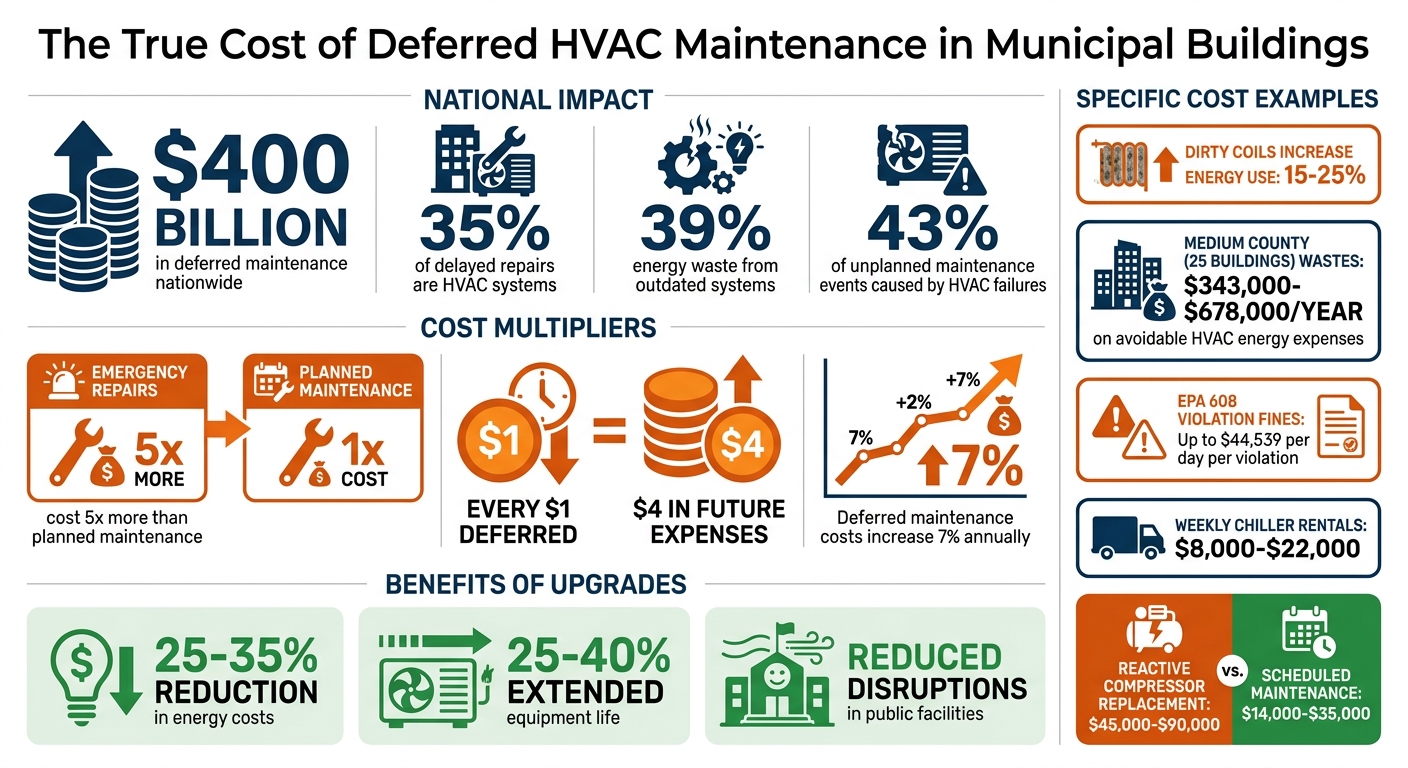
- $400 billion in deferred maintenance nationwide; HVAC systems account for 35% of delayed repairs.
- Outdated systems waste 39% of energy, while HVAC failures cause 43% of unplanned maintenance events.
- Emergency repairs cost 5x more than planned maintenance, and every $1 deferred leads to $4 in future expenses.
Upgrading HVAC systems can cut energy costs by 25–35%, extend equipment life by 25–40%, and reduce disruptions in public facilities. Modern solutions like high-efficiency systems, IoT sensors, and predictive maintenance programs address these challenges while saving money and improving reliability.
Municipalities can finance upgrades through PACE financing or performance-based models, ensuring improvements without upfront costs. Proactive planning, energy audits, and expert contractors are key to tackling deferred maintenance effectively.
The True Cost of Deferred HVAC Maintenance in Municipal Buildings
Effective HVAC Preventive Maintenance: A Comprehensive Guide by UpKeep
sbb-itb-034f8e1
What Is Deferred HVAC Maintenance in Municipal Buildings?
Deferred maintenance happens when scheduled repairs are postponed due to constraints like limited funding, time, or access to specialized skills [7][9]. In municipal buildings, this often occurs because budgets can’t cover every repair in a given year. The issue stems from how maintenance is typically viewed – as an "operational need" rather than a "financial risk." This mindset leads elected officials to prioritize other public needs over maintenance [7][8].
"Council members approve risk mitigation, not operational maintenance." – Oxmaint [8]
Budget planners often treat deferred maintenance as if it’s a zero-interest loan from future budgets. However, they overlook how costs grow over time due to inflation and worsening damage. In fact, deferred maintenance costs can increase by about 7% annually [8][10].
Common Challenges in Municipal Buildings
Municipal buildings face unique pressures that make deferred maintenance especially tricky. These aging facilities, including courthouses, libraries, and city halls, are constantly in use by the public. When systems fail, it can cause ADA compliance issues or public health complaints that quickly draw the attention of elected officials [1].
On top of that, municipalities must navigate a complex web of regulations. For example, they must comply with OSHA lockout/tagout rules, EPA refrigerant handling requirements under Section 608, and state boiler certifications [1]. Missing records for EPA 608 leak inspections or refrigerant additions can lead to fines of up to $44,539 per day per violation [1]. Failures in high-traffic areas can have immediate consequences, such as disrupting court proceedings or making public spaces unusable.
How Delays Increase Costs
Pushing maintenance down the road doesn’t just create operational headaches – it also drives up costs significantly. For instance, dirty coils and poorly calibrated sensors can increase energy use by 15–25% [1]. Additionally, emergency repairs cost about five times more than planned maintenance [1]. A medium-sized county with 25 buildings could waste between $343,000 and $678,000 per year on avoidable HVAC energy expenses [2].
Delays also lead to "cascade damage", where a small issue snowballs into a much larger problem. For example, a leaking HVAC pipe can corrode electrical panels or ruin ceiling systems, turning a $3,500 repair into an $80,000 multi-system fix [10]. When municipalities finally address these problems, they often face hefty emergency costs – like chiller rentals costing $8,000–$22,000 per week [1] or reactive compressor replacements that range from $45,000–$90,000, compared to $14,000–$35,000 for scheduled maintenance [1].
The table below highlights the financial benefits of proactive maintenance strategies:
| Maintenance Strategy | Annual Benefit | Payback Period |
|---|---|---|
| PM Program (10 buildings) | $180,000–$340,000 in emergency avoidance | 6–10 months [8] |
| IoT Sensor Integration | $200,000–$500,000 in predictive/energy savings | 10–18 months [8] |
| Full Digital Program | $600,000–$2 million+ in total ROI | 12–20 months [8] |
Financial and Operational Consequences of Delayed HVAC Maintenance
Postponing HVAC maintenance can wreak havoc on municipal budgets and disrupt day-to-day operations. Without regular upkeep, these systems become massive resource drains. In fact, HVAC failures are responsible for 43% of all unplanned maintenance events in government buildings when preventive programs are absent. This leads to costly emergency calls and reliance on pricey temporary solutions like chiller rentals [1]. Beyond financial strain, these breakdowns disrupt operations – courthouses face delays in proceedings, ADA heat-related complaints pile up, and public health concerns escalate, often reaching elected officials in no time [1]. The mounting costs and operational chaos highlight the pressing need for modern HVAC upgrades.
"The psychological impact on facility teams should not be overlooked. Constantly responding to breakdowns creates stress, reduces morale, and diverts attention from strategic initiatives." – Commercial HVAC Maintenance Professional [12]
Even more troubling is the "capital cliff", a term used by industry experts to describe how aging systems become interdependent. Replacing one deferred component often triggers the need for simultaneous upgrades to electrical and safety systems to meet current codes [13].
Energy Waste and Higher Utility Costs
Beyond the immediate financial burden, neglecting HVAC maintenance drives energy inefficiency. Over time, poorly maintained systems turn into energy guzzlers. For example, clogged filters and dirty coils can restrict airflow by 20–30%, forcing fan motors to work harder and increasing energy use by 8–15% [6]. Dirty coils also reduce heat transfer efficiency by 20–40%, which makes compressors run longer and at higher pressures [6]. Miscalibrated Building Automation System (BAS) sensors can cause systems to operate 15–25% above optimal energy levels, often unnoticed [1]. Even a 10°F increase in condenser head pressure – typically from dirty coils – can push energy consumption up by 5% [1]. Boilers aren’t safe from neglect either; fouled heat transfer surfaces can reduce fuel efficiency by 5–8% annually [1].
| Equipment Class | Energy Impact Without Maintenance | Key Efficiency Driver |
|---|---|---|
| Chillers & Cooling Towers | 15% COP degradation per year | Tube cleanliness and water treatment [1] |
| Air Handling Units (AHU) | 20–30% airflow reduction | Filter and coil cleanliness [1] |
| Boilers | 5–8% efficiency loss per year | Heat transfer surface cleanliness [1] |
| Controls & BAS | 15–25% excess consumption | Sensor calibration and setpoint validation [1] |
| Packaged Units | 5% energy increase per 10°F head pressure | Condenser coil cleanliness [1] |
The numbers are staggering. In a 200,000-square-foot building, deferred coil cleaning alone can waste $38,000–$64,000 annually in energy costs [6]. That’s far more than the maintenance itself would cost. Proactive maintenance programs can slash energy expenses by 30% [1], while neglected systems consume 30% more energy than well-maintained ones [6].
Effects on Indoor Air Quality and Occupant Comfort
Delaying HVAC maintenance doesn’t just hurt budgets – it also compromises indoor air quality and occupant comfort. Dirty coils, broken exhaust fans, and blocked intakes can lead to poor air quality and even OSHA citations for biological hazards [1]. Occupants often report symptoms like headaches and fatigue that disappear once they leave the building [1]. Worse, neglected systems can lead to severe health risks, such as asthma, Legionnaires’ Disease, and hypersensitivity pneumonitis. Standing water in humidifiers or boiler pans can harbor bacteria or fungi, spreading contaminants through the ventilation system. When mold issues arise due to neglected coils, remediation costs can soar to $15,000–$85,000 [1].
Temperature control failures bring immediate challenges. For every degree above the comfort range, productivity in municipal offices drops by 6–9% [6]. In courthouses, HVAC failures can result in ADA heat-related complaints and postponed cases [1]. In critical environments like healthcare facilities, system failures may even force temporary shutdowns [12].
"Government buildings with HVAC PM compliance above 90% consistently achieve 25–35% reductions in HVAC energy spend." – Oxmaint [1]
Meeting compliance standards adds another layer of urgency. Municipal buildings must adhere to ASHRAE Standard 62.1, which requires verified ventilation rates. Failed systems in high-traffic areas like restrooms and kitchens can lead to OSHA violations. Deferred maintenance also shortens the lifespan of major equipment, such as chillers, by 40–60% [6]. This turns what should be 20-year assets into systems needing emergency replacement far earlier than expected.
How HVAC Upgrades Solve Deferred Maintenance Problems
Upgrading HVAC systems can put an end to reactive repairs in municipal facilities, slashing emergency costs and their accompanying expenses [1][4]. Aging equipment tends to fail without warning, draining budgets with emergency premiums like weekly chiller rentals that can cost anywhere from $8,000 to $22,000 [1]. Modern systems shift operations toward a predictive maintenance model, addressing these issues at their root.
The financial benefits are hard to ignore. HVAC systems account for 40–60% of total municipal energy costs, so upgrading to efficient systems can offset maintenance backlogs through Energy Savings Performance Contracts (ESPC) without dipping into annual budgets [1][11]. Take Elmore County, Alabama, for example: in July 2018, the county worked with Schneider Electric to replace outdated gas heaters and window AC units across five key buildings, including a historic courthouse. By installing a centralized HVAC system and advanced building controls, they cut their annual utility costs by 38%, saving $4.4 million over the project’s lifetime [11]. These upgrades not only solve immediate problems but also set the stage for broader facility improvements with lasting benefits.
Modern High-Efficiency HVAC Systems
Modern HVAC systems are designed to replace constant-speed operation with variable-speed technologies. This shift is crucial for tackling deferred maintenance challenges and reducing long-term operational expenses. Features like Variable Frequency Drives (VFDs) and ECM fan arrays adjust output based on actual demand, minimizing mechanical stress and extending equipment life [4]. These systems also enable municipalities to predict and address potential issues before they escalate into expensive breakdowns.
With planned maintenance programs, the operational life of modern HVAC equipment can extend to 15–20 years, compared to just 10–12 years with reactive maintenance [4]. For municipalities unable to replace entire systems at once, retrofitting existing constant-speed motors with VFDs is a practical solution. These upgrades fine-tune output to match occupancy levels, offering a quick return on investment [4].
Combined Facility Upgrades
The benefits of HVAC upgrades grow exponentially when paired with other facility improvements. Combining HVAC efficiency with Building Automation Systems (BAS) and LED lighting, for instance, prevents inefficiencies like "system fighting", where heating and cooling systems operate at cross-purposes. This integrated approach also optimizes the building envelope, addressing the "capital cliff" – a situation where replacing one aging system often necessitates upgrades to other interdependent systems, such as electrical or safety components, to meet modern codes [2][4][13].
Dallas County, Texas, provides a compelling example. In July 2018, the county partnered with Schneider Electric to bundle HVAC upgrades with lighting and water conservation measures through an ESPC. The multi-phase project cut annual utility and operational costs by 23% and is projected to save over $90 million across 20 years [11]. The initiative also spurred local economic growth, creating 867 jobs and generating $122 million in business sales [11].
"We understand energy management means more than simply addressing maintenance issues. It means creating the most sustainable and comfortable environments to free resources for your real mission." – Klip Weaver, President, E3 [3]
Focusing on duct sealing in older municipal buildings can boost distribution efficiency by 20% or more, making it one of the highest-return maintenance actions available [4]. Pairing this with occupancy-based controls – tailoring HVAC schedules to building use, such as court sessions or library hours – eliminates the waste of running systems on fixed 24/7 schedules [2].
Financing Options for Municipal HVAC Upgrades
Modernizing outdated HVAC systems in municipal buildings can be a daunting financial challenge. However, innovative financing solutions offer municipalities a way to tackle deferred maintenance without overwhelming their budgets. These options not only fund upgrades but also generate positive cash flow through energy savings. Two key strategies stand out: PACE financing and performance-based delivery models.
PACE Financing for Municipal Projects
Commercial Property Assessed Clean Energy (C-PACE) financing is a game-changer for municipal projects. It covers the entire cost of upgrades with repayment terms spanning 10–20 years, matching the lifespan of the equipment [15]. Instead of traditional loan structures, repayment is added as a voluntary assessment to the property tax bill. This unique feature allows the repayment obligation to transfer automatically to a new owner if the property changes hands [15].
By 2023, C-PACE has been adopted in 36 states and the District of Columbia, with over $2 billion in financing provided to more than 2,400 projects [15]. Typical project sizes range from $75,000 to $750,000, with many exceeding $250,000. Closing these deals generally takes between 3 and 9 months [15].
One key advantage of C-PACE is its senior lien status, which places the repayment obligation ahead of most other debts. This structure attracts private lenders, enabling lower interest rates and extended repayment periods compared to standard commercial loans [15]. Additionally, municipalities often see immediate budget relief since annual payments are typically less than the energy savings generated by upgraded systems [15]. A bonus? Third-party administrators handle the program at no cost to the municipality [14]. However, properties with existing mortgages usually require lender approval before finalizing C-PACE financing [15].
Performance-Based Delivery Models
Performance-based delivery models are another powerful option for municipalities. These arrangements transfer operational and performance risks from the municipality to contractors or Energy Service Companies (ESCOs). A key feature of these models is the guarantee of energy savings – ensuring that the cost of HVAC upgrades is covered by the savings they generate [1]. If the systems fail to perform as promised, the financial risk doesn’t fall on the municipality.
This model requires no upfront capital and structures repayment over 10–20 years, keeping annual payments below the energy savings achieved. This ensures municipalities experience immediate positive cash flow [15]. When properly maintained, municipal buildings can reduce HVAC energy costs by 25–35% [1].
Performance-based models also encourage bundling. By combining low-return maintenance tasks with high-return efficiency upgrades, municipalities can meet Savings to Investment Ratio (SIR) requirements [15]. This approach not only improves financing terms but also addresses multiple issues at once – replacing outdated equipment, improving indoor air quality, and enhancing occupant comfort [1].
Both PACE financing and performance-based models offer practical, budget-friendly solutions for municipalities looking to upgrade HVAC systems while reducing long-term costs. These strategies provide more than just financial relief – they help create healthier and more efficient buildings for the community.
Steps to Plan and Implement HVAC Upgrades
Taking a structured approach to HVAC upgrades helps tackle deferred maintenance issues while boosting energy efficiency and operational reliability.
Conducting System Assessments
Start by putting together a detailed HVAC asset registry. This should include equipment like chillers, air handling units, boilers, and packaged units, along with their installation dates, warranty statuses, and current condition ratings [18][4]. If any documentation is unavailable, check the manufacturer date on the unit’s nameplate to fill in the gaps.
Another key step is energy baselining. Conduct energy audits to pinpoint underperforming buildings and establish a baseline for energy consumption before making any upgrades [2]. This data is crucial when presenting ROI projections to budget committees. Municipalities should also align their evaluations with ASHRAE Standard 180, which outlines minimum inspection tasks and intervals for commercial and institutional HVAC systems [1]. Following this standard ensures a thorough and consistent assessment.
Categorizing equipment by age can help prioritize actions. Systems that are 15–20 years old should have preliminary replacement quotes, while those over 20 years old need immediate attention to prevent failure [17]. For competitive pricing, aim to get quotes during spring or fall [17]. Assessments should also focus on key problem areas like duct leakage (which can waste 20–30% of conditioned air), coil cleanliness, and sensor calibration to curb unnecessary energy use [4][1].
With a solid understanding of your HVAC assets and their needs, the next step is partnering with experts to carry out upgrades effectively.
Working with Experienced Contractors
After identifying priority areas, it’s time to bring in a contractor who understands municipal HVAC needs. Look for contractors experienced in this space and consider a design-build model, where the same team handles both the design and installation. This ensures seamless collaboration between engineers and contractors, leading to efficient designs and installations [3]. For example, E3 Design-Build Contractor specializes in integrated solutions that address HVAC systems, LED lighting, and building automation, tackling deferred maintenance and energy costs together [3].
Make sure the contractor you choose is familiar with municipal codes like OSHA 1910.147 (Lockout/Tagout), EPA Section 608 (refrigerant handling), and ASHRAE 180 standards [1]. Endorsements from trusted organizations can also provide peace of mind. For instance, E3 is endorsed by the Texas Association of School Boards (TASB), which ensures reliability and trustworthiness [3].
Real-world success stories can highlight the impact of these upgrades. River Trails Middle School in Mt. Prospect, Illinois, serves as a great example. By upgrading HVAC controls and retro-commissioning building systems, the school achieved 27% annual energy savings and saved $18,900 annually [16].
"You’ll never hear us say, ‘It’s not our problem’" – Don Meek, VP of Operations at E3 [3]
Conclusion
Tackling deferred HVAC maintenance with targeted upgrades brings measurable improvements in three key areas.
Financially, municipalities can turn a hefty expense into a source of savings. Deferred maintenance is costly – every dollar delayed can escalate into $4–$6 down the line [5]. Preventive maintenance strategies can slash HVAC energy costs by 25–35% [1], while emergency repairs are five times more expensive than planned interventions [1].
These savings contribute to better operational efficiency. Upgrades shift facilities from reactive problem-solving to steady, reliable performance. HVAC systems are responsible for 43% of unplanned maintenance events in government buildings [1]. Modern high-efficiency systems, paired with building automation, correct issues like misaligned sensors and worn-out components that can push equipment to operate 15–25% above optimal levels [1]. These advancements extend equipment lifespan by 30–50% [5] and help avoid service disruptions that can erode public confidence.
The environmental impact of HVAC upgrades is equally important. These systems help reduce carbon emissions and ensure compliance with environmental regulations. For instance, Dallas County, Texas, cut over 500,000 tons of carbon emissions through its ESPC project, while Elmore County, Alabama, eliminated 15,525 metric tons of CO₂ [11].
"Energy management means more than simply addressing maintenance issues. It means creating the most sustainable and comfortable environments to free resources for your real mission."
- Klip Weaver, President, E3 [3]
The evidence is undeniable: postponing action turns minor issues into major breakdowns. HVAC systems account for 40–60% of total municipal energy expenses [1], and the national deferred maintenance backlog grows by $100 billion every year [5]. Acting now is essential to secure both financial stability and operational reliability for the future.
FAQs
How do I know if my building needs an HVAC upgrade or just maintenance?
To figure out whether you should upgrade your HVAC system or stick with maintenance, take these points into account:
- Frequent breakdowns: If your system keeps failing, especially during high-demand times, it might be time for a change.
- Higher repair costs: Repairs adding up? Or maybe your energy bills are climbing because of an outdated system? Both are red flags.
- Old age: Systems that are 15-20 years old often struggle with efficiency and can make your space less comfortable.
- Inconsistent performance: Uneven temperatures or poor air quality could mean your system isn’t keeping up anymore.
When your HVAC system starts showing its age, becomes inefficient, or can’t be relied on, upgrading might save you more in the long run than sticking with constant repairs.
What HVAC upgrades deliver the fastest energy savings in older municipal buildings?
Upgrading to energy-efficient HVAC systems and integrating modern control technologies, such as Building Automation Systems (BAS), can significantly cut energy consumption and costs in older municipal buildings. Swapping out outdated rooftop units (RTUs) for high-efficiency models not only boosts energy performance but also reduces maintenance demands and enhances indoor comfort. These improvements tackle the inefficiencies of aging systems, especially during extreme weather, providing noticeable and immediate benefits.
Can HVAC upgrades be funded with no upfront cost, and how is repayment handled?
Yes, it’s possible to fund HVAC upgrades without any upfront costs by taking advantage of creative financing options. These programs often allow repayment to be offset by the energy savings or lower utility bills that result from the upgrades. This approach not only helps tackle deferred maintenance but also enhances energy efficiency in a budget-friendly way.